Showing posts with label Bible-Genesis. Show all posts

Thursday, April 30, 2009

HIGHLY RECOMMENDED: BioLogos

I am not an expert in any of the sciences, but I have been interested in the culture war that has been a staple of American society between Biblical Christianity and evolution. I was schooled to be a young-earth creationist, intellectually breastfed on books like The Genesis Flood. I never thought too deeply about the issues, and mostly stayed away from the fray when I was a pastor. It was only when I began studying Genesis seriously that my views began to emerge.

This is not the normal path that those who come to question creationism take. The stereotypical student who comes to reject the fundamentalist view becomes a questioner through considering scientific evidence. However, my doubts were born from studying Scripture! Genesis is so much richer and deeper than the bare literalist explanation. The creation narratives also fit within a larger work, the Torah, an interpretive context that most fundamentalists fail to consider adequately.

Now, esteemed scientist and believer Francis Collins has established a foundation with an excellent website that attempts to provide an alternative to the culture war approach of both atheistic and Christian fundamentalists. It's called BioLogos, and here is its mission...
The BioLogos Foundation promotes the search for truth in both the natural and spiritual realms, and seeks to harmonize these different perspectives.
It is a well-designed and well-written site that seeks to answer many of the questions that arise when one tries to take both the Bible and science seriously.

You can also check out the blog that complements the site at Science and the Sacred.

Highly recommended, even if you don't agree. BioLogos is a fine example of thoughtful, careful, and irenic scholarship.

Sunday, March 1, 2009

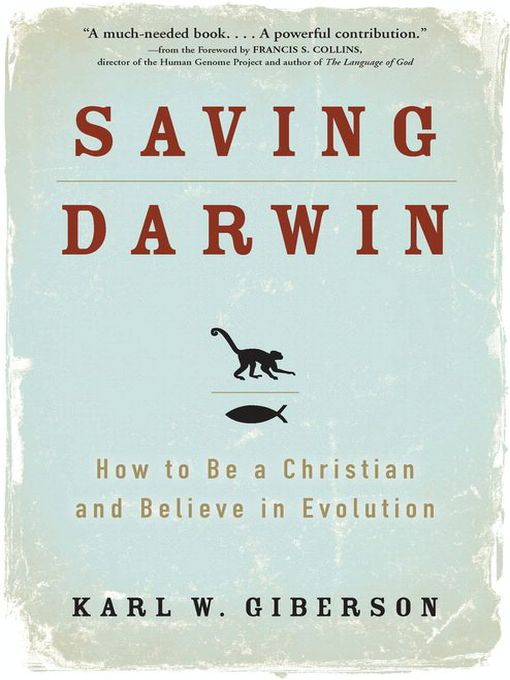
BOOK RECOMMENDATION: Saving Darwin

As part of my ongoing interest in the cultural conflict between science and religion, particularly evangelicalism, I have been reading Karl Giberson's book, Saving Darwin: How to Be a Christian and Believe in Evolution.

Giberson is professor of physics at Eastern Nazarene College, director of the Forum on Faith and Science at Gordon College, and Co-Director of the Venice Summer School on Science and Religion. His unique contribution to the literature is to provide an enlightening historical overview of the cultural conflict in the U.S., while at the same time presenting scientific evidence for evolution in a clear manner from a Christian perspective.

The burden of his book is captured in this quote, with which I wholeheartedly agree...
Places exist on which believers can stand, however, in the midst of the controversy. We don't know near enough about evolution to infer from it that God is not the creator. And we don't know anywhere near enough about God to dismiss the idea that evolution might be a part of God's creative processes. If we can embrace a bit of humility and avoid the temptation to enlarge either evolution or biblical literalism into an entire worldview, we can dismiss this controversy as the irrelevant shouting match that it is. (p. 18)
Giberson's book by itself does not offer a complete case that will satisfy most evangelicals, for it is not his task to examine the Biblical creation texts themselves and deal with the interpretive issues they raise. However, as an evangelical Christian, he does offer this sage advice with regard to our approach to the Bible:
Ambiguities about evolution coexisted with ambiguities about biblical interpretation. For evolution to conflict with the Bible, these ambiguities would have to resolve in a specific way that was genuinely incompatible. We can certainly select a biblical interpretation that will conflict with a particular explanation for evolution. But why would we want to do that? Absent a revelation from God commanding such a cantankerous move, there is simply no reason to do this. Blessed are the peacemakers, said Jesus, not those who go around manufacturing controversy. (p. 58, emphasis mine).
Most helpful to me was the historical overview Giberson gives, with surprising insights about some of the sources of creationist teachings and perspectives. I read The Genesis Flood in Bible College in the 70's when its concepts of flood geology and creationist logic were basic fundamentalist doctrine. However, I was never taught that these teachings originated from the dreams and visions of Ellen G. White, the founder of Adventism, who those same folks considered to be a false prophet.

Giberson also makes the obvious but overlooked point that, in America, this conflict is not really a fight between science and religion, even though the evangelists on each extreme would have us view it that way. To his credit, Giberson attacks the immoderate "religious" agenda of those who are using evolution as a way of promoting materialism with as much vigor as he critiques the persistent creationists.
The creation-evolution controversy is only, in the most trivial sense, a scientific dispute. It is, instead, a culture war, fought with culture-war weapons by culture warriors. Facts are almost irrelevant. Truth is valued when it serves a purpose and not for its own sake. Name-calling, caricature, cover-up, and hyperbole dominate. Compromise is out of the question.... (p. 166)
Thanks to Karl Giberson for providing at least a partial antidote to the unhealthy atmosphere created by this conflict.

Wednesday, February 11, 2009

An Unnecessary Divide

The 200th anniversary of Darwin's birthday has raised the usual dust storms of controversy between creationists and those who are convinced that the theory of evolution best accounts for the scientific evidence about the origins and development of life.

I have no interest in entering this debate. I am a Bible-believing Christian who happens to think that most of the evangelical response to this issue has unnecessarily inflamed the culture wars and exacerbated a needless and harmful divide between the church and science.

My interest as a pastor and teacher has always been in understanding the Bible as a follower of Jesus and as one called to provide spiritual nourishment for others. To read Genesis, the relevant text in the creation debate, for ammunition in that battle, is way down my list of priorities. Furthermore, I think it is an illegitimate use of the text when we force it to speak to issues it was never meant to address.

The early chapters of Genesis should first of all be read in the context of the Torah, the five-fold book that begins the Bible.
  • The Torah's main themes are the Promised Land, God's blessing, and the seed (the chosen people of promise). These are set forth in the topic sentence of the Torah, Genesis 12.1-3.
  • Genesis 1 introduces these themes by telling how the God who made everything (Gen 1.1) prepared a good land and put his people in it to live within his blessing (Gen 1.2-2.3).
  • The larger section of which Gen 1 is a part, Genesis 1-11, is the early history of the land of promise. It shows, over and over again, how people failed to live in God's good blessings and were exiled from the land, yet always with the provision of God's salvation as well. This section ends with people moving eastward from the land and being scattered over the face of the whole earth.
  • Genesis 12-50 is the early history of the people of promise. It shows how God chose Abraham and his descendants, promised them the land and the restoration of his blessing to all nations through his seed.
The rest of the Torah, of course, continues these themes and concludes its story with the people on the verge of entering the Promised Land.

My point is that the early chapters of Genesis are about this story—about the land of promise and God's plan that people live in his blessing and experience his rest. These are the very themes that fill the rest of the Torah, the themes that Moses' audience, the first recipients of this book, needed to hear as they prepared to enter the land. That is why Moses, under the Spirit's inspiration, wrote Genesis 1 as he did.

Creationism vs. evolution? Not anywhere in sight.

Friday, July 25, 2008

Recommended Article on Interpreting Genesis

I'd like to recommend the following article by Clark Pinnock. It is called, "Climbing Out of a Swamp: The Evangelical Struggle to Understand the Creation Texts" [Interpretation 43 (1989) 143-155]

Pinnock argues convincingly (to me, anyway) for the importance of reading the Creation texts as they stand, in their ancient and authorial context first and foremost. In the end, he comes out at the position to which I have come, and I will therefore use the points made in this article when I make my case for a literary framework interpretation of Genesis 1.

He does not go far enough, however, in relating these texts to their literary context in the Torah and the Sitz im Lieben of Moses and the Israelites. I realize this may be beyond his purpose in the article, nevertheless, grasping this is essential for truly understanding the purpose and meaning of the text, and therefore arguing against those who would hijack it for other agendas, such as trying to prove a particular scientific viewpoint.

Friday, May 23, 2008

Updates on Genesis Blog...

Marc Chagall, "Creation" 1960

I have posted updates on the Genesis Studies blog, including edits of former posts as well as a couple of additions. If you are interested in this study, I encourage you to go back and read the early posts so that you can review the flow of my argument.

Monday, February 18, 2008

Understanding Science and the Bible

Today I want to recommend some videos on the internet that deal with the subject of how science and Bible relate. These are found on Gordon J. Glover's blog, BEYOND THE FIRMAMENT.

In three video slide presentations (found here), Glover deals with:
  1. What is Science? What is the Bible?—Understanding the differences between these two ways of knowing lays an important foundation for maintaining a proper, intelligent perspective on both science and biblical religion.
  2. What "Science" does the Bible teach?—Tracing the history of astronomy, Glover shows that the Bible tells its story in terms of the Ancient Near East model of cosmology, and that its point is not to teach this model as unchanging scientific truth, but to communicate God's timeless theological message to its first readers in terms of a worldview they would understand.
  3. How should Christians relate to the natural sciences?—Modern science is at odds with the teachings of the Bible. Of course it is, since the Bible tells its story in terms of a 6000-year old cosmology! But it does so for certain theological purposes, not scientific ones. The key for a proper Christian view is to learn to distinguish between the timeless truths of Scripture and the time-bound models of language and science God used to deliver those truths to humankind.
Highly recommended.

Saturday, November 24, 2007

New Genesis Post—Gen 1.2

You can access the latest post on Genesis here.

Thursday, November 22, 2007

New Genesis Post—Gen 1.1

On my blog, THE MOST BASIC TRUTHS, there is a new post on Genesis 1.1.

Friday, November 9, 2007

Genesis Studies at New Location

NOTICE...
I have moved the posts for the Genesis study. They are rather long, and having them in one location will enable readers to follow them better. From now on, posts on Genesis may be found at the new site.

The new blog for these studies is: THE MOST BASIC TRUTHS: Studies in the Early Chapters of Genesis.

Hope you will find your way there for my consideration of these foundational texts of Scripture.

Thursday, November 8, 2007

The Most Basic Truths, part three

THE STRUCTURE OF GENESIS 1.1-2.3
As we will see, understanding how the author organized this text is a key to grasping its meaning. As we did with our previous study, let's start with the end of the passage and work our way back to the beginning. There is a basic style that the author follows with regard to each day, except for the seventh day. Though each day has its own variations, the overall pattern is the same:
  1. Initiation: "And God said..."
  2. Confirmation: "And it was so."
  3. Evaluation: "And God saw that it was good."
  4. Summation: "And there was evening and there was morning, the _______ day."
Here are the seven days...
  • Gen 2.1-3The seventh day, on which God rests. God blesses this day and calls it holy.
  • Gen 1.24-31The sixth day, on which God commands the land to bring forth living creatures, and on which he makes human beings in his image and blesses them.
  • Gen 1.20-23The fifth day, on which God created the water creatures and creatures of the sky and blessed them.
  • Gen 1.14-19The fourth day, on which he appointed the lights in the sky to be for signs and seasons and to rule day and night.
  • Gen 1.9-13The third day, on which God separated the land from the waters and called the land to bring forth vegetation.
  • Gen 1.6-8The second day, on which God separated the waters above from the waters below and called the expanse "sky." Note: this is the only day about which the text does not say, "And God saw that it was good."
  • Gen 1.3-5Day one, on which God called called light out of darkness and named them "day" and "night." Note: in the Hebrew text, this is not called the "first" day, but "one day." This may indicate that it was not the absolute first day of creation but day one of the seven described in this passage.
The first two verses of the text stand outside the pattern of the seven days. Verse 3 marks the beginning of day one, as seen in its first words, "And God said," which is the way every other day commences (except day seven). That means that Genesis 1.1-2 are not part of the "seven days of creation."
  • Gen 1.2—This verse describes the condition of the land before the seven days. As we will see, it says the land was an uninhabitable wasteland because it was covered by darkness and deep water. However, it also says that God's Spirit was present, a hint that God is about to do something to change the condition of the land.
  • Gen 1.1—This verse describes what God did "in the beginning," before the seven days. He "created the skies and the land," which should be understood as a merism, a figure of speech that describes a single thing by referring to its most contrasting parts. "The skies and the land" means "everything you see," or "all the world before you." It is written from the perspective of the human eye, of one scanning the landscape and pointing out the whole wide world to the reader.
The fact that these two verses stand outside the seven-day scheme is significant for our understanding of Genesis 1. It means that God created what we call "the universe" before the seven days recorded in this passage. Verse 1 is about the original CREATION. Verses 2 and following are about the PREPARATION of a land where people might dwell and the creation of human beings to live there.

Here is how it all fits together...
  • God created all that is in the beginning. (Gen 1.1)
  • Before God prepared it, the land was not yet ready for human habitation. (Gen 1.2)
  • God prepared the land for humans, then created them and blessed them in the good land—in a period of six days. (Gen 1.3-31)
  • God rested from his works on the seventh day and blessed the seventh day (Gen 2.1-3)
Next study...Genesis 1.1.

Monday, November 5, 2007

The Most Basic Truths, part two

IDENTIFYING THE TEXT
Our first task is to observe and mark the extent of the text that the author has given us. On the front end there is no problem, since GENESIS 1.1 begins the Bible.

However, where the text ends is not so clear. In our Bibles with chapter and verse divisions, the true flow of an author's argument is not always evident, and Genesis 1 provides a good example of this. Most of us are aware that the story of beginnings is organized by a seven-day scheme. However, those who gave us chapters and verses separated the seventh day from the story and put it in chapter 2! Right away, we can see and agree that GENESIS 2.1-3 belongs with the material in chapter one.

What about GENESIS 2.4? Some have understood at least the first part of this verse as a summary of chapter 1, and have translated it something like this: "And so, this is the story of the heavens and the earth..." I am persuaded, however, that Genesis 2.4 begins a new section.

This conclusion grows out of observing the way the entire book of Genesis has been put together. In the book there are twelve statements that begin with words like this, "Now these are the generations of..." (2.4, 5:1, 6:9, 10:1, 32, 11:10, 11:27, 25:12, 19, 36:1, 9 and 37:2). Each of these statements then refers to a main character who has already been introduced. What follows each statement is either a listing of family names that trace his descendants, or a series of stories that tell us what became of this character and his family.

If you step back and look at the structure of the book in a bird's eye view, you see how these statements organize the material and move its stories along.

The heavens and the earth are introduced (1.1-2.3)
These are the generations of the heavens and the earth (2.4-ch. 4)

...in which Adam and his family are introduced
These are the generations of Adam (5.1-6.8)

...in which Noah is introduced by a genealogy from Adam to Noah
These are the generations of Noah (6.9-ch. 9)

And so on. We might translate this phrase (Hebrew: toledot) as: "This is what became of ____________." The material before this heading introduces the main character and the material after it describes what happened in subsequent history to that character and his family.

Therefore, Genesis 2.4 belongs to the next section, and the text we will be examining in this study goes from GENESIS 1.1-2.3.

Next Study: The structure of Genesis 1.1-2.3

Thursday, November 1, 2007

The Most Basic Truths, part one

Here begins a series of brief studies on the first chapters of Genesis.

These texts have held a continual fascination for me since the days of seminary, when I studied Hebrew and OT under John Sailhamer at Trinity Evangelical Divinity School (Deerfield, IL). Much of what you will read here will reflect the approach (though not necessarily the details) he takes in his stimulating commentary on Genesis (Expositor's Bible Commentary), his work on the Torah called The Pentateuch as Narrative, and in his specific study of Genesis 1-2, Genesis Unbound.

A word about the nature of this study...I am interested in the meaning of the text, not in its application to apologetics. Many modern studies of Genesis are undertaken in order to help Bible-believing people understand the relationship between Scripture and science. That is the realm of apologetics and it is not unimportant. However, it is secondary. My goal is different, and more foundational. I want to know what the text says and means in the context of the Bible, and what the author wanted his audience to gain from reading this text.

With this in mind, here are three essential positions I believe one must take to approach this part of the Bible correctly:
  1. We must try to read this text through pre-scientific eyes. The author and original readers of this passage knew nothing of Ptolemy, Copernicus and Galileo, Newton or Einstein. They knew only the world they could observe. If you had spoken to one of them about something as basic to us as "planet Earth," he would have had no concept of what you were saying. When we as moderns read "heavens and earth" in our English-language Bibles, we have a much more sophisticated picture in mind than someone in Moses's day (c. 1200BC), who saw "the skies and the land."
  2. We must try to read this text through an earthly observer's eyes. The perspective I think many of us have in our minds when we read Genesis 1 is that of the Apollo 8 astronauts, who gazed at the magnificent blue ball of planet Earth while orbiting the moon. In other words, we imagine that the author is taking us to some divine balcony seat where we can view the action from a cosmic point of view. However, the chapter is actually written from the vantage point of an ordinary human being on the ground, hearing and observing the words and works of God.
  3. We must try to read this text as through the eyes of its first audience and as part of the entire book that was given to them. I take the traditional view of authorship and composition of Genesis and the Pentateuch. Genesis is part one of a five-part book, the Torah, put together by Moses and given to the generation of Israelites that was preparing to enter the Promised Land. If the early part of Genesis introduces this work that was written for them, how does it do that? What message, pertinent to those people, begins with Genesis 1?
Next Study: Identifying the text.