Showing posts with label Culture. Show all posts

Tuesday, May 26, 2009

EVERYONE MUST ACCOMMODATE

Excellent post by Karl Giberson at Science & Sacred, the blog of BioLogos, called "God and Matter." He answers U of Chicago biologist Jerry Coyne's contention that combining faith in God with scientific understanding results in a "hilarious goldmine of accommodationism."

Giberson makes the point that we ALL must make accommodations as we try to understand life and the universe.
But what about the accommodationism of materialists? How do they reconcile their materialism with the rationality of the world? It seems to me reality has to be grounded in one of two deeply mysterious foundations: God or matter. Each has its own set of questions. Theists wonder about the nature of God's existence, the problem of evil, how and why God acts in the world and why God has chosen to remain hidden from us. These are difficult questions and certainly must trouble thoughtful believers. But don't materialists have another set of mysteries? Don't they have to wonder about the nature of physical existence? Why is there something rather than nothing? Why are the laws of nature so rational? Why is our species so religious? Is the world just a big pointless accident?
Don't let the materialistic worldview back you into a corner and make you think theists are the only ones who must face troublesome intellectual problems. "Material alone plus time plus chance" has plenty of its own. In my view, even more troublesome.

Sunday, May 24, 2009

A Christian Apologizes to Atheists

Rev. William Cwirla is a Lutheran pastor who is known for his direct teaching and defense of the truth. He and Craig Donofrio host a podcast called "The God-Whisperers" that is worth your time. Cwirla's blog is always good reading as well.

Today, I read a post there that I admire greatly and commend to you. It's called "Apologies to the Atheists." Christians who tend toward culture warrior-ism ought to meditate on it deeply. Cwirla makes the point that getting angry in response to the rants of today's popular atheists only proves...
  1. Our view of God is too small.
  2. We've forgotten that our anger does not accomplish God's righteous purposes (James 1.20).
  3. We've forgotten Jesus' call to love our enemies.
As Cwirla says,
...I don't know why the atheists are so angry. Perhaps they have good reason to be. I know that Christians aren't always noted for their manners, much less their Jesus-like compassion for those with whom they disagree, myself included. Maybe the angry atheists are just getting back at the playground bullies. Fair enough.

Ghandi once remarked, "I don't reject your Christ. I love your Christ. It's just that so many of you Christians are so unlike your Christ." We can't expect the other guy to put down his sword while we are swinging ours. That's true for many situations. Don't expect someone who believes in nothing to put down his sword. We're called to go first. We claim to follow the One who said, "Turn the other cheek, walk the extra mile, bless those who hate you, pray for your persecutors."

Tuesday, May 12, 2009

WHY I AM NOT A CULTURE WARRIOR...

I've said it before and I'll say it again: When it comes to the culture wars, I am a conscientious objector.

Since the 1970's evangelicalism in America has taken to getting involved in public cultural activism and the political sphere with unprecedented vigor. Evangelicals have followed the voices of religious leaders like Francis Schaeffer, Jerry Falwell, D. James Kennedy, and James Dobson to raise their voices in the public debate about such issues as abortion, the erosion of personal morality especially as portrayed in the entertainment media, and the gay rights movement. In the process, evangelical Christianity became so connected to the conservative wing of the Republican party that at times the two seemed indistinguishable. This involvement had its high water mark in the presidency of George W. Bush and the Republican domination of Congress.

As a result of this evangelical embrace of a culture war approach to their mission in the world, churches, pastors, and individual Christians have been swept up into having to choose sides on many complex issues and to adopt a "Christ against culture" mentality. This has coincided with the development of an entire Christian subculture, which in my view has isolated believers from their neighbors and genuine redemptive interaction with the world.

Thus, evangelicals find themselves in the equivalent of spiritual trench warfare. We are dug in to our positions, separated from our "enemies," seeing things only from one perspective, and having no real contact with those on the other side except to bombard them relentlessly. Doesn't sound like a Great Commission lifestyle to me!

As Michael Spencer observes on his Internet Monk blog:
Every day I listen to and read Christians whose consideration of other persons is on the basis of politics and cultural conflict. Not the Gospel. Their anger and frustration dominates, not the Gospel.
Frankly, I don't want any part of that approach. And so I've decided to conscientiously object to that path of life and "ministry."

Here are some of the reasons I've gone AWOL...

(1) The culture war approach assumes the position that America is somehow different than other nations in our manifest destiny, a "Christian" land that must be "saved" and "brought back" to its Christian "roots."

In the minds of those who assume this, there is an idea of some kind of vague Eden that once existed in our nation when people all went to church, lived moral lives, and the government supported the teachings of Christ. 'Twas never so.

(2) The culture war approach holds that the media is the arena in which we should fight our battles, that it accurately represents the reality of the situation on the ground, and that therefore we must make our voice be heard through the media in order to win peoples' hearts and minds.

The simple fact is that most people listen to broadcasts that confirm their beliefs, not challenge them. You won't find the conservatives lining up to see the latest Michael Moore or Bill Maher film. Nor will you pass many liberals listening to Rush in their cars or catch them watching Fox News at night. Culture warriors generally preach to the choir.

But that's not the only problem. By moving to a media-driven strategy, Christians have become conditioned to seek the spectacular and forsake the down-to-earth path our Savior teaches us to take--the small, seemingly insignificant, seed-planting approaches of loving our neighbors in the context of real daily life. That is the mystery of how the Kingdom comes and how the world is changed.

(3) The culture war approach relies on political machinery as a primary weapon to restore righteousness to the land.

This means we have allowed the world to choose the arena, the weapons, the rules, the referees, and the definitions of what it means to "win" or "lose" in the conflict. In addition, it makes Christians vulnerable to the temptations of power, which are among the least understood among us.

(4) The culture war approach teaches us to fear, dislike, oppose, and look down on our neighbors rather than lay down our lives for them in sacrificial love.

It pits us "against" them, when the Incarnation teaches us to be "with" them.

(5) The culture war approach leads to Christians unwisely choosing our battles and showing a misleading face to the world.

Must a person have "correct" political or cultural opinions before he can come to faith in Christ? The simple Good News of Jesus and his gracious salvation can become so mixed with righteous "positions" that the Gospel itself gets distorted.


IMHO, the culture war approach has a lot more in common with the way the Pharisees lived out the religious life and ministry than it does with our Lord Jesus Christ and his Apostles.

Saturday, April 18, 2009

Reflections from the Bible Belt

While volunteering at my son's public high school for a band competition today, I noticed various motivational signs and banners posted around the building.
CHARACTER:
It's who you are when no one's looking.

CHARACTER:

Each person must live his life as a
model for others
There were signs for "respect," "honor," "knowledge" (you'd expect that one), "responsibility," "leadership," and other moral virtues and practices. Near the main lobby, a prominent display case held pictures of those who had won the "Set a Good Example" award. This award, sponsored by a local family in memory of their son, honors young people who show exemplary character, leadership, and who serve as role models for their fellow students.

I know many of the teachers, coaches and administrators in the school, and it is clear that these signs and honors are not just for decoration. The qualities represented are actively promoted and urged upon students and the entire school community.

Of course, I am thrilled to have had my children attend a public school that seeks to foster moral character as well as academic and extra-curricular achievement. And this is not surprising to us. We live in a small Midwestern town that is filled with churches and conservative folks, surrounded by an entire region of such communities. A "Bible-belt," you might say.

Which got me thinking. If you mixed in a few "Jesus" words and a couple of hymns or praise songs, what I've seen at our son's public high school would represent something not dissimilar to many churches I've experienced around here. You have a community of caring people, an emphasis on learning, discipline, moral education, all served up via a full program of activities for having fun, building community, and encouraging growth.

What does that sound like to you?

My question is, "How should Christ-followers think about this situation?"
  • Does it show that the Christian message has infiltrated local culture to such an extent that our secular institutions reflect the light of the Gospel, at least in moral terms?
  • Or does it show that churches (at least in "Bible-belt" regions) have become mirrors of American conservative culture, serving as little more than reflections of the God and country, family values, law and order, bourgeois middle class ethos? Have many congregations become "Christian activity centers" that primarily serve to promote morality and the "righteous" status quo?
  • Perhaps it is some of both? What is positive about this state of affairs, and what may be negative, even harmful to the growth of genuinely Biblical Christianity?
Furthermore, when Christ and culture seem to complement rather than radically oppose one another in a given setting, in what ways is the church called to be counter-cultural, and in what ways may it cooperate with the institutions in that community to fulfill the Missio Dei?

Tuesday, March 31, 2009

Pentecost Remix?

I'm no expert on Rick Warren or the ministry of Saddleback Church. I've read a couple of his books and found them unremarkable. He seems to have the facility that many American megachurch pastors have—he can condense the complex and incomprehensible mysteries of God into concise formulas and communicate them clearly, outlining simple pathways for people to follow. He puts the cookies on the bottom shelf.

Then of course, his organization has all the bells and whistles of a superb megachurch. He is committed to missions and making the world a better place. He has also used his well-built platform to garner nationwide public respect through a more moderate and civil approach to evangelical politics. Rick Warren is the epitome of a successful American entrepreneur Christian leader.

But...if you want to get a taste of the kind of shameless marketing, promotion, and religious salesmanship used by Warren and Saddleback, just read Pastor Rick's latest edition of his News and Views. Stand amazed at the church's latest effort to—yes, you heard it right—stage a second Pentecost. Apparently, if enough people will just take four easy steps and become members of Saddleback, divine history will be repeated!

When you read Pastor Rick's upbeat appeal, can you find...
  • An extremely truncated Gospel message?
  • An instant catechism (discipleship) process? (In fact, if I read it correctly, on this day only you even get a "discount" on the normal time required for the membership class!)
  • Horrendous sacramental theology that focuses on rebaptism of those already baptized in other Christian churches?
  • A "pastor" who is apparently such a celebrity that only on rare special occasions is it possible for the hoi polloi to meet him? (On this day, you can even have your picture taken with him!)
  • Free giveaways?
It's history! It's fun! You're the greatest! You can do it all in one Saturday!

Sigh.

Wednesday, March 18, 2009

Another view...

Take a look at a blog called "Parchment and Pen," where you'll find a good piece of observational writing from C. Michael Patton, who made an ecclesiastical field trip to visit a couple of (quite) different churches.

The author is kind and generous, but also honest in his observations and evaluation. I think I would have been tempted to come across much more critically.

Read it, and let me know what YOU think.


...Wait, they had an elf who greeted the kids at the door?

Tuesday, March 17, 2009

Would you take this man into your home?

A pastor in Chicester, NH thinks that it is his Christian duty to try and help this man, even though the man is a convicted criminal who has committed horrendous crimes in the past.

You can read about the furor this missional act is stirring up up HERE.

I take it as a given that this kind of hospitality is not possible or even desirable for everyone. However, radical examples sometimes get our attention and cause us to think.
  • Is this pastor just being naive and idealistic?
  • What responsibilities does he have toward his other neighbors in a situation like this?
  • What part should his church (which, according to the article, is in another town) and the local churches in this town play?

I'd love to hear your thoughts.

Sunday, March 1, 2009

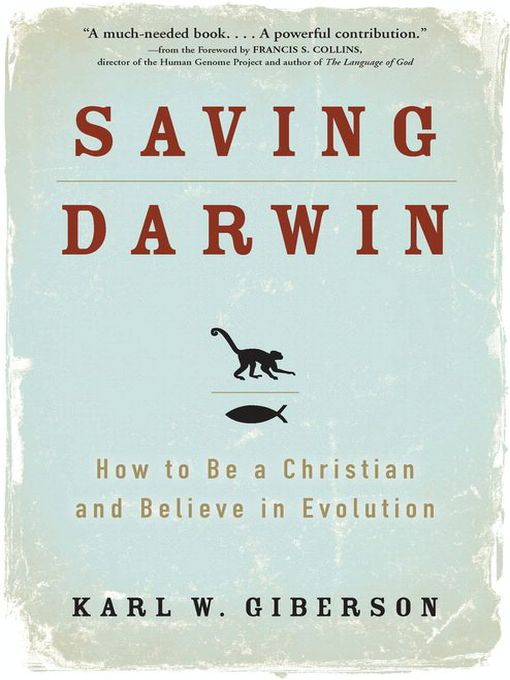
BOOK RECOMMENDATION: Saving Darwin

As part of my ongoing interest in the cultural conflict between science and religion, particularly evangelicalism, I have been reading Karl Giberson's book, Saving Darwin: How to Be a Christian and Believe in Evolution.

Giberson is professor of physics at Eastern Nazarene College, director of the Forum on Faith and Science at Gordon College, and Co-Director of the Venice Summer School on Science and Religion. His unique contribution to the literature is to provide an enlightening historical overview of the cultural conflict in the U.S., while at the same time presenting scientific evidence for evolution in a clear manner from a Christian perspective.

The burden of his book is captured in this quote, with which I wholeheartedly agree...
Places exist on which believers can stand, however, in the midst of the controversy. We don't know near enough about evolution to infer from it that God is not the creator. And we don't know anywhere near enough about God to dismiss the idea that evolution might be a part of God's creative processes. If we can embrace a bit of humility and avoid the temptation to enlarge either evolution or biblical literalism into an entire worldview, we can dismiss this controversy as the irrelevant shouting match that it is. (p. 18)
Giberson's book by itself does not offer a complete case that will satisfy most evangelicals, for it is not his task to examine the Biblical creation texts themselves and deal with the interpretive issues they raise. However, as an evangelical Christian, he does offer this sage advice with regard to our approach to the Bible:
Ambiguities about evolution coexisted with ambiguities about biblical interpretation. For evolution to conflict with the Bible, these ambiguities would have to resolve in a specific way that was genuinely incompatible. We can certainly select a biblical interpretation that will conflict with a particular explanation for evolution. But why would we want to do that? Absent a revelation from God commanding such a cantankerous move, there is simply no reason to do this. Blessed are the peacemakers, said Jesus, not those who go around manufacturing controversy. (p. 58, emphasis mine).
Most helpful to me was the historical overview Giberson gives, with surprising insights about some of the sources of creationist teachings and perspectives. I read The Genesis Flood in Bible College in the 70's when its concepts of flood geology and creationist logic were basic fundamentalist doctrine. However, I was never taught that these teachings originated from the dreams and visions of Ellen G. White, the founder of Adventism, who those same folks considered to be a false prophet.

Giberson also makes the obvious but overlooked point that, in America, this conflict is not really a fight between science and religion, even though the evangelists on each extreme would have us view it that way. To his credit, Giberson attacks the immoderate "religious" agenda of those who are using evolution as a way of promoting materialism with as much vigor as he critiques the persistent creationists.
The creation-evolution controversy is only, in the most trivial sense, a scientific dispute. It is, instead, a culture war, fought with culture-war weapons by culture warriors. Facts are almost irrelevant. Truth is valued when it serves a purpose and not for its own sake. Name-calling, caricature, cover-up, and hyperbole dominate. Compromise is out of the question.... (p. 166)
Thanks to Karl Giberson for providing at least a partial antidote to the unhealthy atmosphere created by this conflict.

Sunday, February 22, 2009

AN EVANGELICAL'S LAMENT AND JOURNEY: The Missional Issue, part one

The Good Samaritan
Rembrandt (1650-55)


I will introduce the third and final subject of our journey from evangelicalism to mainline Christianity with a story...

WHO IS MY NEIGHBOR?
Lee was a writer and photographer, the kind of person who drew strength and energy from being alone and working on her arts. She and Frank had been married twenty-four years; it was a second marriage for both of them, each having divorced from unhappy first unions. Neither had brought children to the marriage and, after a few tearful arguments early in their life together, the subject of having children with one another never came up again.

Frank worked hard, long hours, and provided well for them, freeing Lee to pursue her artistic interests. Then, unexpectedly, a few years before retirement, he was diagnosed with cancer and almost before you knew it, Frank was bed bound and his free-spirited wife lost her liberty. She attended to his needs night and day, feeding him, helping him to the toilet, passing his medicines, and getting him up in the recliner where he watched TV, increasingly distant and dependent. At first she got out for an hour or two here and there, but Lee could see that those opportunities were diminishing; she became more and more afraid to leave Frank alone for fear he would awaken confused and fall out of bed.

And so Lee became despondent. Frank’s constant demands kept her from pursuing the solitude and creative work she needed to refuel her spirit. They had no family to help them, and couldn’t really afford paid caregivers. Lee discovered she had few human supports on which to lean, and she felt alone, helpless and hopeless.

But a new sense of spiritual hunger also grew in Lee. She began reading the Bible and thinking about church. “Maybe a church family would provide some help with Frank,” she thought. She remembered that there was a new, large congregation a few blocks away, on the edge of her neighborhood. You could almost see it from her house. She decided to phone.

“Jericho Community Church,” the receptionist answered. “How may I direct your call?”

“I’m not sure who to talk to,” said Lee. “I live in the neighborhood and I’m wondering if you have anyone who could help me by coming to my house for a few hours to sit with my husband who has cancer.”

The receptionist transferred her to the Outreach Office. “Are you a member of our church?” the woman there asked her. When Lee said no, she offered to send an evangelistic team over to the house to talk with her and Frank. “But that’s not really what I’m interested in,” Lee protested. “Right now, I’m kind of homebound because of my husband’s illness. I hope to visit your church soon, but what I really need at the moment is a volunteer who can help me by coming to sit with my husband for an hour or two a week. Can you help?”

Again she was put on hold and transferred, this time to the Small Groups Office. “Are you in one of our Care Groups?” she was asked. “We care for our members through a network of small home groups. If you come to church this Sunday, we could hook you up with one of our Care Group leaders and maybe you could find a group to be part of.” And once more Lee tried in vain to communicate her need. She finally hung up the phone with a sigh.

She moved to the front window and looked out, wondering where to turn next. As she watched, two men crossed the street and walked down the sidewalk opposite her house. For a moment, they glanced up and saw her lonely figure through the darkened glass. Then, redirecting their eyes, they walked on. Lee watched until they reached the end of her street, and turned to walk south, to the church at the edge of her neighborhood.

Tuesday, February 17, 2009

AN EVANGELICAL'S LAMENT AND JOURNEY: The Pastoral Issue, part three

In his remarkable book, Under the Unpredictable Plant, Eugene Peterson describes how the conditions in which pastors work, embodied in the three different parties that affect the pastoral vocation, often conflict with the minister's true calling.
First, there is the ordaining body, the denomination.
I had discovered that spiritually and vocationally I was on my own. The people who ordained me and took responsibility for my work were interested in financial reports, attendance graphs, program planning. But they were not interested in me. They were interested in my job; they cared little for my vocation. (p. 80)

Second, the local congregation
.
The people who gather in our congregations want help through a difficult time; they want meaning and significance in their ventures. They want God, in a way, but certainly not a "jealous God," not the "God and Father of our Lord Jesus Christ." Mostly they want to be their own god and stay in control but have ancillary idol assistance for the hard parts, which the pastor can show them how to get. (p. 81)

Third, the ego of the pastor him or herself
.
We must do only what we are there to do: pronounce the Name, name the hunger. But it is so easy to get distracted. There is so much going on, so much to see and hear and say. So much emotion. So many tasks. So much, we think, "opportunity." But our assignment is to the "one thing needful," the invisible quiet center—God.

Such restraint is not easy. Dealing with important matters, we assert ourselves as important. We do it, of course, in the name of God, supposing we are upholding the primacy of the One we represent and intending to build up congregational effectiveness. This is done with distressing regularity by pastors. But such posturing does not give glory to God; it only advertises clerical vanity and contributes to congregational inanity. We are only hogging the show.... (p. 88)
I will use these categories to continue sharing my own perspectives on what I perceive to be some shortcomings of evangelicalism with regard to pastoral theology. I served as a pastor in mostly nondenominational evangelical churches for more than 25 years and directly experienced (and contributed to) the concerns I write about here. What I have seen in that church culture is Peterson's critique gone to seed.

The rest of the story...

First Concern: Where are the "apostles"?
If Eugene Peterson found no nurture and guidance from his denominational leaders, that is a shame. Those who serve as "apostles" above the local church level should have at least some among them assigned to be spiritual mentors and directors to pastors, who need constant support and direction. Peterson's critique shows us that no system is perfect, and that administrative structures don't always address the situations they are created to handle.

However, the problem in the autonomous world of evangelicalism is that there is NO STRUCTURE whatsoever. There is not even the least possibility of spiritual guidance, support, personal counsel, or accountability from the "apostolic" level, for there is no "apostolic" level! Like the churches they serve, pastors are expected to be independent, autonomous, and self-supporting. Each one is a solo act, and he works without a net.

This starts in school, where you will look long and hard to find a course or program that instructs prospective pastors about what a minister actually does day in and day out. Then, the world of church work he enters after school is the world of the entrepreneur. You are the man! Start your own. Do it your way. Come up with the next new and big idea. Climb the ladder. Learn to compete with the big boys. It's spiritual capitalism at its best, and only the strongest survive.

When I left my last church, a troubled congregation, I went home alone with my family. I literally had no idea what to do next. Oh sure, the folks from the pews were sympathetic and kind and very generous to help us out as they could, but where was the vocational "net"? Where was the older, wiser apostle overseeing the churches, whose job it was to pick up a colleague who had fallen on his face, bandage his wounds, put him on his own animal, bring him to the inn, and take care of him until he was strong enough to stand up again? Who would envision a future and point out possibilities?

Some lost pastors have found such healing and help providentially, but in my experience, it is far too rare and most of the time the fallen one himself has to search for it. There simply is no structure, no vocational net. Peterson warns us that denominational structures may not work well, or even at all sometimes. But at least someone cared enough to do something!

Timothy, you are on your own. You won't be hearing from Paul anytime soon.

Second Concern: Cultural ecclesiology
Peterson reminds us that Aaron was one of the most popular spiritual leaders in Scripture. He gave the people what they wanted and let them enjoy their "religion" to the fullest. According to Calvin, all people seek idols before God, and with today's technology, the American evangelical church can churn them out at record pace. In Peterson's priceless words, "John Calvin's insight plus Henry Ford's technology equals North American religion" (p. 81).

One idol that constantly provides hurdles for the evangelical pastor is that of the all-purpose church. This is the suburban doctrine of ecclesiology. A program for everything, and everything packaged in a program. A veritable Disney World of opportunities for all ages to find fulfilling spiritually-themed things to do. A religious activity center.

If the community and congregation are allowed to define "church" in these terms, it has an appalling effect on the pastor's vocation. He is no longer the shepherd whose job it is to help folks pay attention to God in their daily lives. No longer the one who is relieved from the normal demands of daily work to make a living and given leisure to keep company with God himself. No longer the one to practice what David Hansen calls, "long, wandering prayer." No longer the one encouraged to spend time among "the least of these," to "visit the orphans and widows in their distress," to leave the flock and seek the single lost sheep.

Instead he becomes the busy executive, who works in his "office" rather than his "study." Who oversees a staff and conducts their performance reviews and approves their budgets. Who works on a "campus," and conducts programs in the "worship center" rather than leading people to contemplate God in the "sanctuary." Who is called upon to cast the vision and come up with the strategy. Whose true sacred text is his DayTimer. He is CEO. He is shopkeeper. He is where the buck stops. He runs a church.

The customers demand it.

Third Concern: The celebrity pastor
Given the first two concerns, being a pastor in a contemporary evangelical church is a high risk/high reward proposition. You work without a net. You exist in a highly competitive market. If you ain't got the stuff, you'll probably get the stuffin' kicked out of you. If you got it, you can be a star.

Evangelical churches are mostly known by their pastors. Charismatic. Gifted. Dynamic. Visionary. Born leaders. These guys (and they are almost all guys in this tradition) have their pictures on all the conference brochures. You hear them on Christian radio. Their books are the ones you see when you first walk in the bookstore. People visit their churches and run from the parking lot to get good seats in the service.

Has anyone ever thought it strange that they represent a Savior who was mostly unknown by the world in which in lived? Who traveled by foot to obscure places and spent inordinate amounts of time with people who would never be able to return him any favors? Who rejected all attempts at publicity and "marketing"? Who intentionally said things so that some people would turn away and not follow him anymore? Who refused to make his teachings easy or "user-friendly," but spoke some of the strangest, hard-to-grasp words ever spoken? Who let his disciples fail again and again but never gave up on them, even when they gave the "ministry" a bad name? Whose greatest work was done in absolute shame and nakedness, darkness, death and despair? Whose symbol is not some snazzy logo designed by savvy marketers, but a bloody cross?

Pastors commonly give lip service to the vocabulary of their vocation, but in our working lives we more commonly pursue careers. Our actual work takes shape under the pressure of the marketplace, not the truth of theology or the wisdom of spirituality. I would like to see as much attention given to the holiness of our vocations as to the piety of our lives.

Basically, all I am doing is trying to get it straight, get straight what it means to be a pastor, and then develop a spirituality adequate to the work. The so-called spirituality that was handed to me by those who put me to the task of pastoral work was not adequate. I do not find the emaciated, exhausted spirituality of institutional careerism adequate. I do not find the veneered, cosmetic spirituality of personal charisma adequate. I require something biblically spiritual—rooted and cultivated in creation and covenant, leisurely in Christ, soaked in Spirit.

Eugene Peterson, Under the Unpredictable Plant, p. 5

Tuesday, February 10, 2009

AN EVANGELICAL'S LAMENT AND JOURNEY: The Pastoral Issue, part two

Eugene Peterson defines the shape of pastoral work as a triangle. With a triangle, it is important to get the ANGLES right. The precision of the angles determines the shape of the triangle and the length of each line. If the angles are all constructed equally, the result is a triangle with matching sides, perfectly balanced.

In pastoral ministry, Peterson says there are three “angles” that form the shape of our work: (1) Prayer, (2) Scripture, and (3) Spiritual Direction. If we properly understand and give attention to these angles, we fulfill our ministerial calling, and the “lines,” which represent the activities in which we engage, will fall into place.

By his definition, then, a pastor is called to be a person who attends to God through…
  • Prayer, living in a responsive, conversational relationship with God,
  • Scripture, living a contemplative life that is immersed in the words of the Bible,
  • Spiritual direction, being with people in community and individually for the cure and care of their souls
If we "work these angles" and let them shape us, the result will be a pastoral ministry that has integrity, depth, and appropriate balance. Peterson comments,
None of these acts is public, which means that no one knows for sure whether or not we are doing any of them. People hear us pray in worship, they listen to us preach and teach from the Scriptures, they notice when we are listening to them in a conversation, but they can never know if we are attending to God in any of this. It doesn’t take many years in this business to realize that we can conduct a fairly respectable pastoral ministry without giving much more than ceremonial attention to God. Since we can omit these acts of attention without anybody noticing, and because each of the acts involves a great deal of rigor, it is easy and common to slight them.

This is not entirely our fault. Great crowds of people have entered into a grand conspiracy to eliminate prayer, Scripture, and spiritual direction from our lives. They are concerned with our image and standing, with what they can measure, with what produces successful church-building programs and impressive attendance charts, with sociological impact and economic viability. They do their best to fill our schedules with meetings and appointments so that there is time for neither solitude nor leisure to be before God, to ponder Scripture, to be unhurried with another person.

…Pastoral work disconnected from the angle actions—the acts of attention to God in relation to myself, the biblical communities of Israel and church, the other person—is no longer given its shape by God. Working the angles is what gives shape and integrity to the daily work of pastors and priests. If we get the angles right it is a simple matter to draw in the lines. But if we are careless with or dismiss the angles, no matter how long or straight we draw the lines we will not have a triangle, a pastoral ministry.

Working the Angles, p. 4f
In my years as a pastor in local congregations, I saw (and lived out) some very different incarnations of ministry, pastoral caricatures which would lead one to suspect some poorly drawn angles. Here are a few I have witnessed and experienced…

The rest of the story...

THE PROFESSOR
Faster than Mr. Answer Man! More powerful than a German theologian! Able to parse Greek verbs with a single glance! I have been the professor. I have attempted to turn small churches into world-renowned seminaries. At times, I held the belief that discipleship means opening a new convert’s head and pouring in vast amounts of Biblical and theological knowledge. Many pastors love to teach. We were trained to teach. We got the idea, somehow, mistakenly, that what it really takes to help people follow Christ is for pastors to teach them Bible stories and Bible facts and Bible passages and Bible themes until their cranial cavities are bursting with sound doctrine. So, sanctuaries become lecture halls, words like “eschatological” are taught to toddlers, and congregations split over the number of links in the chain that will bind Satan during the Millennium.

I believe in deep, sound, faithful teaching, but pastors are not simply professors. How dull would that be?

THE MASTER OF CEREMONIES
This guy knows how to work a room. With Osteenesque brilliance, this genial host makes everyone feel welcome. Praying in public, he warms each one’s heart. As Master of Ceremonies, he makes certain that the presentation is impeccable, his stage manner flawless. His stories make you feel good. He speaks in sayings that are consistently clever and witty. Did I mention that smile? His sermons (“talks”) may not have depth, but they are eminently listenable. He is always positive, always affirming, always patting little children on the head, always making sure that people leave feeling better than when they came in. He never forgets a name. He could sell sand in the Sahara.

We all appreciate positive, affirming people, and we should. We should also be as encouraging and winsome as possible toward others. However, being a pastor is not to be equated with being “Mr. Personality.” Ask Luther or Tozer, or better yet, their congregations.

THE SHOPKEEPER
First one in the door, last one to leave. Responsible for each detail of the operation. Familiar with every inch of the property and every last piece of inventory. Takes his work home and burns the midnight oil pouring over the books. Never takes a vacation; in fact, rarely takes a lunch! Eats, drinks, sleeps, and breathes the business. Always working on new ideas to make things better and more profitable. Keeps one eye on the competition at all times. “Workaholic” is an insult—he is more dedicated than that. The answer to every problem is simply to roll up his sleeves and hit it a little harder.

I admire dedicated pastors who work hard. Slothfulness is a sin, and diligence is a virtue. It may very well be better to burn out than to rust out. I just don’t think it’s our calling. Even God stopped working at one point; we call that Sabbath. It doesn’t all depend on you, Mr. Shopkeeper.

THE DRILL SERGEANT
Mr. Shopkeeper thinks he has to do it all himself. At least this next pastoral type understands that people in the congregation must also have an active faith that works. In fact, that is his sole focus. People, get busy! You have been saved to serve! Start standing on the promises rather than sitting on the premises! God wants to direct your life, but he can’t steer a bicycle that is standing still, only one that is moving! To the work! The Drill Sergeant takes the urgency that’s burning in his own soul and urges it onto others. Hear the constant, fervent appeals for folks to get busy for the Lord by getting involved in the church program? His counsel to anyone who has a spiritual problem is to stop focusing on self and start working for Christ. He has no time for spiritual navel-gazing or people who want to waste time. When the house is on fire, you don’t sit around sharing your feelings.

Yes, pastors are called to assist people in using their spiritual gifts for the Body’s benefit and the world’s blessing. However, we are shepherds, not sheep dogs.

THE CEO
Natural born leader, remarkably gifted, entrepreneurial, visionary, with great capacity for understanding large organizations, an uncanny knack for administrating them, and endless energy to keep it all going, this is the "rancher" that the church growth movement used to talk about. (As in, a shepherd cares for a flock, but a rancher oversees an operation; ergo, for churches to grow really, really big they need ranchers not pastors.) The guy's ambitious and knows how to build. He could run a Fortune 500 company; instead he runs the incredibly complex megachurch. He is high profile, thrives on new challenges, and earns the respect of the business folks who used to thumb their noses at the church. Finally, they say, a minister we can respect! A guy who can duke it out with the bankers and politicians! He does it the American way and does it right.

Thank God for this pastor's amazing gifts. The problem comes when he is lifted up as THE model for pastoral success. Then the whole enterprise for all of us becomes about being big and excellent, and about having more, and about pastoring a "great" church. Ever gone to a pastor's conference where the keynote speaker was Pastor Joe from rural Kansas, who shared about his church's great success in reaching four new children for VBS this year? Didn't think so. He's a shepherd, not a rancher.

THE VISIONARY LEADER
The pastor who has regular visions may or may not become a CEO-type. He may not have the stuff to build big, but he sure dreams and talks big. There is always something great on the horizon and his job is to see it and rally the troops in hot pursuit. To use the lingo, he devotes a great deal of effort to "vision-casting" (ugh), continually challenging his congregation to new heights, ever the cheerleader to spur them on, always ladling out the hot sauce to keep the enthusiasm high. After all, God is in the business of doing new things... all the time... everywhere... for everyone! His sermons are rife with military metaphors—conquest, triumph, and victory over the strong forces arrayed against us. He knows how to raise the flag and get the patriots to cheer.

Nothing wrong with enthusiasm or being on the outlook for new direction from the Spirit. However, having my eyes fixed on the horizon may mean missing something right beside me, something not so exciting or dazzling but just as important. Why not lead the flock beside quiet waters once in awhile?

THE TECHNICIAN
Have I got a program for you! Take this discipleship course, and in thirteen weeks, guaranteed or your money back, you will be a mature follower of Christ! Memorize this packet of Bible verses and your mind will be renewed!
Follow these nine steps and you will be financially free! Here are some Christian diet suggestions to keep you healthy, a Christian exercise video to keep you fit, Christian clothing so you can be a public witness, Christian music for your CD player to keep you holy while you drive, a Christian Yellow Pages so that you never have to hire someone who doesn't work "as unto the Lord," Christian child-raising tips so your kids will turn out just right, a Christian sex video to keep your marriage smoking hot, and our latest church newsletter so you can find something to do at the church building every day of the week. By such means, pastoral ministry morphs into programmatic activity.

The technician pastor believes in a lot of this stuff. He probably has testimonials to back up the claims. It's simple. It's easy. It works. Where's God?


In the entrepreneurial, anti-tradition, historically ignorant, low-accountability world of evangelicalism, pastors are pretty much free to choose their identity and many end up like the caricatures above. Of course, each description contains elements of genuine pastoral ministry, but only when we properly "work the angles" at the heart of our calling can we escape the unbalanced approaches that are more determined by personality and culture than Biblical wisdom.

Tuesday, February 3, 2009

AN INTERVIEW YOU SHOULD READ

Check out Michael Spencer's interview with Christine Wicker, author of the challenging book, The Fall of the Evangelical Nation.

Here are a couple of quotes:
The evidence comes entirely from evangelicals themselves. When I talk about demise, I’m talking about numbers, growth, attitudes and behavior. The preachers often say that the culture has had more impact on the church than the church has had on the culture.

...What worries me is that the split between evangelical ideals and evangelical actions may be getting wider. Not because evangelicals are comfortable being hypocrites but because societal pressures are more intense.

For instance, I’m told that many evangelical kids and single adults come to church on Sunday and are regularly sleeping around or living with people they aren’t married to. Why? Because waiting until you’re married to have sex means that you are very likely never to get married and never to have sex either. Those are the “facts on the ground.”

...For the brand [of Christianity] I like best, you would look among the quieter, more humble, probably the older members of the congregation. I’d look among those with the least power. Not because powerful people can’t be Jesus-shaped, but the temptations are so much greater for them. I suspect it’s easier to become like Jesus if you’re among the “nobodies” of the world.

For more of Ms. Wicker's perspectives, visit her website. I also recommend her book highly. You won't agree with all her comments or interpretations, but the the analysis is one we need to hear and ponder.

Monday, February 2, 2009

If you must have a "worship band," please read this...

Here's a good word on the Out of Ur blog to remind us who is accompanying whom when we sing praises in worship, and a few implications of that fact.

Sunday, February 1, 2009

A Great Night...

Picture from Reuters

Great game. Springsteen put on an amazing half-time show. The commercials were entertaining if not groundbreaking.

I'll speak for myself and say Super Bowl XVIII was a lot of fun to watch. With no specific rooting interest in either team, I was just hoping for an exciting game, which is what we got—Steelers 27, Cardinals 23. MVP is Santonio Holmes, who made the remarkable game-winning catch seen above.

Saturday, January 31, 2009

I'm Speechless...

This one gets a gigantic, "Huh?"

Read this post and see if you can make any sense of it. I sure can't.

It actually sounds like one of Jesus' parables, you know, those stories that so often shamed the religious folks by pointing out that "sinners" were acting in a much more godly manner than the "righteous."

Friday, January 30, 2009

AN EVANGELICAL'S LAMENT AND JOURNEY: The Pastoral Issue

Marc Chagall
Solitude, 1933


Thus far, I have posted about the central issue that led my wife and I, recently in a position to search for a church family, to leave non-denominational evangelicalism and to join a mainline (Lutheran) church. That core issue is worship. In an early post in this series, I pointed out two other areas of concern: the pastoral issue and the missional issue.

Today, I begin to take up what I believe is the broken model of pastoral work in evangelicalism and our search for ministerial integrity.

The rest of the story...

Actually, there would be an simple way to write this post. I could simply recommend to you all the books on ministry written by Eugene Peterson. However, instead of taking the easy way out, I will try to put my own thoughts together in a series of articles. But I will use Peterson today to introduce this series by giving you some of my favorites quotes from a few of his books.

I could not easily put my hands on all the books I wanted to quote from, but I think you will get the message from what is shared here today.
When I look for help in developing my pastoral craft and nurturing my pastoral vocation, the one century that has the least to commend it is the twentieth. Has any century been so fascinated with gimmickery, so surfeited with fads, so addicted to nostrums, so unaware of God, so out of touch with the underground spiritual streams which water eternal life? In relation to pastoral work the present-day healing and helping disciplines are like the River Platte as described by Mark Twain, a mile wide and an inch deep. They are designed by a people without roots in an age without purpose for a people without God.

Five Smooth Stones for Pastoral Work, p. 12

Until about a century ago, what pastors did between Sundays was a piece with what they did on Sundays. The context changed: instead of an assembled congregation, the pastor was with one other person or with small gatherings of persons, or alone in study and prayer. The manner changed: instead of proclamation, there was conversation. But the work was the same: discovering the meaning of Scripture, developing a life of prayer, guiding growth into maturity.

...The between-Sundays work of American pastors in this century, though, is running a church. I first heard the phrase just a few days before my ordination. After thirty years, I can still remember the unpleasant impression it made.

I was traveling with a pastor I respected very much. I was full of zest and vision, anticipating pastoral life. My inner conviction of call to the pastorate was about to be confirmed by others. What God wanted me to do, what I wanted to do, and what others wanted me to do were about to converge. From fairly extensive reading about pastor and priest predecessors, I was impressed that everyday pastoral life was primarily concerned with developing a life of prayer among the people. Leading worship, preaching the gospel, and teaching Scripture on Sundays would develop in the next six days into representing the life of Christ in the human traffic of the everyday.

With my mind full of these thoughts, my pastor friend and I stopped at a service station for gasoline. My friend, a gregarious person, bantered with the attendant. Something in the exchange provoked a question.

"What do you do?"

"I run a church."

No answer could have surprised me more. I knew, of course, that pastoral life included institutional responsibilities, but it never occurred to me that I would be defined by those responsibilities. But the moment I became ordained, I found I was so defined both by the pastors and executives over me and by the parishioners around me. The first job description given me omitted prayer entirely.

The Contemplative Pastor, p. 66f

There are powerful cultural forces determined to turn Jesus into a kindly, wandering sage, teaching us how to live well, dispensing homespun wisdom, arousing our desire for God, whetting our appetite for higher truths—all of which are good things. These same forces are similarly determined to turn us, the church's pastors and leaders, into kindly religious figures, men and women who provide guidance through difficult times, who dole out inspiration and good cheer on a weekly schedule, who provide smiling reassurance that "God's in his heaven...," and keep our congregations busy at tasks that bolster their self-esteem—also good things.

And if they don't turn us into merely nice people, they turn us into replicas of our cultural leaders, seeking after power and influence and prestige. These insistent voices drum away at us, telling us pastors to go out and compete against the successful executives and entertainers who have made it to the top, so that we can put our churches on the map and make it big in the world.

The Unnecessary Pastor, p. 1

We're not the only church in Bel Air, and I'm not the only pastor. Few places in America are unchurched. Am I going to trust the Holy Spirit to do his work through other churches in my community, or am I going to think that if we don't do it, it's not going to get done?

A great deal of arrogance develops out of the feeling that when we have something good going, we have to triple it so everybody gets in on it. Many different ministries take place in the community and in the world, and it's bad faith on my part to assume the Holy Spirit isn't just as active in them as in my ministry.

Subversive Spirituality, p. 228

There is, of course, nothing wrong with a large-membership congregation. But neither is there anything right about it. Size is not a moral quality. It is a given. It is what is there—part of the environment in which the pastor works. "It is not the pastor's fault if he is born in times of barrenness, when it is difficult to do good" (Bengel). Size is mostly the result of cultural conditions. Congregations are large when there is social approval to be part of a religious establishment, small when there isn't. The pastor cannot choose his or her culture. The size of the congregations we serve is contingent on what decade we happen to be living in and what qualities of leadership happen to be in vogue at the time. While pious ways in the pastor will attract churchgoers in one place, worldly sophistication will attract them in another place. Angry preaching will be rewarded at one time, kindly preaching at another, quite apart from whether either the anger or the kindness communicates the gospel of Jesus Christ. Because these variables are notoriously inconstant, spiritual and biblical integrity is far more important than the skillful use of propaganda in doing pastoral work, the doctrine of providence of more significance than any image-making publicity.

Five Smooth Stones for Pastoral Work, p. 165
Amazing words. Peterson's insights on the pastoral ministry cut like a laser to the heart of the matter almost every time. I regret that I did not read, digest, and figure out how to put his stuff into practice every week of my 30 years of pastoral ministry. Any further thoughts I share will be faint echoes of his strong voice.

Tuesday, January 27, 2009

A PROPHECY OF DOOM: What Do You Think?

Adam and Eve Expelled
Marc Chagall, 1954-67


UPDATE 3: Part 3 of Michael Spencer's forecast about the future of evangelicalism has been posted at Internet Monk.

UPDATE 2:
Part 2 of Michael Spencer's forecast about the future of evangelicalism has been posted at Internet Monk.

UPDATE:
In one of the comments on Internet Monk, the theological problem of evangelicalism has been called, "Therapeutic Moral Deism." This is a devastatingly accurate description of the kind of "teaching" that is permeating so many evangelical churches and groups today. I, for one, don't believe that such doctrinal weakness can sustain God's people for very long.

***

Echoing warnings from books like The Fall of the Evangelical Nation, by Christine Wicker, Michael Spencer at Internet Monk predicts that...
I believe that we are on the verge- within 10 years- of a major collapse of evangelical Christianity; a collapse that will follow the deterioration of the mainline Protestant world and that will fundamentally alter the religious and cultural environment in the West. I believe this evangelical collapse will happen with astonishing statistical speed; that within two generations of where we are now evangelicalism will be a house deserted of half its current occupants, leaving in its wake nothing that can revitalize evangelicals to their former “glory.”

The party is almost over for evangelicals; a party that’s been going strong since the beginning of the “Protestant” 20th century. We are soon going to be living in a very secular and religiously antagonistic 21st century in a culture that will be between 25-30% non-religious.
Is there such a dramatic sea change in the near future for evangelicalism? What do you see from your vantage point?

This would be a great article to read and discuss. Feel free to do that at iMonk or here. I'd love to hear from you.

Tuesday, January 20, 2009

President Obama

First of all, then, I urge that supplications, prayers, intercessions, and thanksgivings should be made for everyone, for kings and all who are in high positions, so that we may lead a quiet and peaceable life in all godliness and dignity. This is right and is acceptable in the sight of God our Saviour, who desires everyone to be saved and to come to the knowledge of the truth. (1Timothy 2.1-3)

Monday, January 12, 2009

A Man Who Walks the Walk

In sports, the troublemakers often seem to get all the press. Today was different. Today, especially here in central Indiana, was about saying goodbye to one of the truly good guys—Coach Tony Dungy of the Indianapolis Colts, who announced his retirement from football.

His record speaks for itself...
  • A regular season record of 127-65
  • Overall mark of 136-74
  • Ten consecutive playoff appearances
  • First African-American coach to win a Super Bowl
However, as the senior NFL writer for FOXSports.com, Alex Marva, writes, "The NFL's loss will be society's gain. For all of his football accomplishments, the best is yet to come for Tony Dungy."

Tony Dungy is a man of strong Christian faith. Today he taught all prosperous American Christians a lesson by example. Success is not everything. Money is not everything. Sports are not nearly as important as many of us think. What is important is participating in God's mission in the world.

And by all accounts, that is what Dungy intends to do in a different way now, starting with devoting more time to his own family. He also has a passion for participating in good works that will help make the world a better place, especially for young African-American men.

I'm sure he won't coach again. He has moved on, letting go a life that most of us dream about.

Walk on, Coach Dungy, walk on. Lead on.