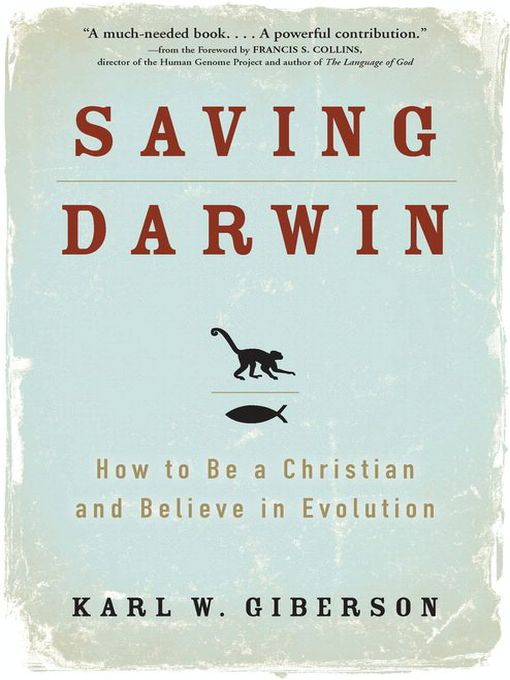
 As part of my ongoing interest in the cultural conflict between science and religion, particularly evangelicalism, I have been reading Karl Giberson's book, Saving Darwin: How to Be a Christian and Believe in Evolution.
Giberson is professor of physics at Eastern Nazarene College, director of the Forum on Faith and Science at Gordon College, and Co-Director of the Venice Summer School on Science and Religion. His unique contribution to the literature is to provide an enlightening historical overview of the cultural conflict in the U.S., while at the same time presenting scientific evidence for evolution in a clear manner from a Christian perspective.
The burden of his book is captured in this quote, with which I wholeheartedly agree...
Places exist on which believers can stand, however, in the midst of the controversy. We don't know near enough about evolution to infer from it that God is not the creator. And we don't know anywhere near enough about God to dismiss the idea that evolution might be a part of God's creative processes. If we can embrace a bit of humility and avoid the temptation to enlarge either evolution or biblical literalism into an entire worldview, we can dismiss this controversy as the irrelevant shouting match that it is. (p. 18)Giberson's book by itself does not offer a complete case that will satisfy most evangelicals, for it is not his task to examine the Biblical creation texts themselves and deal with the interpretive issues they raise. However, as an evangelical Christian, he does offer this sage advice with regard to our approach to the Bible:
Ambiguities about evolution coexisted with ambiguities about biblical interpretation. For evolution to conflict with the Bible, these ambiguities would have to resolve in a specific way that was genuinely incompatible. We can certainly select a biblical interpretation that will conflict with a particular explanation for evolution. But why would we want to do that? Absent a revelation from God commanding such a cantankerous move, there is simply no reason to do this. Blessed are the peacemakers, said Jesus, not those who go around manufacturing controversy. (p. 58, emphasis mine).Most helpful to me was the historical overview Giberson gives, with surprising insights about some of the sources of creationist teachings and perspectives. I read The Genesis Flood in Bible College in the 70's when its concepts of flood geology and creationist logic were basic fundamentalist doctrine. However, I was never taught that these teachings originated from the dreams and visions of Ellen G. White, the founder of Adventism, who those same folks considered to be a false prophet.
Giberson also makes the obvious but overlooked point that, in America, this conflict is not really a fight between science and religion, even though the evangelists on each extreme would have us view it that way. To his credit, Giberson attacks the immoderate "religious" agenda of those who are using evolution as a way of promoting materialism with as much vigor as he critiques the persistent creationists.
The creation-evolution controversy is only, in the most trivial sense, a scientific dispute. It is, instead, a culture war, fought with culture-war weapons by culture warriors. Facts are almost irrelevant. Truth is valued when it serves a purpose and not for its own sake. Name-calling, caricature, cover-up, and hyperbole dominate. Compromise is out of the question.... (p. 166)Thanks to Karl Giberson for providing at least a partial antidote to the unhealthy atmosphere created by this conflict.