Showing posts with label What I'm Reading. Show all posts

Tuesday, May 26, 2009

EVERYONE MUST ACCOMMODATE

Excellent post by Karl Giberson at Science & Sacred, the blog of BioLogos, called "God and Matter." He answers U of Chicago biologist Jerry Coyne's contention that combining faith in God with scientific understanding results in a "hilarious goldmine of accommodationism."

Giberson makes the point that we ALL must make accommodations as we try to understand life and the universe.
But what about the accommodationism of materialists? How do they reconcile their materialism with the rationality of the world? It seems to me reality has to be grounded in one of two deeply mysterious foundations: God or matter. Each has its own set of questions. Theists wonder about the nature of God's existence, the problem of evil, how and why God acts in the world and why God has chosen to remain hidden from us. These are difficult questions and certainly must trouble thoughtful believers. But don't materialists have another set of mysteries? Don't they have to wonder about the nature of physical existence? Why is there something rather than nothing? Why are the laws of nature so rational? Why is our species so religious? Is the world just a big pointless accident?
Don't let the materialistic worldview back you into a corner and make you think theists are the only ones who must face troublesome intellectual problems. "Material alone plus time plus chance" has plenty of its own. In my view, even more troublesome.

Sunday, May 24, 2009

A Christian Apologizes to Atheists

Rev. William Cwirla is a Lutheran pastor who is known for his direct teaching and defense of the truth. He and Craig Donofrio host a podcast called "The God-Whisperers" that is worth your time. Cwirla's blog is always good reading as well.

Today, I read a post there that I admire greatly and commend to you. It's called "Apologies to the Atheists." Christians who tend toward culture warrior-ism ought to meditate on it deeply. Cwirla makes the point that getting angry in response to the rants of today's popular atheists only proves...
  1. Our view of God is too small.
  2. We've forgotten that our anger does not accomplish God's righteous purposes (James 1.20).
  3. We've forgotten Jesus' call to love our enemies.
As Cwirla says,
...I don't know why the atheists are so angry. Perhaps they have good reason to be. I know that Christians aren't always noted for their manners, much less their Jesus-like compassion for those with whom they disagree, myself included. Maybe the angry atheists are just getting back at the playground bullies. Fair enough.

Ghandi once remarked, "I don't reject your Christ. I love your Christ. It's just that so many of you Christians are so unlike your Christ." We can't expect the other guy to put down his sword while we are swinging ours. That's true for many situations. Don't expect someone who believes in nothing to put down his sword. We're called to go first. We claim to follow the One who said, "Turn the other cheek, walk the extra mile, bless those who hate you, pray for your persecutors."

Wednesday, May 20, 2009

BECOMING THE RIGHTEOUSNESS OF GOD, part 3

For our sake he made him to be sin who knew no sin, so that in him we might become the righteousness of God.
2 Corinthians 5.21 (NRSV)
Jan Lembrecht's Sacra Pagina commentary on 2 Corinthians sets the immediate context for 5.21 as 2 Cor 5.11-21, which begins with the word "Therefore..." and announces a conclusion in Paul's argument.
In this verse Paul returns to his self-defense and plea. No longer the future common destination of all Christians, but the actual situation—his strained relations with the Corinthians—will be treated.
"Self-defense and plea."
Lembrecht's observations answer a major weakness in N.T. Wright's interpretation of 2 Cor 5.21. Wright correctly identifies the primary theme of this portion of the letter as a defense and theological explanation of Paul's apostleship. What he does not emphasize is the APPEAL that Paul is making to the Corinthians on the basis of this defense. Wright therefore interprets 2 Cor 5.21 as a further element in Paul's description of his own apostolic ministry, when in fact it is more likely linked to the challenge he is delivering to the wayward church.

"We and you"
One way to grasp the flow of this passage is to note the interplay between "we" ("us"), and "you," and broader terms such as "the world" or "all" in the passage.
Therefore, knowing the fear of the Lord, WE try to persuade others; but WE ourselves are well known to God, and I hope that WE are also well known to YOUR consciences. WE are not commending ourselves to YOU again, but giving YOU an opportunity to boast about US, so that YOU may be able to answer those who boast in outward appearance and not in the heart. For if WE are beside ourselves, it is for God; if WE are in OUR right mind, it is for YOU.

For the love of Christ urges US on, because WE are convinced that one has died for all; therefore all have died. And he died for all, so that those who live might live no longer for themselves, but for him who died and was raised for them.

From now on, therefore, WE regard no one from a human point of view; even though WE once knew Christ from a human point of view, WE know him no longer in that way. So if anyone is in Christ, there is a new creation: everything old has passed away; see, everything has become new! All this is from God, who reconciled US to himself through Christ, and has given US the ministry of reconciliation; that is, in Christ God was reconciling the world to himself, not counting their trespasses against them, and entrusting the message of reconciliation to US.

So WE are ambassadors for Christ, since God is making his appeal through US; WE entreat YOU on behalf of Christ, be reconciled to God. For our sake he made him to be sin who knew no sin, so that in him WE might become the righteousness of God.

Viewed like this, we can see that Paul's statements break down into three types:
  1. Words about the apostles and their ministry
  2. Words about what God has done for the world
  3. Words about, and directed personally to, the Corinthians
In particular, the words in the first and final paragraphs are personal words about and to the Corinthian situation—they form PAUL'S APPEAL TO THE CHURCH. Note how the "you" texts are found only in these paragraphs.

That means that the final "we" in this passage (in 5.21) is different than all the other "we's" that come earlier. In every other instance, the "we" refers to the apostles and their ministry. But the final "we" grows out of Paul's personal appeal to the church and links them together. If the verse is a creedal statement or line from a hymn that Paul is quoting, as I believe it is, then this solidifies the idea that he is not narrowly referring to the apostles here, but to all Christians.

2Cor 5.21 functions as the REASON for Paul's appeal in v. 20—"We entreat you on behalf of Christ—be reconciled to God."

Next time, we'll sum up...

Sunday, May 17, 2009

BECOMING THE RIGHTEOUSNESS OF GOD, part 2

For our sake he made him to be sin who knew no sin, so that in him we might become the righteousness of God.
2 Corinthians 5.21 (NRSV)
In his commentary on 2 Corinthians, Ralph Martin notes that, "the thought of Christians 'becoming the righteousness of God in him [Christ]' is not paralleled elsewhere in Paul." This and other observations lead him to conclude that Paul has included traditional materials about God's reconciliation into 1Cor 5.18-21.

Verse 21, in particular, may be a creedal statement or hymn fragment, which likely reflects Isaiah 53.10-11, about the Suffering Servant who would be made a sin offering, the Righteous One who would make many righteous by bearing their iniquities.

Further, he observes that the emphasis of 5.21 is not on the justification language, but rather on the simple idea of substitution and exchange. (Martin does say, however, that other aspects of the passage, which may indicate Paul's own hand interpreting and applying the traditional materials, cast a light on v. 21 that mirrors Paul's usage elsewhere.)

Yet another aspect of this passage is the way Paul uses evangelistic language to deal with a pastoral situation in a church. "The call [be reconciled to God] is issued with the Corinthian congregation and its pastoral problems in view, and should primarily be interpreted in that context." Paul uses language normally directed to call people to saving faith in Christ and applies it to believers, to impress upon them the ongoing implications of living as reconciled people in right relationship with God.

So, what we have in 2 Corinthians 5.21 is...
  1. A creedal statement about Christ's substitutionary sacrifice that brings us righteousness,
  2. In a context about being reconciled to God,
  3. Which is addressed to a church, not those who need to come to initial faith in Christ.
More to come...

Comments always welcome!

Saturday, May 16, 2009

Becoming the Righteousness of God

Crucifixion
Giotto di Bondone, 1304-1306

I have been reading N.T. Wright’s new book, Justification: God’s Plan & Paul’s Vision. It is a well-written defense of certain aspects of the so-called “new perspective” on Paul, which has caused a great deal of controversy, especially among those who hold traditional (“old perspective”) Reformed and Lutheran views of justification by faith. More on that debate another time.

For this post, I want to focus on a verse that has become central to the controversy—2 Corinthians 5.21. This has always been a favorite verse of mine. I have considered it to be one of those great summary texts, which express the Gospel message in a nutshell.

Here it is in the NRSV translation:
For our sake he (God) made him (Christ) to be sin who knew no sin, so that in him we might become the righteousness of God.
The immediate context for this verse is the section that runs from verses 18-21. This passage has as its focus the ministry of Paul as a “minister of reconciliation,” and here is how he develops that focus:
  • God reconciled the apostles to himself through Christ.
  • God then gave them the ministry of reconciliation.
  • Their message is that God reconciled the world to himself through Christ, that he did not count their trespasses against them, and that the apostles are the authorized proclaimers of this message.
  • Therefore, the apostles are God’s ambassadors and God is making his appeal through them.
  • And so, Paul appeals to them to be reconciled to God for Christ’s sake.
I think it best to interpret 2 Cor 5.21 as the CONCLUSION to this emphasis on Paul's ministry. It states the Gospel truth the apostles proclaim that leads to reconciliation with God.

2 Cor 5.21 is an expansion of what Paul introduced in v.19—that God reconciled the world to himself and did not count their trespasses against them. Some commentators think Paul may be quoting a creedal statement of the church that sums up what Christ has done for us. If so, this solidifies the interpretation that Paul's purpose here is to state the apostolic message in concise form.

The traditional interpretation of 2 Cor 5.21 is represented by this quote from Phil Johnson in his blog post, “The Great Exchange”:
Here is the apostle Paul's most succinct statement about the meaning of the cross. This could be the shortest, simplest verse among many in the Pauline epistles that make the meaning of justification inescapable: "He hath made him to be sin for us, who knew no sin; that we might be made the righteousness of God in him."

That text is all about the atoning work of Christ. Its meaning can be summed up in a single principle: substitution. It describes an exchange that took place through the atonement that Christ offered—our sin for Christ's righteousness. He took the place of sinners so that they might stand in His place as a perfectly righteous man.

Notice the graphic language: He was made sin (that's the very epitome of all that is despicable and odious), so that we might be made righteousness (that's everything that is good and pure and acceptable in God's estimation). This was the exchange: our sin for His righteousness. Our sin charged to His account; His righteousness credited to our account....
Now, N.T. Wright takes a radically different approach in interpreting this text. Trying to remain faithful to the context, which focuses on Paul as a minister of reconciliation and an ambassador for Christ, he takes the phrase, “that we might become the righteousness of God,” as synonymous with these other vocational descriptions. So, it turns out something like this: “God made Christ, who knew no sin, to be made a sin-offering for us, so that we (the apostles) might become (representatives of) the covenant faithfulness (i.e. righteousness) of God.”

I understand Wright's concern to respect the context, but I don’t think his is the best reading of 5.21 in relation to its context. I believe it makes more sense to see it as a summary statement of the message that the apostles bring as God’s ambassadors. This interpretation fits the context just as well. Wright's view seems forced.

Even though I don't accept that position, nevertheless, on other grounds this verse does present problems for the traditional view. Most notably, what are we to make of the verb, “become” in the second half of the "great exchange" described here. What does it mean that, “in him we...BECOME the righteousness of God”?

The Lutheran and Reformed understanding, based on the economic concept of imputation, is that our sin is placed on Christ’s account and counted against him, and in exchange his righteousness (the merit earned by his sinless life) is reckoned to our account. This "double imputation" leads to a change in the believer's status. We are declared righteous; our legal position before God the Judge is changed from that of "sinner" to that of “righteous.” Imputation does not describe an actual change within us, but a change in our legal standing before the Divine Court. Justification is a forensic matter. We are acquitted of any charges of law-breaking, and furthermore, God declares us perfectly righteous.

This traditional Protestant view has been defended against other interpretations of justification, such as that of Roman Catholicism, which holds that justification consists of a real, interior change in a person—imparted righteousness or infused grace—rather than an external legal transaction.

It is at this point that 2 Corinthians 5.21 causes Protestants problems. Listen again to the text:
For our sake he made him to be sin who knew no sin, so that in him we might become the righteousness of God.
If Paul wanted to describe justification as a declaration of righteousness based upon imputation, would he have said, “that in him we might become the righteousness of God”? Wouldn’t it make more sense to say something like, “that in him we might be declared righteous by God,” or “that in him we might receive righteousness (i.e. a righteous status) from God”?

What does it mean to “BECOME the righteousness of God”?

Please share your thoughts and the insights you have gained from your own study as I work through this text in the days ahead and try to grasp Paul's meaning.

Thursday, May 14, 2009

DEFINING SPIRITUAL MATURITY

Green Ears of Wheat
Van Gogh, 1888


Some of you may have heard about the latest poll from The Barna Group on spirituality, which produced this headline, "Many Churchgoers and Faith Leaders Struggle to Define Spiritual Maturity." Here is the introductory paragraph to their findings:
America may possess the world’s largest infrastructure for nurturing human spirituality, complete with hundreds of thousands of houses of worship, thousands of parachurch organizations and schools, and seemingly unlimited products, resources and experts.

Yet, a new study from the Barna Group identifies an underlying reason why there is little progress in helping people develop spiritually: many churchgoers and clergy struggle to articulate a basic understanding of spiritual maturity. People aspire to be spiritually mature, but they do not know what it means. Pastors want to guide others on the path to spiritual wholeness, but they are often not clearly defining the goals or the outcomes of that process.
They found "five challenges" with regard to the subject of spiritual maturity:
  1. Most Christians equate spiritual maturity with following the rules.
  2. Most churchgoers are not clear what their church expects in terms of spiritual maturity.
  3. Most Christians offer one-dimensional views of personal spiritual maturity.
  4. Most pastors struggle with feeling the relevance as well as articulating a specific set of objectives for spirituality, often favoring activities over attitudes.
  5. Pastors are surprisingly vague about the biblical references they use to chart spiritual maturity for people.
The director of the research project pointed out the implications of their findings:
America has a spiritual depth problem partly because the faith community does not have a robust definition of its spiritual goals. The study shows the need for new types of spiritual metrics. One new metric might be a renewed effort on the part of leaders to articulate the outcomes of spiritual growth. Another might be the relational engagement and accountability that people maintain. Of course, spirituality is neither a science nor a business, so there is a natural resistance to ascribing scientific or operational standards to what most people believe is an organic process. Yet, the process of spiritual growth is neither simplistic nor without guidelines, so hard work and solid thinking in this arena is needed.
What are we to make of these findings?

Thursday, April 30, 2009

HIGHLY RECOMMENDED: BioLogos

I am not an expert in any of the sciences, but I have been interested in the culture war that has been a staple of American society between Biblical Christianity and evolution. I was schooled to be a young-earth creationist, intellectually breastfed on books like The Genesis Flood. I never thought too deeply about the issues, and mostly stayed away from the fray when I was a pastor. It was only when I began studying Genesis seriously that my views began to emerge.

This is not the normal path that those who come to question creationism take. The stereotypical student who comes to reject the fundamentalist view becomes a questioner through considering scientific evidence. However, my doubts were born from studying Scripture! Genesis is so much richer and deeper than the bare literalist explanation. The creation narratives also fit within a larger work, the Torah, an interpretive context that most fundamentalists fail to consider adequately.

Now, esteemed scientist and believer Francis Collins has established a foundation with an excellent website that attempts to provide an alternative to the culture war approach of both atheistic and Christian fundamentalists. It's called BioLogos, and here is its mission...
The BioLogos Foundation promotes the search for truth in both the natural and spiritual realms, and seeks to harmonize these different perspectives.
It is a well-designed and well-written site that seeks to answer many of the questions that arise when one tries to take both the Bible and science seriously.

You can also check out the blog that complements the site at Science and the Sacred.

Highly recommended, even if you don't agree. BioLogos is a fine example of thoughtful, careful, and irenic scholarship.

Tuesday, April 28, 2009

WHY LITURGY?

Good post by Lutheran Rev. William Cwirla on The Top Ten Reasons We Use the Liturgy. Here's the list. Check out his blog for details.
  1. It shows our historic roots.
  2. It serves as a distinguishing mark.
  3. It is both Theocentric and Christocentric.
  4. It teaches.
  5. It is transcultural.
  6. It is repetitive in a good way.
  7. It is corporate.
  8. It rescues us from the tyranny of the “here and now.”
  9. It is external and objective.
  10. It is the Word of God.
I find the last point one of his most interesting. Critics of liturgical worship often claim that their churches are more "Biblical". However, they fail to realize several obvious facts:
  • The Bible itself is filled with liturgical materials, in both OT and NT. This shows that God's people have always worshiped in a liturgical fashion.
  • The Bible portrays God's people worshiping through liturgy. A simple example may be found in Acts 2.42: "They devoted themselves to the apostles’ teaching and fellowship, to the breaking of bread and the prayers." Note especially that they used "the prayers"—that is, the set liturgical prayers that they had learned in synagogue and temple worship. I find it interesting that this liturgical text describes the practice of the Spirit-filled church soon after Pentecost. Those who critique liturgical worship because they say it does not allow for the freedom of the Spirit have a problem here.
  • The liturgy is filled with Scripture. More Scripture is read, prayed, sung, and referenced in one liturgical service than in an entire season of services in most free worship congregations. As Cwirla notes, the liturgy IS the Word of God spoken for and by God's people, not simply a "service" in which the Word is included.

Saturday, April 18, 2009

EVANGELICALISM'S PROSPERITY GOSPEL PROBLEM

Well, well, it's Easter season. God's people are rejoicing in the risen Savior, meditating on the awesome mystery of his finished work that conquered sin, death, and hell, and provided his followers with a glimpse of the new heavens and new earth in his own risen state.

Jesus' resurrection and subsequent appearances restored and reassured his disciples in their faith, challenged and corrected their inadequate conceptions of who he is and what he came to do, thrilled their hearts and initiated a process of awakening and renewal that climaxed when Jesus ascended into heaven and then poured out the Holy Spirit on the Day of Pentecost, empowering the newly born church to boldly proclaim the Good News of Christ the Messiah, Savior of the world.

This is what Easter is about, right?

It's about Jesus, raised from the dead. It's about...
"the gospel of God, which he promised beforehand through his prophets in the holy scriptures, the gospel concerning his Son, who was descended from David according to the flesh and was declared to be Son of God with power according to the spirit of holiness by resurrection from the dead, Jesus Christ our Lord..."
Romans 1.1-4
Of all the events in Scripture that are about Jesus, and not about me, the Easter story of Christ's resurrection and appearances has to be at the top of the list. The entire focus is on Jesus.

But wait. A new book has unlocked the secrets of the resurrection accounts! PATH OF MIRACLES: The Seven Life-Changing Principles that Lead to Purpose and Fulfillment, by Samuel Rodriguez, tells readers that the real significance of the resurrection lies in seven principles that show us how to unlock the power within us so that we might achieve a happy, successful life. Read for yourself...
Prepare yourself; your life is about to change.

You are about to discover the way to a life full of accomplishment, achievement, and attainment, of realization, reward, and prosperity. Of healthy and happy relationships, and lasting love. Of satisfying work and success on the job. Of building wealth and financial freedom.

Right now.

This book will show you how. I will be your guide.

...God has a marathon of miracles waiting for you to enjoy right now, in this lifetime, and the seven simple principles in this book will show you how to unlock the power within you, and secure those treasures, right here, right now.

...The seven principles in this book activate heaven so we can live heaven right here. We can experience heaven here on Earth.
This is such transparently awful theology, such impossibly bad exegesis and use of Scripture, such an indefensibly cruel collection of undeliverable promises to the hungry and hurting among us that one might be tempted just to laugh it off as the pitiful sideshow of some insignificant snake-oil salesman.

However, the book's author is the president of the National Hispanic Christian Leadership Conference (NHCLC), America's largest Hispanic Christian organization, and was identified by the Wall Street Journal as one of four Latino leaders who are most influential in our nation's politics. The organization recently entered into a strategic partnership with Liberty University. The book's forward was written by respected evangelical leader, Jim Wallis. A blurb on the back flap was written by the chairman of the Board of Trustees for Gordon-Conwell Theological Seminary, a leading evangelical institution.

Evangelicalism has a "prosperity Gospel" problem. When an evangelical author who heads an evangelical organization, who is praised by leading evangelicals, writes a book that promotes said "Gospel" with such flagrant disregard for the Bible and such in-your-face enthusiasm, can there be any meaning left to the word "evangelical"?

Most certainly NOT recommended for your Easter season reading.

Tuesday, April 7, 2009

RECOMMENDED READING: Mark Galli on Worship

Mark Galli is an evangelical in good standing, the senior managing editor of Christianity Today, evangelicalism's leading magazine. He is also a member of the Anglican tradition. This combination equips him to speak with true credibility on the subject of worship to other evangelicals. Galli has done so by writing an articulate and winsome book, called Beyond Smells & Bells: The Wonder and Power of Christian Liturgy.

I may write more about Galli's fine overview of liturgical worship in future posts, but today I will let him speak for himself in a passage about "relevance" that is one of the most powerful in the book.
The liturgy asks us to rethink what we mean by "relevant" worship.

For example, it is not an accident that when we think about making church more relevant, we usually have only one group in mind. In North America, that usually means twenty-somethings and young families. For one, twenty-somethings are some of the hardest people to attract to church, and two, only when they start raising families do they begin to return to church. It's a perfect target audience for a struggling or new church to strive to reach.

...self-identified relevant churches, by their nature, limit a full-bodied expression of the church. In our worse moments, this approach appeals to immature motives. For example, I am currently in what many people consider a relevant and even "cool" church, and I have to admit I am proud of it. It's an interesting contrast to note how few churches that want to "reincarnate the gospel within a specific cultural context" want to do so among the poor, the homeless, welfare moms, drug-addicted men, or those trapped in nursing homes and convalescent hospitals.

This is one reason I thank God for the liturgy. The liturgy does not target any age or cultural sub-group. It does not even target this century (it does not assume, as we moderns are tempted to do, that this is the best of all possible ages, the most significant era of history). Instead, the liturgy presents a form of worship that transcends our time and place. Its earliest forms took shape in ancient Israel, and its subsequent development occurred in a variety of cultures and sub-cultures—Greco-Roman, North African, German, Frankish, Anglo-Saxon. The liturgy has been meaningfully prayed by bakers, housewives, tailors, teachers, philosophers, priests, monks, kings, and slaves. As such, it has not been shaped to meet any particular group's needs. It seeks only to enable people—people in general—to see God.
This is top-notch thinking, communicated with clarity. Would that other evangelicals (indeed, all of God's people) might learn to think about meeting with God with such Biblical, theological, and cultural insight.

Highly recommended.

Monday, March 30, 2009

Evangelicalism's Authority Problem

The Indianapolis Star ran an article this weekend about a man who confronted his pastor in the middle of the Sunday service. The man had evidence about a situation in which the minister was being accused of sexual harassment by a woman he had been counseling. While this was certainly a dramatic instance of how congregations handle ministerial problems, what caught my attention was the Star's observation about (lack of) accountability in autonomous congregations.

...at Hope Baptist and the growing legion of independent congregations with no denominational affiliation, there is no bishop ready to step in, no hierarchy waiting to conduct an investigation or hear an appeal, and no outside accountability.

In traditional denominations, disputes that are not settled within the congregation are funneled through a structured judicial process with long-established rules, said Carol Johnston, an associate professor of theology and culture at Christian Theological Seminary in Indianapolis. Don Gifford, superintendent of the Indiana District of the Assemblies of God, said he sees the additional layers of a denomination or a fellowship as additional accountability for everyone.

"All of us need to be under authority," he said.

But in recent decades, the traditional denominations have been in decline. As they have shrunk, many people have migrated to independent churches, which often are freer to move into growing population centers and have been quicker to embrace new worship and preaching styles attractive to younger generations.

The risk with being independent comes when the church is organized around the personality of a charismatic pastor who has much greater autonomy than his denominational brothers.

This is an important authority problem Protestants face, particularly with regard to independent, autonomous evangelical churches that have no authority-bearing traditions or practices, and no episcopal levels of oversight.

In the Star article, some of those interviewed said that there need not be a lack of accountability in such churches because boards of directors or deacons may function to provide it. However, the level of historical, theological, and pastoral understanding required to provide true oversight for a pastor or pastoral staff is usually minimal at best when it comes to the lay people appointed to such boards. In my experience, most board members are not even able to provide a knowledgeable annual evaluation of how the pastor is doing with his routine work, even when the local congregation and board have defined it! Imagine how unlikely it is that they would be able to provide skilled guidance in a time of crisis.

When we pursue a "start your own," "make it up as we go along," entreprenurial approach to ecclesiology and pastoral ministry, there are few safeguards. Every man does that which is right in his own eyes.

Houston, we have an authority problem.

Thursday, March 19, 2009

AN EVANGELICAL'S LAMENT AND JOURNEY, The Missional Issue, Part 3

My first clear understanding of the missional nature of the church emerged when I was in seminary and pastoring a small church in suburban Chicago. It came to me in the form of two small books by Dr. Richard C. Halverson, called Between Sundays, and How I Changed My Thinking about the Church.

Dr. Halverson has a simple practical ecclesiology, one which I think is still being missed by the church in America...
  • The church exists in two basic forms: (1) the church gathered, and (2) the church scattered.

  • The first we might call the Sunday church; the second, the church "between Sundays".

  • When the congregation gathers, it does so to do "church work"—the work that takes place among God's people, and which also includes maintaining and supporting the institution. When the church scatters, it does so to do "the work of the church"—fulfilling God's mission in Christ in the world.

  • One primary purpose of the church's gathering is to equip the church to fulfill its mission when scattered throughout the week in various places where the routines of everyday life occur.

Today, a few pertinent quotes from Dr. Halverson to flesh this out a bit...

The Christian life is elliptical; it revolves around two foci--one an invitation and the other a commission. The invitation is that of Jesus Christ, "Come unto me...." The commision, also from Jesus Christ, is "Go ye into all the world...." The healthy Christian life revolves around the coming and the going. (How I Changed..., p.21)
He further observes that this "coming and going" lifestyle must be balanced. There are those who are always "coming"—who build church-centered lives and devote most of their time and attention to being involved with the Christian community. Others, perhaps disillusioned with the institution, are always "going"—devoting their lives to doing good in their community but neglecting the edifying fellowship of other believers.

However, these complementary spheres of Christian living are meant to balance and support one another...

If one were to begin from scratch to build a theology of evangelism and mission on the basis of what he found in the New Testament epistles, he would probably be impressed with the paucity of material upon which to build....

...the weight of the exhortation and instruction in the epistles has to do with the relationship of believer with believer in the community, in the body of Christ. The implication can be clearly drawn that when these relationships are right, i.e., when the brothers and sisters love one another and when they are abiding in Christ, evangelism and mission will be the normal and healthy result of such relationships....


...Here one does not find the churches organizing to reach the world with the Gospel of Jesus Christ. But what one does find is the Gospel being scattered widely and rapidly because the church is in such a healthy condition that this can happen. (How I Changed..., pp. 63-65)
The true work of the church happens when this kind of congregation scatters and each member engages the world of his neighbors daily in the context of real life situations...
It became apparent that the work of the church is not what is done for the institution, the organization, the establishment. The real work of the church is what is done between Sundays when the church is scattered all over the metropolitan area where it is located—in homes, in schools, in offices, on construction jobs, in market places. This is the work of the church and it requires every single member. The responsibility of the pastor is to equip every member to do the work of the church wherever he is between Sundays. This radically alters the pastor's way of thinking about his responsibility to the congregation. No longer do they represent men and women who are to be mobilized to do the work of his ministry; but on the contrary, they have a ministry wherever they are and God has called the pastor to equip them for their ministry....

One of the reasons the institutional church has become irrelevant to the extent that it has in our contemporary life is that many Christians have become so busy in church work they have not had time to do the work of the church....

The view persists that the serious Christian, the one truly committed, will be active in the life of the religious institution. If he loves Christ he ought to be doing "something for the church." The program of the establishment is equated with service for Christ. As one does this he is "spiritual." In everything else, except as he may sporadically talk to someone in an effort to win him to Christ or get him into the church, he is "secular."
The truth is, everything we do in the church organization, in the church building, in the church program ought to contribute to the church's effectiveness when it is not involved in the building or the program or the organization—when it is out in the world.

...In other words, the measure of the effectiveness of a congregation is not what one sees when the congregation is gathered, not the size of the building, nor the size of the budget, nor the size of the congregation or the Sunday school. The real measure of the effectiveness of the congregation is what happens when the congregation is not in the sanctuary or the Sunday school or meeting officially as boards or committees or councils. The measure of the effectiveness of any local congregation when it is gathered, is the measure of what that congregation is doing when it is dispersed.
(How I Changed..., pp. 71-77)
Halverson summarizes the missional focus of the church in this succinct, earthshaking statement:
Think of it this way. The program of our church is everything all the members are doing between Sundays. (How I Changed..., p.106)
Why is this so earthshaking? Because it challenges the fundamental understandings and deeply ingrained practices of a vast majority of churches. In fact, I know of NO churches in my own experience that genuinely believe and act like this.
  • Isn't the church's program what we announce in our bulletins, calendars, newsletters, and websites?
  • Doesn't the program of the church consist of what we organize and oversee in order to fulfill God's mission in the world?
For the most part, NO.

The programmatic approach that most churches take says much more about our cultural commitments than it does about living out our Biblical calling to be Christ's people in the world.

Sunday, March 1, 2009

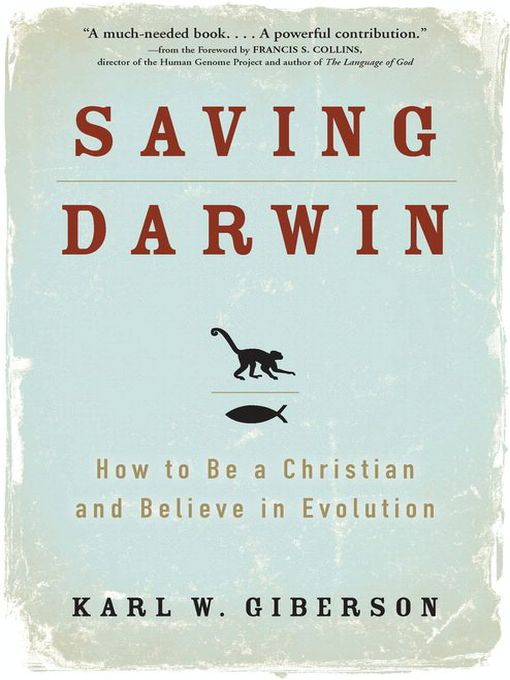
BOOK RECOMMENDATION: Saving Darwin

As part of my ongoing interest in the cultural conflict between science and religion, particularly evangelicalism, I have been reading Karl Giberson's book, Saving Darwin: How to Be a Christian and Believe in Evolution.

Giberson is professor of physics at Eastern Nazarene College, director of the Forum on Faith and Science at Gordon College, and Co-Director of the Venice Summer School on Science and Religion. His unique contribution to the literature is to provide an enlightening historical overview of the cultural conflict in the U.S., while at the same time presenting scientific evidence for evolution in a clear manner from a Christian perspective.

The burden of his book is captured in this quote, with which I wholeheartedly agree...
Places exist on which believers can stand, however, in the midst of the controversy. We don't know near enough about evolution to infer from it that God is not the creator. And we don't know anywhere near enough about God to dismiss the idea that evolution might be a part of God's creative processes. If we can embrace a bit of humility and avoid the temptation to enlarge either evolution or biblical literalism into an entire worldview, we can dismiss this controversy as the irrelevant shouting match that it is. (p. 18)
Giberson's book by itself does not offer a complete case that will satisfy most evangelicals, for it is not his task to examine the Biblical creation texts themselves and deal with the interpretive issues they raise. However, as an evangelical Christian, he does offer this sage advice with regard to our approach to the Bible:
Ambiguities about evolution coexisted with ambiguities about biblical interpretation. For evolution to conflict with the Bible, these ambiguities would have to resolve in a specific way that was genuinely incompatible. We can certainly select a biblical interpretation that will conflict with a particular explanation for evolution. But why would we want to do that? Absent a revelation from God commanding such a cantankerous move, there is simply no reason to do this. Blessed are the peacemakers, said Jesus, not those who go around manufacturing controversy. (p. 58, emphasis mine).
Most helpful to me was the historical overview Giberson gives, with surprising insights about some of the sources of creationist teachings and perspectives. I read The Genesis Flood in Bible College in the 70's when its concepts of flood geology and creationist logic were basic fundamentalist doctrine. However, I was never taught that these teachings originated from the dreams and visions of Ellen G. White, the founder of Adventism, who those same folks considered to be a false prophet.

Giberson also makes the obvious but overlooked point that, in America, this conflict is not really a fight between science and religion, even though the evangelists on each extreme would have us view it that way. To his credit, Giberson attacks the immoderate "religious" agenda of those who are using evolution as a way of promoting materialism with as much vigor as he critiques the persistent creationists.
The creation-evolution controversy is only, in the most trivial sense, a scientific dispute. It is, instead, a culture war, fought with culture-war weapons by culture warriors. Facts are almost irrelevant. Truth is valued when it serves a purpose and not for its own sake. Name-calling, caricature, cover-up, and hyperbole dominate. Compromise is out of the question.... (p. 166)
Thanks to Karl Giberson for providing at least a partial antidote to the unhealthy atmosphere created by this conflict.

Tuesday, February 17, 2009

AN EVANGELICAL'S LAMENT AND JOURNEY: The Pastoral Issue, part three

In his remarkable book, Under the Unpredictable Plant, Eugene Peterson describes how the conditions in which pastors work, embodied in the three different parties that affect the pastoral vocation, often conflict with the minister's true calling.
First, there is the ordaining body, the denomination.
I had discovered that spiritually and vocationally I was on my own. The people who ordained me and took responsibility for my work were interested in financial reports, attendance graphs, program planning. But they were not interested in me. They were interested in my job; they cared little for my vocation. (p. 80)

Second, the local congregation
.
The people who gather in our congregations want help through a difficult time; they want meaning and significance in their ventures. They want God, in a way, but certainly not a "jealous God," not the "God and Father of our Lord Jesus Christ." Mostly they want to be their own god and stay in control but have ancillary idol assistance for the hard parts, which the pastor can show them how to get. (p. 81)

Third, the ego of the pastor him or herself
.
We must do only what we are there to do: pronounce the Name, name the hunger. But it is so easy to get distracted. There is so much going on, so much to see and hear and say. So much emotion. So many tasks. So much, we think, "opportunity." But our assignment is to the "one thing needful," the invisible quiet center—God.

Such restraint is not easy. Dealing with important matters, we assert ourselves as important. We do it, of course, in the name of God, supposing we are upholding the primacy of the One we represent and intending to build up congregational effectiveness. This is done with distressing regularity by pastors. But such posturing does not give glory to God; it only advertises clerical vanity and contributes to congregational inanity. We are only hogging the show.... (p. 88)
I will use these categories to continue sharing my own perspectives on what I perceive to be some shortcomings of evangelicalism with regard to pastoral theology. I served as a pastor in mostly nondenominational evangelical churches for more than 25 years and directly experienced (and contributed to) the concerns I write about here. What I have seen in that church culture is Peterson's critique gone to seed.

The rest of the story...

First Concern: Where are the "apostles"?
If Eugene Peterson found no nurture and guidance from his denominational leaders, that is a shame. Those who serve as "apostles" above the local church level should have at least some among them assigned to be spiritual mentors and directors to pastors, who need constant support and direction. Peterson's critique shows us that no system is perfect, and that administrative structures don't always address the situations they are created to handle.

However, the problem in the autonomous world of evangelicalism is that there is NO STRUCTURE whatsoever. There is not even the least possibility of spiritual guidance, support, personal counsel, or accountability from the "apostolic" level, for there is no "apostolic" level! Like the churches they serve, pastors are expected to be independent, autonomous, and self-supporting. Each one is a solo act, and he works without a net.

This starts in school, where you will look long and hard to find a course or program that instructs prospective pastors about what a minister actually does day in and day out. Then, the world of church work he enters after school is the world of the entrepreneur. You are the man! Start your own. Do it your way. Come up with the next new and big idea. Climb the ladder. Learn to compete with the big boys. It's spiritual capitalism at its best, and only the strongest survive.

When I left my last church, a troubled congregation, I went home alone with my family. I literally had no idea what to do next. Oh sure, the folks from the pews were sympathetic and kind and very generous to help us out as they could, but where was the vocational "net"? Where was the older, wiser apostle overseeing the churches, whose job it was to pick up a colleague who had fallen on his face, bandage his wounds, put him on his own animal, bring him to the inn, and take care of him until he was strong enough to stand up again? Who would envision a future and point out possibilities?

Some lost pastors have found such healing and help providentially, but in my experience, it is far too rare and most of the time the fallen one himself has to search for it. There simply is no structure, no vocational net. Peterson warns us that denominational structures may not work well, or even at all sometimes. But at least someone cared enough to do something!

Timothy, you are on your own. You won't be hearing from Paul anytime soon.

Second Concern: Cultural ecclesiology
Peterson reminds us that Aaron was one of the most popular spiritual leaders in Scripture. He gave the people what they wanted and let them enjoy their "religion" to the fullest. According to Calvin, all people seek idols before God, and with today's technology, the American evangelical church can churn them out at record pace. In Peterson's priceless words, "John Calvin's insight plus Henry Ford's technology equals North American religion" (p. 81).

One idol that constantly provides hurdles for the evangelical pastor is that of the all-purpose church. This is the suburban doctrine of ecclesiology. A program for everything, and everything packaged in a program. A veritable Disney World of opportunities for all ages to find fulfilling spiritually-themed things to do. A religious activity center.

If the community and congregation are allowed to define "church" in these terms, it has an appalling effect on the pastor's vocation. He is no longer the shepherd whose job it is to help folks pay attention to God in their daily lives. No longer the one who is relieved from the normal demands of daily work to make a living and given leisure to keep company with God himself. No longer the one to practice what David Hansen calls, "long, wandering prayer." No longer the one encouraged to spend time among "the least of these," to "visit the orphans and widows in their distress," to leave the flock and seek the single lost sheep.

Instead he becomes the busy executive, who works in his "office" rather than his "study." Who oversees a staff and conducts their performance reviews and approves their budgets. Who works on a "campus," and conducts programs in the "worship center" rather than leading people to contemplate God in the "sanctuary." Who is called upon to cast the vision and come up with the strategy. Whose true sacred text is his DayTimer. He is CEO. He is shopkeeper. He is where the buck stops. He runs a church.

The customers demand it.

Third Concern: The celebrity pastor
Given the first two concerns, being a pastor in a contemporary evangelical church is a high risk/high reward proposition. You work without a net. You exist in a highly competitive market. If you ain't got the stuff, you'll probably get the stuffin' kicked out of you. If you got it, you can be a star.

Evangelical churches are mostly known by their pastors. Charismatic. Gifted. Dynamic. Visionary. Born leaders. These guys (and they are almost all guys in this tradition) have their pictures on all the conference brochures. You hear them on Christian radio. Their books are the ones you see when you first walk in the bookstore. People visit their churches and run from the parking lot to get good seats in the service.

Has anyone ever thought it strange that they represent a Savior who was mostly unknown by the world in which in lived? Who traveled by foot to obscure places and spent inordinate amounts of time with people who would never be able to return him any favors? Who rejected all attempts at publicity and "marketing"? Who intentionally said things so that some people would turn away and not follow him anymore? Who refused to make his teachings easy or "user-friendly," but spoke some of the strangest, hard-to-grasp words ever spoken? Who let his disciples fail again and again but never gave up on them, even when they gave the "ministry" a bad name? Whose greatest work was done in absolute shame and nakedness, darkness, death and despair? Whose symbol is not some snazzy logo designed by savvy marketers, but a bloody cross?

Pastors commonly give lip service to the vocabulary of their vocation, but in our working lives we more commonly pursue careers. Our actual work takes shape under the pressure of the marketplace, not the truth of theology or the wisdom of spirituality. I would like to see as much attention given to the holiness of our vocations as to the piety of our lives.

Basically, all I am doing is trying to get it straight, get straight what it means to be a pastor, and then develop a spirituality adequate to the work. The so-called spirituality that was handed to me by those who put me to the task of pastoral work was not adequate. I do not find the emaciated, exhausted spirituality of institutional careerism adequate. I do not find the veneered, cosmetic spirituality of personal charisma adequate. I require something biblically spiritual—rooted and cultivated in creation and covenant, leisurely in Christ, soaked in Spirit.

Eugene Peterson, Under the Unpredictable Plant, p. 5

Tuesday, February 3, 2009

AN INTERVIEW YOU SHOULD READ

Check out Michael Spencer's interview with Christine Wicker, author of the challenging book, The Fall of the Evangelical Nation.

Here are a couple of quotes:
The evidence comes entirely from evangelicals themselves. When I talk about demise, I’m talking about numbers, growth, attitudes and behavior. The preachers often say that the culture has had more impact on the church than the church has had on the culture.

...What worries me is that the split between evangelical ideals and evangelical actions may be getting wider. Not because evangelicals are comfortable being hypocrites but because societal pressures are more intense.

For instance, I’m told that many evangelical kids and single adults come to church on Sunday and are regularly sleeping around or living with people they aren’t married to. Why? Because waiting until you’re married to have sex means that you are very likely never to get married and never to have sex either. Those are the “facts on the ground.”

...For the brand [of Christianity] I like best, you would look among the quieter, more humble, probably the older members of the congregation. I’d look among those with the least power. Not because powerful people can’t be Jesus-shaped, but the temptations are so much greater for them. I suspect it’s easier to become like Jesus if you’re among the “nobodies” of the world.

For more of Ms. Wicker's perspectives, visit her website. I also recommend her book highly. You won't agree with all her comments or interpretations, but the the analysis is one we need to hear and ponder.

Tuesday, January 27, 2009

A PROPHECY OF DOOM: What Do You Think?

Adam and Eve Expelled
Marc Chagall, 1954-67


UPDATE 3: Part 3 of Michael Spencer's forecast about the future of evangelicalism has been posted at Internet Monk.

UPDATE 2:
Part 2 of Michael Spencer's forecast about the future of evangelicalism has been posted at Internet Monk.

UPDATE:
In one of the comments on Internet Monk, the theological problem of evangelicalism has been called, "Therapeutic Moral Deism." This is a devastatingly accurate description of the kind of "teaching" that is permeating so many evangelical churches and groups today. I, for one, don't believe that such doctrinal weakness can sustain God's people for very long.

***

Echoing warnings from books like The Fall of the Evangelical Nation, by Christine Wicker, Michael Spencer at Internet Monk predicts that...
I believe that we are on the verge- within 10 years- of a major collapse of evangelical Christianity; a collapse that will follow the deterioration of the mainline Protestant world and that will fundamentally alter the religious and cultural environment in the West. I believe this evangelical collapse will happen with astonishing statistical speed; that within two generations of where we are now evangelicalism will be a house deserted of half its current occupants, leaving in its wake nothing that can revitalize evangelicals to their former “glory.”

The party is almost over for evangelicals; a party that’s been going strong since the beginning of the “Protestant” 20th century. We are soon going to be living in a very secular and religiously antagonistic 21st century in a culture that will be between 25-30% non-religious.
Is there such a dramatic sea change in the near future for evangelicalism? What do you see from your vantage point?

This would be a great article to read and discuss. Feel free to do that at iMonk or here. I'd love to hear from you.

Saturday, January 24, 2009

The "Right" Church?

Again I direct you to Michael Spencer's Internet Monk blog today for some wise pastoral theology and counsel.

Some of you might have the mistaken idea that the search we have been going through and writing about is a personal quest to find "the One True Church," or "THE Right Church" in contrast to all others who are deficient in doctrine or practice.

Listen up! There is no such place, and the compulsion to find it can drive you crazy.

Saturday, January 17, 2009

The "Big Picture" of the Gospel

It has been a slow week with regard to blogging—what with sickness and all—but I'm slowly finding my way back to the computer.

Let me start tonight by recommending a good summary of the Gospel, written by Derrick Olliff.

We tend to make the Gospel into an individualistic matter, when the real point is that God, through the Gospel, is calling us to participate in his program of transforming all creation through the Lord Jesus Christ. We also divorce the Gospel message from its First Testament roots, turning it into a strictly personal transaction rather than part of a continuing story.

Olliff overturns these notions and gives a good overview of the full Gospel message.

Friday, January 2, 2009

PRAY FOR GAZA'S CHRISTIANS

Source: NY Times

Lost in the news stories about Israel's bombing of Hamas targets in Gaza is the fact that there are many minority groups caught in the crossfire. The Christian community in Gaza is one such group. There are about 3,000 Christians in Gaza, and they are unwelcome in either the Muslim majority of their own communities or in Israel. They are trapped in the midst of the violence, and we should pray for them.

For more information, read this Mission Network News piece, which quotes Carl Moeller of Open Doors...
"It's remarkable how much that the church is facing there," Moeller said. "And yet the Christians continue to pray; they continue to cry out to God; and when they can, reach out to their neighbors with comfort."
Let us continue to cry out to God for them.

Saturday, November 15, 2008

THURSDAY THINGAMAJIG: Christmas Book List I

Here's part one of my annual Christmas wish list for books. We'll start today with the realm of Biblical studies.

Here are ten books about the Bible and biblical theology, any of which I would love to find under the tree on Christmas morning...
  • Psalms, 3 vols. (Baker Commentary on the Old Testament Wisdom and Psalms), by John Goldingay
  • Psalms 1-59 (Continental Commentaries), by Hans-Joachim Kraus
That's a good start!