Showing posts with label Evangelicalism. Show all posts

Sunday, May 24, 2009

A Christian Apologizes to Atheists

Rev. William Cwirla is a Lutheran pastor who is known for his direct teaching and defense of the truth. He and Craig Donofrio host a podcast called "The God-Whisperers" that is worth your time. Cwirla's blog is always good reading as well.

Today, I read a post there that I admire greatly and commend to you. It's called "Apologies to the Atheists." Christians who tend toward culture warrior-ism ought to meditate on it deeply. Cwirla makes the point that getting angry in response to the rants of today's popular atheists only proves...
  1. Our view of God is too small.
  2. We've forgotten that our anger does not accomplish God's righteous purposes (James 1.20).
  3. We've forgotten Jesus' call to love our enemies.
As Cwirla says,
...I don't know why the atheists are so angry. Perhaps they have good reason to be. I know that Christians aren't always noted for their manners, much less their Jesus-like compassion for those with whom they disagree, myself included. Maybe the angry atheists are just getting back at the playground bullies. Fair enough.

Ghandi once remarked, "I don't reject your Christ. I love your Christ. It's just that so many of you Christians are so unlike your Christ." We can't expect the other guy to put down his sword while we are swinging ours. That's true for many situations. Don't expect someone who believes in nothing to put down his sword. We're called to go first. We claim to follow the One who said, "Turn the other cheek, walk the extra mile, bless those who hate you, pray for your persecutors."

Thursday, May 14, 2009

DEFINING SPIRITUAL MATURITY

Green Ears of Wheat
Van Gogh, 1888


Some of you may have heard about the latest poll from The Barna Group on spirituality, which produced this headline, "Many Churchgoers and Faith Leaders Struggle to Define Spiritual Maturity." Here is the introductory paragraph to their findings:
America may possess the world’s largest infrastructure for nurturing human spirituality, complete with hundreds of thousands of houses of worship, thousands of parachurch organizations and schools, and seemingly unlimited products, resources and experts.

Yet, a new study from the Barna Group identifies an underlying reason why there is little progress in helping people develop spiritually: many churchgoers and clergy struggle to articulate a basic understanding of spiritual maturity. People aspire to be spiritually mature, but they do not know what it means. Pastors want to guide others on the path to spiritual wholeness, but they are often not clearly defining the goals or the outcomes of that process.
They found "five challenges" with regard to the subject of spiritual maturity:
  1. Most Christians equate spiritual maturity with following the rules.
  2. Most churchgoers are not clear what their church expects in terms of spiritual maturity.
  3. Most Christians offer one-dimensional views of personal spiritual maturity.
  4. Most pastors struggle with feeling the relevance as well as articulating a specific set of objectives for spirituality, often favoring activities over attitudes.
  5. Pastors are surprisingly vague about the biblical references they use to chart spiritual maturity for people.
The director of the research project pointed out the implications of their findings:
America has a spiritual depth problem partly because the faith community does not have a robust definition of its spiritual goals. The study shows the need for new types of spiritual metrics. One new metric might be a renewed effort on the part of leaders to articulate the outcomes of spiritual growth. Another might be the relational engagement and accountability that people maintain. Of course, spirituality is neither a science nor a business, so there is a natural resistance to ascribing scientific or operational standards to what most people believe is an organic process. Yet, the process of spiritual growth is neither simplistic nor without guidelines, so hard work and solid thinking in this arena is needed.
What are we to make of these findings?

What is the GOSPEL?

To many people, this is the Gospel message that we should share with others:
  1. God created you to live in relationship with him.
  2. However, you have a sin problem that has separated you from God.
  3. Jesus died to save you from your sins.
  4. If you put your trust in him, he will forgive your sins, you will become God's child, and you will go to heaven when you die.
Is there anything wrong with this "Gospel"?

I'd love to hear what you think.

Tuesday, May 12, 2009

WHY I AM NOT A CULTURE WARRIOR...

I've said it before and I'll say it again: When it comes to the culture wars, I am a conscientious objector.

Since the 1970's evangelicalism in America has taken to getting involved in public cultural activism and the political sphere with unprecedented vigor. Evangelicals have followed the voices of religious leaders like Francis Schaeffer, Jerry Falwell, D. James Kennedy, and James Dobson to raise their voices in the public debate about such issues as abortion, the erosion of personal morality especially as portrayed in the entertainment media, and the gay rights movement. In the process, evangelical Christianity became so connected to the conservative wing of the Republican party that at times the two seemed indistinguishable. This involvement had its high water mark in the presidency of George W. Bush and the Republican domination of Congress.

As a result of this evangelical embrace of a culture war approach to their mission in the world, churches, pastors, and individual Christians have been swept up into having to choose sides on many complex issues and to adopt a "Christ against culture" mentality. This has coincided with the development of an entire Christian subculture, which in my view has isolated believers from their neighbors and genuine redemptive interaction with the world.

Thus, evangelicals find themselves in the equivalent of spiritual trench warfare. We are dug in to our positions, separated from our "enemies," seeing things only from one perspective, and having no real contact with those on the other side except to bombard them relentlessly. Doesn't sound like a Great Commission lifestyle to me!

As Michael Spencer observes on his Internet Monk blog:
Every day I listen to and read Christians whose consideration of other persons is on the basis of politics and cultural conflict. Not the Gospel. Their anger and frustration dominates, not the Gospel.
Frankly, I don't want any part of that approach. And so I've decided to conscientiously object to that path of life and "ministry."

Here are some of the reasons I've gone AWOL...

(1) The culture war approach assumes the position that America is somehow different than other nations in our manifest destiny, a "Christian" land that must be "saved" and "brought back" to its Christian "roots."

In the minds of those who assume this, there is an idea of some kind of vague Eden that once existed in our nation when people all went to church, lived moral lives, and the government supported the teachings of Christ. 'Twas never so.

(2) The culture war approach holds that the media is the arena in which we should fight our battles, that it accurately represents the reality of the situation on the ground, and that therefore we must make our voice be heard through the media in order to win peoples' hearts and minds.

The simple fact is that most people listen to broadcasts that confirm their beliefs, not challenge them. You won't find the conservatives lining up to see the latest Michael Moore or Bill Maher film. Nor will you pass many liberals listening to Rush in their cars or catch them watching Fox News at night. Culture warriors generally preach to the choir.

But that's not the only problem. By moving to a media-driven strategy, Christians have become conditioned to seek the spectacular and forsake the down-to-earth path our Savior teaches us to take--the small, seemingly insignificant, seed-planting approaches of loving our neighbors in the context of real daily life. That is the mystery of how the Kingdom comes and how the world is changed.

(3) The culture war approach relies on political machinery as a primary weapon to restore righteousness to the land.

This means we have allowed the world to choose the arena, the weapons, the rules, the referees, and the definitions of what it means to "win" or "lose" in the conflict. In addition, it makes Christians vulnerable to the temptations of power, which are among the least understood among us.

(4) The culture war approach teaches us to fear, dislike, oppose, and look down on our neighbors rather than lay down our lives for them in sacrificial love.

It pits us "against" them, when the Incarnation teaches us to be "with" them.

(5) The culture war approach leads to Christians unwisely choosing our battles and showing a misleading face to the world.

Must a person have "correct" political or cultural opinions before he can come to faith in Christ? The simple Good News of Jesus and his gracious salvation can become so mixed with righteous "positions" that the Gospel itself gets distorted.


IMHO, the culture war approach has a lot more in common with the way the Pharisees lived out the religious life and ministry than it does with our Lord Jesus Christ and his Apostles.

Saturday, April 18, 2009

EVANGELICALISM'S PROSPERITY GOSPEL PROBLEM

Well, well, it's Easter season. God's people are rejoicing in the risen Savior, meditating on the awesome mystery of his finished work that conquered sin, death, and hell, and provided his followers with a glimpse of the new heavens and new earth in his own risen state.

Jesus' resurrection and subsequent appearances restored and reassured his disciples in their faith, challenged and corrected their inadequate conceptions of who he is and what he came to do, thrilled their hearts and initiated a process of awakening and renewal that climaxed when Jesus ascended into heaven and then poured out the Holy Spirit on the Day of Pentecost, empowering the newly born church to boldly proclaim the Good News of Christ the Messiah, Savior of the world.

This is what Easter is about, right?

It's about Jesus, raised from the dead. It's about...
"the gospel of God, which he promised beforehand through his prophets in the holy scriptures, the gospel concerning his Son, who was descended from David according to the flesh and was declared to be Son of God with power according to the spirit of holiness by resurrection from the dead, Jesus Christ our Lord..."
Romans 1.1-4
Of all the events in Scripture that are about Jesus, and not about me, the Easter story of Christ's resurrection and appearances has to be at the top of the list. The entire focus is on Jesus.

But wait. A new book has unlocked the secrets of the resurrection accounts! PATH OF MIRACLES: The Seven Life-Changing Principles that Lead to Purpose and Fulfillment, by Samuel Rodriguez, tells readers that the real significance of the resurrection lies in seven principles that show us how to unlock the power within us so that we might achieve a happy, successful life. Read for yourself...
Prepare yourself; your life is about to change.

You are about to discover the way to a life full of accomplishment, achievement, and attainment, of realization, reward, and prosperity. Of healthy and happy relationships, and lasting love. Of satisfying work and success on the job. Of building wealth and financial freedom.

Right now.

This book will show you how. I will be your guide.

...God has a marathon of miracles waiting for you to enjoy right now, in this lifetime, and the seven simple principles in this book will show you how to unlock the power within you, and secure those treasures, right here, right now.

...The seven principles in this book activate heaven so we can live heaven right here. We can experience heaven here on Earth.
This is such transparently awful theology, such impossibly bad exegesis and use of Scripture, such an indefensibly cruel collection of undeliverable promises to the hungry and hurting among us that one might be tempted just to laugh it off as the pitiful sideshow of some insignificant snake-oil salesman.

However, the book's author is the president of the National Hispanic Christian Leadership Conference (NHCLC), America's largest Hispanic Christian organization, and was identified by the Wall Street Journal as one of four Latino leaders who are most influential in our nation's politics. The organization recently entered into a strategic partnership with Liberty University. The book's forward was written by respected evangelical leader, Jim Wallis. A blurb on the back flap was written by the chairman of the Board of Trustees for Gordon-Conwell Theological Seminary, a leading evangelical institution.

Evangelicalism has a "prosperity Gospel" problem. When an evangelical author who heads an evangelical organization, who is praised by leading evangelicals, writes a book that promotes said "Gospel" with such flagrant disregard for the Bible and such in-your-face enthusiasm, can there be any meaning left to the word "evangelical"?

Most certainly NOT recommended for your Easter season reading.

Tuesday, April 7, 2009

RECOMMENDED READING: Mark Galli on Worship

Mark Galli is an evangelical in good standing, the senior managing editor of Christianity Today, evangelicalism's leading magazine. He is also a member of the Anglican tradition. This combination equips him to speak with true credibility on the subject of worship to other evangelicals. Galli has done so by writing an articulate and winsome book, called Beyond Smells & Bells: The Wonder and Power of Christian Liturgy.

I may write more about Galli's fine overview of liturgical worship in future posts, but today I will let him speak for himself in a passage about "relevance" that is one of the most powerful in the book.
The liturgy asks us to rethink what we mean by "relevant" worship.

For example, it is not an accident that when we think about making church more relevant, we usually have only one group in mind. In North America, that usually means twenty-somethings and young families. For one, twenty-somethings are some of the hardest people to attract to church, and two, only when they start raising families do they begin to return to church. It's a perfect target audience for a struggling or new church to strive to reach.

...self-identified relevant churches, by their nature, limit a full-bodied expression of the church. In our worse moments, this approach appeals to immature motives. For example, I am currently in what many people consider a relevant and even "cool" church, and I have to admit I am proud of it. It's an interesting contrast to note how few churches that want to "reincarnate the gospel within a specific cultural context" want to do so among the poor, the homeless, welfare moms, drug-addicted men, or those trapped in nursing homes and convalescent hospitals.

This is one reason I thank God for the liturgy. The liturgy does not target any age or cultural sub-group. It does not even target this century (it does not assume, as we moderns are tempted to do, that this is the best of all possible ages, the most significant era of history). Instead, the liturgy presents a form of worship that transcends our time and place. Its earliest forms took shape in ancient Israel, and its subsequent development occurred in a variety of cultures and sub-cultures—Greco-Roman, North African, German, Frankish, Anglo-Saxon. The liturgy has been meaningfully prayed by bakers, housewives, tailors, teachers, philosophers, priests, monks, kings, and slaves. As such, it has not been shaped to meet any particular group's needs. It seeks only to enable people—people in general—to see God.
This is top-notch thinking, communicated with clarity. Would that other evangelicals (indeed, all of God's people) might learn to think about meeting with God with such Biblical, theological, and cultural insight.

Highly recommended.

What Passes for the Gospel Nowadays...

It's Holy Week, and the local churches are advertising their special services and inviting the community to attend. Today, I received an offer in the mail to visit a new nondenominational church in town ("A free gift for first time guests!). The postcard they sent was slick and attractive, if a bit impersonal. However, what truly saddened me was its message.

Here is the "Good News" they're preaching this Easter...
FIND THE POWER TO RISE AGAIN AT CHRIST'S CHURCH

Jesus didn't let a nearly two-ton stone keep him down; that Resurrection Sunday he moved the stone and rose from the grave. Are you carrying a weight that feels like two tons: pain, hardship, unmet expectations, or guilt? If you feel exhausted or trapped, join us at Christ's Church and learn how to experience the power of the resurrection in your life. Your burdens can be lifted—a relationship with God can roll them away just like the stone rolled away from Jesus' tomb at the resurrection.
The front side of the card portrays a stone with the words, "Doubt, worry, fear, anger, pain—He still moves stones."

THIS is the message of Easter?

Help! Someone has taken the "evangel" out of "evangelical"!


Sunday, April 5, 2009

Thought-provoking Stuff on Religious "Stuff"

iMonk takes evangelicals to task for their criticisms of Roman Catholics and Orthodox Christians in the area of devotion to religious objects. Here's a sample from his riff...
Humans are religious. In their religious practices, they endow objects, associations, places, persons and certain sense experiences with meaning. They use these objects, etc. to focus upon God’s presence in the world. All that Catholics/Orthodox do is come out and tell you they believe God mediates his presence through matter. We believe the exact same thing, and can outdo our brothers and sisters in the gear department most days. (I haven’t seen Catholic amusement parks and their bookstores are not quite as numerous as Family Bookstores, Lifeway, etc.).
He's right. For years iconoclastic fundamentalists and evangelicals have looked down on their more liturgical brethren for their habits of worship, particularly when it comes to venerating sacred objects or surrounding themselves with material reminders of their faith. All the while, we've been doing the same thing and calling these objects "tools for witnessing," or something like that.

I encourage you to take a look at his post. Just click the link in the first paragraph to access it.

What do you think?

Tuesday, March 31, 2009

Pentecost Remix?

I'm no expert on Rick Warren or the ministry of Saddleback Church. I've read a couple of his books and found them unremarkable. He seems to have the facility that many American megachurch pastors have—he can condense the complex and incomprehensible mysteries of God into concise formulas and communicate them clearly, outlining simple pathways for people to follow. He puts the cookies on the bottom shelf.

Then of course, his organization has all the bells and whistles of a superb megachurch. He is committed to missions and making the world a better place. He has also used his well-built platform to garner nationwide public respect through a more moderate and civil approach to evangelical politics. Rick Warren is the epitome of a successful American entrepreneur Christian leader.

But...if you want to get a taste of the kind of shameless marketing, promotion, and religious salesmanship used by Warren and Saddleback, just read Pastor Rick's latest edition of his News and Views. Stand amazed at the church's latest effort to—yes, you heard it right—stage a second Pentecost. Apparently, if enough people will just take four easy steps and become members of Saddleback, divine history will be repeated!

When you read Pastor Rick's upbeat appeal, can you find...
  • An extremely truncated Gospel message?
  • An instant catechism (discipleship) process? (In fact, if I read it correctly, on this day only you even get a "discount" on the normal time required for the membership class!)
  • Horrendous sacramental theology that focuses on rebaptism of those already baptized in other Christian churches?
  • A "pastor" who is apparently such a celebrity that only on rare special occasions is it possible for the hoi polloi to meet him? (On this day, you can even have your picture taken with him!)
  • Free giveaways?
It's history! It's fun! You're the greatest! You can do it all in one Saturday!

Sigh.

Monday, March 30, 2009

The Preschooler and the Pistol

Recently, here in Indianapolis, a four-year-old was taken by emergency personnel to the hospital with a gunshot wound. At first, it was not clear what had happened. The family told police the child had shot himself. The police weren't sure that the preschooler was strong enough to have pulled the trigger of the suspected weapon by himself, and so they wondered if someone else had done it, perhaps a family member.

It turned out the family was correct. The little boy lived in a home with other relatives, at least one of whom had several guns. This uncle left one of his pistols on a bedside table and the child discovered it there. The preschooler picked up, played with it, and shot himself in the hand. Fortunately, his injuries were not life-threatening, though he did nearly sever one of his fingers. All in all, the whole family was lucky, including the little boy's two siblings, neither of whom were hurt.

In evangelicalism, pastors too often play the part of the preschooler with the pistol. The Bible is a powerful, explosive tool. When its power is used with wisdom and love, it brings healing, comfort, direction, and salvation. It forms people and congregations into the image of Christ. When its power is used recklessly and without discernment, the Bible can hurt, divide, and destroy. You can blow your own hand off, or someone else's head.

A friend told me a sad story this week about her small-town church, an independent Bible-believing congregation that prides itself for standing on the Scriptures and not the doctrines of men. They have a young pastor who has been with them a few years now. A while ago, he came to the "Biblical conviction" that they were not running their congregation according to what the Bible teaches about church polity.

At the time, they had a joint board of elders and deacons, which included women deaconesses as well. The board made decisions together as leaders of the church. The pastor did a study and concluded that elders alone should rule the church, that deacons should not be included in the decision-making process, and that in any case, women should not be allowed a vote as leaders on church matters. So, he put the congregation through an extended process to change this, and ultimately got his way through a congregational vote to alter the bylaws.

My friend was one of the vocal minority who spoke against this, and the pastor let her know that her lack of support had been noted. She didn't tell me much about how others felt, or whether this situation threatened to divide the church. However, it was clear that she was troubled and concerned about the health of the church. And then she told me the kicker—while all this was going on, the pastor has been actively pursuing a position in another congregation. He will be leaving soon, right after taking my friend's church through this controversial process and forcing a change in the way they've done things for years.

I was reminded of the preschooler and the pistol. Here is a pastor who believes in the Bible, but does not appreciate its power, nor comprehend its wise use. His reckless application of God's Word has wounded rather than healed God's people. Now he's going to walk away and leave it to someone else to stop the bleeding.

Let me be clear—I am not criticizing the decision this church made. People of faith can differ on church polity and women in leadership and a thousand other matters, and have for centuries. No, my complaint is about a minister who does not understand Biblical priorities, who showed his lack of wisdom in elevating a matter that was of minor significance in the church so that it became a leading issue that now threatens to divide them.

This is another aspect of the authority problem in the evangelical world. We subscribe to Sola Scriptura ("Scripture alone") as our source of authority for faith and practice, but we have far too little appreciation for proper interpretation and wise application of the Bible's teaching. And too many churches and pastors, especially in the nondenominational or independent Christian world have little or no guidance in the process.
  • In that autonomous congregation, which eschews "tradition," what theologically sound and historically proven practices were there to provide perspective, structure, and guidance to this pastor and the members of the congregation?
  • In that small-town congregation, what pastoral mentor or overseer was available to tell the young minister, "Look, you may think you've discovered something in the Bible, but with regard to scriptural priorities, this is way down the list of things for a minister in your setting and situation to be concerned about."
  • In that nondenominational congregation, what experience or counsel from the larger community of faith was available to help them work through an issue that other churches have dealt with already?
"Scripture Alone" does not mean "My Bible and Me Alone." Scripture is meant to be studied, interpreted, and applied within a community of faith that honors and respects history and tradition, the larger Body of Christ, and the wise counsel of respected spiritual overseers. Instead, we have too many maverick ministers recklessly taking what they find on the bedside table and firing into the crowd each Sunday.

Evangelicalism's Authority Problem

The Indianapolis Star ran an article this weekend about a man who confronted his pastor in the middle of the Sunday service. The man had evidence about a situation in which the minister was being accused of sexual harassment by a woman he had been counseling. While this was certainly a dramatic instance of how congregations handle ministerial problems, what caught my attention was the Star's observation about (lack of) accountability in autonomous congregations.

...at Hope Baptist and the growing legion of independent congregations with no denominational affiliation, there is no bishop ready to step in, no hierarchy waiting to conduct an investigation or hear an appeal, and no outside accountability.

In traditional denominations, disputes that are not settled within the congregation are funneled through a structured judicial process with long-established rules, said Carol Johnston, an associate professor of theology and culture at Christian Theological Seminary in Indianapolis. Don Gifford, superintendent of the Indiana District of the Assemblies of God, said he sees the additional layers of a denomination or a fellowship as additional accountability for everyone.

"All of us need to be under authority," he said.

But in recent decades, the traditional denominations have been in decline. As they have shrunk, many people have migrated to independent churches, which often are freer to move into growing population centers and have been quicker to embrace new worship and preaching styles attractive to younger generations.

The risk with being independent comes when the church is organized around the personality of a charismatic pastor who has much greater autonomy than his denominational brothers.

This is an important authority problem Protestants face, particularly with regard to independent, autonomous evangelical churches that have no authority-bearing traditions or practices, and no episcopal levels of oversight.

In the Star article, some of those interviewed said that there need not be a lack of accountability in such churches because boards of directors or deacons may function to provide it. However, the level of historical, theological, and pastoral understanding required to provide true oversight for a pastor or pastoral staff is usually minimal at best when it comes to the lay people appointed to such boards. In my experience, most board members are not even able to provide a knowledgeable annual evaluation of how the pastor is doing with his routine work, even when the local congregation and board have defined it! Imagine how unlikely it is that they would be able to provide skilled guidance in a time of crisis.

When we pursue a "start your own," "make it up as we go along," entreprenurial approach to ecclesiology and pastoral ministry, there are few safeguards. Every man does that which is right in his own eyes.

Houston, we have an authority problem.

Thursday, March 19, 2009

AN EVANGELICAL'S LAMENT AND JOURNEY, The Missional Issue, Part 3

My first clear understanding of the missional nature of the church emerged when I was in seminary and pastoring a small church in suburban Chicago. It came to me in the form of two small books by Dr. Richard C. Halverson, called Between Sundays, and How I Changed My Thinking about the Church.

Dr. Halverson has a simple practical ecclesiology, one which I think is still being missed by the church in America...
  • The church exists in two basic forms: (1) the church gathered, and (2) the church scattered.

  • The first we might call the Sunday church; the second, the church "between Sundays".

  • When the congregation gathers, it does so to do "church work"—the work that takes place among God's people, and which also includes maintaining and supporting the institution. When the church scatters, it does so to do "the work of the church"—fulfilling God's mission in Christ in the world.

  • One primary purpose of the church's gathering is to equip the church to fulfill its mission when scattered throughout the week in various places where the routines of everyday life occur.

Today, a few pertinent quotes from Dr. Halverson to flesh this out a bit...

The Christian life is elliptical; it revolves around two foci--one an invitation and the other a commission. The invitation is that of Jesus Christ, "Come unto me...." The commision, also from Jesus Christ, is "Go ye into all the world...." The healthy Christian life revolves around the coming and the going. (How I Changed..., p.21)
He further observes that this "coming and going" lifestyle must be balanced. There are those who are always "coming"—who build church-centered lives and devote most of their time and attention to being involved with the Christian community. Others, perhaps disillusioned with the institution, are always "going"—devoting their lives to doing good in their community but neglecting the edifying fellowship of other believers.

However, these complementary spheres of Christian living are meant to balance and support one another...

If one were to begin from scratch to build a theology of evangelism and mission on the basis of what he found in the New Testament epistles, he would probably be impressed with the paucity of material upon which to build....

...the weight of the exhortation and instruction in the epistles has to do with the relationship of believer with believer in the community, in the body of Christ. The implication can be clearly drawn that when these relationships are right, i.e., when the brothers and sisters love one another and when they are abiding in Christ, evangelism and mission will be the normal and healthy result of such relationships....


...Here one does not find the churches organizing to reach the world with the Gospel of Jesus Christ. But what one does find is the Gospel being scattered widely and rapidly because the church is in such a healthy condition that this can happen. (How I Changed..., pp. 63-65)
The true work of the church happens when this kind of congregation scatters and each member engages the world of his neighbors daily in the context of real life situations...
It became apparent that the work of the church is not what is done for the institution, the organization, the establishment. The real work of the church is what is done between Sundays when the church is scattered all over the metropolitan area where it is located—in homes, in schools, in offices, on construction jobs, in market places. This is the work of the church and it requires every single member. The responsibility of the pastor is to equip every member to do the work of the church wherever he is between Sundays. This radically alters the pastor's way of thinking about his responsibility to the congregation. No longer do they represent men and women who are to be mobilized to do the work of his ministry; but on the contrary, they have a ministry wherever they are and God has called the pastor to equip them for their ministry....

One of the reasons the institutional church has become irrelevant to the extent that it has in our contemporary life is that many Christians have become so busy in church work they have not had time to do the work of the church....

The view persists that the serious Christian, the one truly committed, will be active in the life of the religious institution. If he loves Christ he ought to be doing "something for the church." The program of the establishment is equated with service for Christ. As one does this he is "spiritual." In everything else, except as he may sporadically talk to someone in an effort to win him to Christ or get him into the church, he is "secular."
The truth is, everything we do in the church organization, in the church building, in the church program ought to contribute to the church's effectiveness when it is not involved in the building or the program or the organization—when it is out in the world.

...In other words, the measure of the effectiveness of a congregation is not what one sees when the congregation is gathered, not the size of the building, nor the size of the budget, nor the size of the congregation or the Sunday school. The real measure of the effectiveness of the congregation is what happens when the congregation is not in the sanctuary or the Sunday school or meeting officially as boards or committees or councils. The measure of the effectiveness of any local congregation when it is gathered, is the measure of what that congregation is doing when it is dispersed.
(How I Changed..., pp. 71-77)
Halverson summarizes the missional focus of the church in this succinct, earthshaking statement:
Think of it this way. The program of our church is everything all the members are doing between Sundays. (How I Changed..., p.106)
Why is this so earthshaking? Because it challenges the fundamental understandings and deeply ingrained practices of a vast majority of churches. In fact, I know of NO churches in my own experience that genuinely believe and act like this.
  • Isn't the church's program what we announce in our bulletins, calendars, newsletters, and websites?
  • Doesn't the program of the church consist of what we organize and oversee in order to fulfill God's mission in the world?
For the most part, NO.

The programmatic approach that most churches take says much more about our cultural commitments than it does about living out our Biblical calling to be Christ's people in the world.

Wednesday, March 18, 2009

Another view...

Take a look at a blog called "Parchment and Pen," where you'll find a good piece of observational writing from C. Michael Patton, who made an ecclesiastical field trip to visit a couple of (quite) different churches.

The author is kind and generous, but also honest in his observations and evaluation. I think I would have been tempted to come across much more critically.

Read it, and let me know what YOU think.


...Wait, they had an elf who greeted the kids at the door?

Tuesday, March 17, 2009

Would you take this man into your home?

A pastor in Chicester, NH thinks that it is his Christian duty to try and help this man, even though the man is a convicted criminal who has committed horrendous crimes in the past.

You can read about the furor this missional act is stirring up up HERE.

I take it as a given that this kind of hospitality is not possible or even desirable for everyone. However, radical examples sometimes get our attention and cause us to think.
  • Is this pastor just being naive and idealistic?
  • What responsibilities does he have toward his other neighbors in a situation like this?
  • What part should his church (which, according to the article, is in another town) and the local churches in this town play?

I'd love to hear your thoughts.

Wednesday, March 4, 2009

AN EVANGELICAL'S LAMENT AND JOURNEY: The Missional Issue, part 2

ROSES AND LILIES CHRISTIANITY
Tonight, we began a series of Lenten services at our church. We are reading and discussing Dietrich Bonhoeffer's classic, Life Together. Written out of his experiences of living in intentional community in an underground seminary in Germany during WWII, Bonhoeffer teaches believers what it means to relate to one another as brothers and sisters in Christ. However, the book opens with an important reminder that is all too often forgotten by believers today...
It is not simply to be taken for granted that the Christian has the privilege of living among other Christians. Jesus Christ lived in the midst of his enemies. At the end all his disciples deserted him. On the Cross he was utterly alone, surrounded by evildoers and mockers. For this cause he had come, to bring peace to the enemies of God. So the Christian, too, belongs not in the seclusion of a cloistered life but in the thick of foes. There is his commission, his work. "The Kingdom is to be in the midst of your enemies. And he who will not suffer this does not want to be of the Kingdom of Christ; he wants to be among friends, to sit among roses and lilies, not with the bad people but the devout people. O you blasphemers and betrayers of Christ! If Christ had done what you are doing who would ever have been spared?" (Luther) (p. 1f)
The problem with much contemporary American evangelicalism is that it has created an alternate "kingdom," one which is OF the world but not IN the world. The freedom and prosperity we enjoy in this country has allowed us to withdraw from meaningful interaction with our neighbors in the context of real life situations so that we might spend time in "Christian" pursuits.

Churches are organized to satisfy this centripetal impulse. Life for many American Christians revolves around the "temple" and its program of activities for all ages and interests. It seems that the purpose of the church is to provide what Luther called a "roses and lilies" experience for people that protects them from the harsh realities of the world and the challenges of learning to relate authentically with those who don't share our faith.

This pattern is "of the world" because it grows directly out of the American suburban ethos. Suburban living is all about comfort, security, and prosperity. The modern evangelical movement has capitalized on these desires by providing superbly outfitted temples that continually cater to the consumerist cravings of their congregations. It provides "safe places" where parents can be assured that they and their children will never have to rub shoulders with pagans, never be disturbed by ideas or concepts that challenge their Sunday School faith, and never have to deal with the uncomfortable realities that live next door.

Nor have I even begun to speak about the Christian publishing industry, the Christian music business, the host of Christian enterprises that provide unlimited "edification" opportunities for believers so that they need never be in a situation where they are not surrounded by an atmosphere of godliness.

A church newsletter from one of our local megachurches contained an article about their sports program, written by the elder responsible for it. When asked why he had signed up to lead this "ministry," he related a story about how one of his children had a bad experience with a soccer coach in a community youth league. Apparently this coach was always yelling at the kids. The elder decided he would head up the church soccer league so that no child in his program would ever have to have suffer such indignity.

So...the answer in this situation, as we find so often in the evangelical approach, is to withdraw from the world and start something of our own that will be "safe" and promote a more godly way. Sure, we say we will invite the community and "win people for Christ," but in reality the root desire is for protection, safety, and non-involvement with a messy world of sinful people. We want "to be among friends, to sit among roses and lilies, not with the bad people, but the devout people."

As we'll see in the next post, this approach denies one whole aspect of the church's identity. The church lives out its life in Christ in two contexts in this world—as the church gathered and as the church scattered. Unfortunately, we seem mostly to have retreated into fortresses of our own making, satisfied that we are fulfilling the Great Commission by lobbing gospel tracts and culture war diatribes over the walls, and occasionally inviting someone on the outside to come in and take a tour of the castle.

We are thus losing the ability to relate to our neighbors on the basis of a shared humanity in the context of real-life situations. This is the missional issue in a nutshell.

Monday, March 2, 2009

GOOD TEACHING...

While in Chicago, we attended two classes in Biblical studies that were wonderfully stimulating to both mind and spirit.

The first, at North Park University, was taught by Dr. Boaz Johnson. Dr. Johnson is from New Delhi, India, and we have mutual friends in the Christian community there so we were anxious to meet him. He was teaching an introduction to the Bible class, and was dealing with the Book of Joshua. To set the stage for Joshua, he reviewed the Torah and the structure of the early prophetic books (Joshua through Kings). Dr. Johnson gave a breathtaking overview of the First Testament and its message. This is the kind of teaching I received in seminary, which put together so much for me in my understanding of Scripture. How wonderful to know that now college students have access to such rich insights.

The second Biblical class we attended was at Wheaton College, taught by John Walton. I have greatly benefited from Dr. Walton's commentary on Genesis, and was anxious to hear him teach. His lesson was on 1-2 Samuel. His instruction was winsome and insightful, aided by multimedia. Once again, the level of the teaching was extraordinary, the instruction profitable.

It was heartening to see the quality of Biblical instruction being taught at both of these fine evangelical schools.

Sunday, March 1, 2009

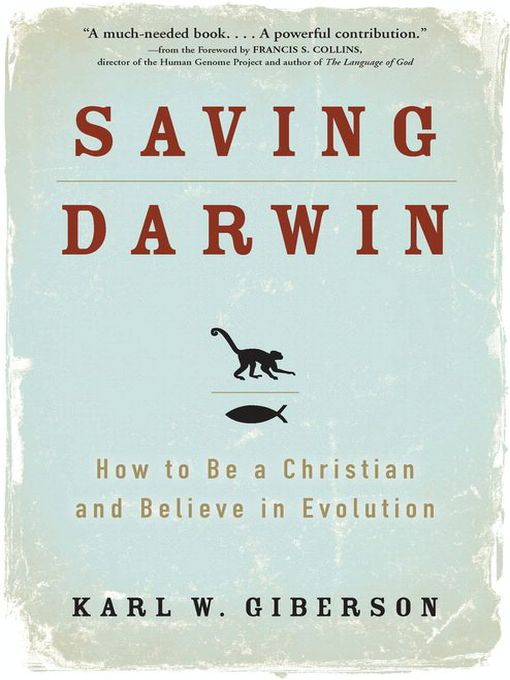
BOOK RECOMMENDATION: Saving Darwin

As part of my ongoing interest in the cultural conflict between science and religion, particularly evangelicalism, I have been reading Karl Giberson's book, Saving Darwin: How to Be a Christian and Believe in Evolution.

Giberson is professor of physics at Eastern Nazarene College, director of the Forum on Faith and Science at Gordon College, and Co-Director of the Venice Summer School on Science and Religion. His unique contribution to the literature is to provide an enlightening historical overview of the cultural conflict in the U.S., while at the same time presenting scientific evidence for evolution in a clear manner from a Christian perspective.

The burden of his book is captured in this quote, with which I wholeheartedly agree...
Places exist on which believers can stand, however, in the midst of the controversy. We don't know near enough about evolution to infer from it that God is not the creator. And we don't know anywhere near enough about God to dismiss the idea that evolution might be a part of God's creative processes. If we can embrace a bit of humility and avoid the temptation to enlarge either evolution or biblical literalism into an entire worldview, we can dismiss this controversy as the irrelevant shouting match that it is. (p. 18)
Giberson's book by itself does not offer a complete case that will satisfy most evangelicals, for it is not his task to examine the Biblical creation texts themselves and deal with the interpretive issues they raise. However, as an evangelical Christian, he does offer this sage advice with regard to our approach to the Bible:
Ambiguities about evolution coexisted with ambiguities about biblical interpretation. For evolution to conflict with the Bible, these ambiguities would have to resolve in a specific way that was genuinely incompatible. We can certainly select a biblical interpretation that will conflict with a particular explanation for evolution. But why would we want to do that? Absent a revelation from God commanding such a cantankerous move, there is simply no reason to do this. Blessed are the peacemakers, said Jesus, not those who go around manufacturing controversy. (p. 58, emphasis mine).
Most helpful to me was the historical overview Giberson gives, with surprising insights about some of the sources of creationist teachings and perspectives. I read The Genesis Flood in Bible College in the 70's when its concepts of flood geology and creationist logic were basic fundamentalist doctrine. However, I was never taught that these teachings originated from the dreams and visions of Ellen G. White, the founder of Adventism, who those same folks considered to be a false prophet.

Giberson also makes the obvious but overlooked point that, in America, this conflict is not really a fight between science and religion, even though the evangelists on each extreme would have us view it that way. To his credit, Giberson attacks the immoderate "religious" agenda of those who are using evolution as a way of promoting materialism with as much vigor as he critiques the persistent creationists.
The creation-evolution controversy is only, in the most trivial sense, a scientific dispute. It is, instead, a culture war, fought with culture-war weapons by culture warriors. Facts are almost irrelevant. Truth is valued when it serves a purpose and not for its own sake. Name-calling, caricature, cover-up, and hyperbole dominate. Compromise is out of the question.... (p. 166)
Thanks to Karl Giberson for providing at least a partial antidote to the unhealthy atmosphere created by this conflict.

WEEKEND IN MECCA...

We traveled to Chicago this weekend to visit colleges for my son, and had the opportunity to make pilgrimage to two icons of evangelicalism, Willow Creek Community Church and Wheaton Bible Church.

WILLOW CREEK
On Saturday evening we went to Willow and heard a practical, challenging message about finances from guest speaker Dave Ramsey. I had not been there for many years, and was thoroughly impressed (duh!) with their latest state-of-the-art facilities, production values and presentation. The service was simple but creative, with ample use of music and multimedia to communicate the message that God will take care of his people in hard times.

[Editorial comment:] Actually, it was kind of hard to imagine "hard times" in that setting, but I know that people from the wealthiest to the poorest are affected by the current economic crisis, so it would be silly for me to be critical.

During the service, I witnessed one of the more gracious acts of worship I've seen. An older man a few rows ahead of us put his hands over his ears and grimaced through the loud, intense parts of the music. Nevertheless, he stayed and participated fully in a service that I'm sure did not agree with his ideal style-preferences. I think it was C.S. Lewis who said that one sign of grace in a person's life is the ability to worship when singing a hymn he does not like. This gentleman was a contemporary parable to me of that thought.

Dave Ramsey's message was enthusiastic, funny, direct, and at times manic. He is an excellent communicator, and his instruction was solidly based on wisdom teaching from Proverbs. I especially appreciated the distinction he made between "sinful" and "foolish" behavior in Biblical ethics. We were helped by his firm no-nonsense exhortations.

Bill Hybels concluded the service with one of his trademark appeals for folks to make a heartfelt decision to go God's way.

WHEATON BIBLE CHURCH
In the morning we joined Gail's sister for Sunday worship. She attends Wheaton Bible Church, which meets at a new, impressive campus also. The building's appearance is more "church-like" but the ambience inside was pretty much the same as Willow Creek—contemporary, slick, pragmatic.

We went to the earliest service, which is more traditional in style. A lot more suits and ties. A significant number of older people made up the majority of the congregation. Music was mostly hymns, accompanied by organ, piano, orchestra and choir, and directed by a song leader. There was a pastoral prayer, communion, a two-person dramatic skit to introduce the message, and an expository sermon on 1Peter 1.1-2. They used multmedia effectively and with relative unobtrusiveness in a way that (IMHO) enhanced the service rather than being distracting.

As at WC, the emphasis of the service was also on the hard times we are facing, and what a godly response to that entails. Sr. Pastor Rob Bugh's sermon was less "practical" and more theologically-oriented, taken right out of the text itself. He explained how Peter greeted the scattered, suffering exiles in ancient Asia Minor by emphasizing, not their troubles, but God's gracious, eternal salvation plan for their lives. He ended with a moving letter from a congregation member who is truly facing hard times—he's dying with ALS—and how God has used him to advance the gospel in his neighborhood and family in spite of his situation. It was a fine example of solid expositional teaching/preaching.


These two huge evangelical churches represent the "best of the best" of what evangelicalism is all about. There is so much to appreciate in what we experienced this weekend. At the heart of it all is a firm commitment to Scripture joined to a fervent passion for mission and reaching people with the Gospel message. These churches stand at the pinnacle of the evangelical revivalist tradition, and they do much good in the world for God's glory.


From my perspective, they also display the weaknesses of evangelicalism in large format. However, this is not the time to talk about that. We are simply thankful for the experience of being with some of God's people this weekend.

Sunday, February 22, 2009

AN EVANGELICAL'S LAMENT AND JOURNEY: The Missional Issue, part one

The Good Samaritan
Rembrandt (1650-55)


I will introduce the third and final subject of our journey from evangelicalism to mainline Christianity with a story...

WHO IS MY NEIGHBOR?
Lee was a writer and photographer, the kind of person who drew strength and energy from being alone and working on her arts. She and Frank had been married twenty-four years; it was a second marriage for both of them, each having divorced from unhappy first unions. Neither had brought children to the marriage and, after a few tearful arguments early in their life together, the subject of having children with one another never came up again.

Frank worked hard, long hours, and provided well for them, freeing Lee to pursue her artistic interests. Then, unexpectedly, a few years before retirement, he was diagnosed with cancer and almost before you knew it, Frank was bed bound and his free-spirited wife lost her liberty. She attended to his needs night and day, feeding him, helping him to the toilet, passing his medicines, and getting him up in the recliner where he watched TV, increasingly distant and dependent. At first she got out for an hour or two here and there, but Lee could see that those opportunities were diminishing; she became more and more afraid to leave Frank alone for fear he would awaken confused and fall out of bed.

And so Lee became despondent. Frank’s constant demands kept her from pursuing the solitude and creative work she needed to refuel her spirit. They had no family to help them, and couldn’t really afford paid caregivers. Lee discovered she had few human supports on which to lean, and she felt alone, helpless and hopeless.

But a new sense of spiritual hunger also grew in Lee. She began reading the Bible and thinking about church. “Maybe a church family would provide some help with Frank,” she thought. She remembered that there was a new, large congregation a few blocks away, on the edge of her neighborhood. You could almost see it from her house. She decided to phone.

“Jericho Community Church,” the receptionist answered. “How may I direct your call?”

“I’m not sure who to talk to,” said Lee. “I live in the neighborhood and I’m wondering if you have anyone who could help me by coming to my house for a few hours to sit with my husband who has cancer.”

The receptionist transferred her to the Outreach Office. “Are you a member of our church?” the woman there asked her. When Lee said no, she offered to send an evangelistic team over to the house to talk with her and Frank. “But that’s not really what I’m interested in,” Lee protested. “Right now, I’m kind of homebound because of my husband’s illness. I hope to visit your church soon, but what I really need at the moment is a volunteer who can help me by coming to sit with my husband for an hour or two a week. Can you help?”

Again she was put on hold and transferred, this time to the Small Groups Office. “Are you in one of our Care Groups?” she was asked. “We care for our members through a network of small home groups. If you come to church this Sunday, we could hook you up with one of our Care Group leaders and maybe you could find a group to be part of.” And once more Lee tried in vain to communicate her need. She finally hung up the phone with a sigh.

She moved to the front window and looked out, wondering where to turn next. As she watched, two men crossed the street and walked down the sidewalk opposite her house. For a moment, they glanced up and saw her lonely figure through the darkened glass. Then, redirecting their eyes, they walked on. Lee watched until they reached the end of her street, and turned to walk south, to the church at the edge of her neighborhood.