Showing posts with label Monday Musings. Show all posts

Monday, November 17, 2008

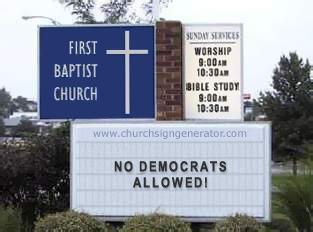
MONDAY MUSINGS: Who Sets the Agenda for the Church?

The sign in the picture is not real, just someone's impression of what the real message is in many churches today.

Somehow in the last twenty years, the evangelical church has often allowed those who advocate culture war politics to set the agenda for the church and Christian people. We have become known more for the political positions we take and the particular sinful practices we oppose than for the Good News we promote!
  • In many cases we have bought the questionable argument that there is only one correct "Christian" position, not only on a moral or ethical question under discussion, but also on the one right way to go about changing things. Anyone who disagrees with that position or method, or who even wants to consider other options, is automatically considered suspect.
  • Furthermore, and even more dangerous, is the fact that we have been drawn into the political arena and have accepted the premise that this is the arena in which we fight our most important battles.
  • Finally, we have accepted the "culture warrior" definition of ourselves, which makes it impossible to treat those with other political views as anything other than "enemies" in the struggle.
In short, we have allowed the world system, the media, and those who have anointed themselves war strategists and generals in the culture war to set our agenda for us. Why don't we believe the Bible? Why do we get sucked in like this? Why don't we allow words like these, from Paul, to protect us from being drawn into the world's agenda?

Indeed, we live as human beings, but we do not wage
war according to human standards... (2Cor 10.3)

In this light, Scot McKnight has posted a remarkable letter on the Jesus Creed blog today. It is from a conservative pastor who struggled with the issues during this past election and ultimately voted for Barack Obama. In the process he shared his struggles and decision with a few close friends. It became known, as things tend to get known within church families, and now he is facing severe criticism, people leaving the church, folks saying he is not qualified to be a pastor, etc. I encourage everyone who reads this to go to Scot's blog, meditate on this letter, and give a comment.

Monday, November 10, 2008

MONDAY MUSINGS: Making Giving Easier

As a pastor, I always found it difficult to communicate about money matters with my congregations. For one thing, I am not gifted with any degree of financial acumen, nor am I particularly interested in the business aspects of the church. Of course, I recognized and taught stewardship principles from the Bible, but my teaching, I'm sure, communicated much more theory than practical counsel.

That is why I was so impressed with the insert in our church bulletin yesterday and the brief presentation made during announcements after the service. Our congregation celebrates the final Sunday of the church year, Christ the King Sunday, with an emphasis on consecration and stewardship. By way of practical application, on this day we designate our financial pledges for the next year.

We are preparing for that day now, and therefore the insert and presentation on Sunday.
  • On one side of the insert was, "A revealing breakdown of our congregation's giving patterns." A set of ten steps was pictured, signifying levels of weekly pledged amounts from $0.00 per week to $100.01 plus per week. As the leader instructed us, we wrote down how many member families were giving at each level. This gave us a clear picture in one snapshot of where the whole church is with regard to stewardship.
  • On the other side was a table. The far left column listed weekly income amounts from $200 to $3,000. The rest of the columns showed how much it would be to give 15%, 12%, 10%, and so on down to 1% of one's weekly income. Find your income, go across to the percentage you would like to give, and you get the amount. So, for example, if your weekly income was $1,000 and you wanted to give 12%, you go to that box and see that your weekly giving would be $120.
The challenge was for each of us to grow in our giving 1% for the year to come.

Simple. Practical. Understandable. Effective.

Monday, November 3, 2008

MONDAY MUSINGS: The Church and Politics

On election eve, some wise thoughts from Greg Boyd.

No matter what happens in tomorrow's election, God will remain in control and the church will still be called to be Body of Christ in this world. Some may lure us into thinking that the political process is the only effective way to get things done, and those in positions of power may get the most press for their decisions, but the world will only truly be changed when ordinary people of faith begin getting involved in the world as Jesus did, laying down their lives day after day to benefit others.

By the way, if someone thinks I am picking on the "Christian Right" here, the article from which these thoughts are taken is an extended criticism of the "Christian Left." Both are misguided when they buy into the notion that exercising power over others and passing laws to enforce desirable behavior is what God's people are to be pursuing as their primary agenda. Jesus' words could not be plainer:

"You know that those who are recognized as rulers of the Gentiles lord it over them; and their great men exercise authority over them. But it is not this way among you, but whoever wishes to become great among you shall be your servant; and whoever wishes to be first among you shall be slave of all. For even the Son of Man did not come to be served, but to serve, and to give His life a ransom for many."
(Mark 10.42-45)

It is in the context of this radical approach to changing the world that Pastor Boyd writes:

The church should provide leadership to the world by our spiritual and moral example of how we live together and serve the world, not by our self-designated superior wisdom on how to fix society by political means. Swearing allegiance to Christ doesn’t mean we know more than others. It just means we are willing to sacrifice more than others. Swearing allegiance to Christ thus doesn’t mean one has more wisdom on domestic or international social issues. It just means one is willing to bleed more to bring God’s love to domestic and international social issues.

This willingness to suffer gives the Church a unique and powerful authority to address issues and transform the world. But it does so only if the Church in fact is willing to sacrifice more than others. If the Church would model the beautiful life as a community and in our Christ-like service to the world, we would win authority to speak into domestic and international issues. But when we focus on how we should speak into domestic and international issues before we ourselves model the beautiful life, we have no more authority than anyone else. Like everyone else, we have only our opinion to offer.

Trying to get the Church to participate in the political process the “right” way is like trying to motivate a secular person to pray the “right” way. So it is, for example, that we have the “Christian Right” trying to get Christians to vote to “save the family” by outlawing gay marriage while Christians happen to have a higher divorce rate than the national average. And the “Christian Left” is trying to get Christians to vote to end poverty while the vast majority of churches in America don’t have any of their day-to-day budget or activity allocated to helping alleviate poverty. What Jesus said of individuals applies to the Church as a whole: first take the plank out of your own eye before you look for a dust particle in your neighbor’s eye (Mt. 7.1-3).

Our singular focus ought to be on the church simply being the church, manifesting the beautiful life of the Kingdom. And we ought to do this not as a practical step toward gaining some of Caesar’s power – as though this was our ultimate goal — but because this is simply what it means to faithfully follow Jesus.

Monday, October 27, 2008

MONDAY MUSINGS: Reformation Day Thoughts

Yesterday, in the Lutheran church we attend, the congregation celebrated Reformation Sunday. With one strong voice we sang:
Did we in our own strength confide
Our striving would be losing

Were not the right Man on our side

The Man of God's own choosing

Dost ask who that may be?

Christ Jesus, it is He!

Lord Sabaoth His name

From age to age the same

And He must win the battle!


(Martin Luther, "A Mighty Fortress")
This matchless hymn, and a song the choir sang, "God Is Our Refuge and Strength," are both based on Psalm 46, which begins,
"God is our refuge and strength,
A very present help in trouble.
Therefore, we will not fear, though the earth should change
And though the mountains slip into the heart of the sea..."
Therefore, we will not fear. These words express the strong sense of confidence and assurance by which believers face the troubles and upheavals of the world around us. It is a given that such convulsions and even cataclysms will occur in this fallen world. However, the believer has a refuge. The believer has a God with him who presses strength into the depths of his being. The believer has an Advocate who is present and active to help in time of trouble. Therefore, we will not fear.

How disturbing it was then to hear about the most recent appeal to fear published by Focus on the Family Action. It is called, "Letter from 2012 in Obama's America," and it paints a frightening apocalyptic scenario that the organization says will likely occur should Barack Obama be elected president in the upcoming election—everything from terrorist attacks to the end of homeschooling to energy blackouts and rampant inner city crime because of gun restrictions. For a Christian organization to distribute fear-mongering propaganda like this is utterly counter to the great message of Reformation faith.

Please don't interpret these musings as support for Barack Obama. That is not my point. As a Christ-follower and pastor, I just cannot understand when professing Christian people completely jettison Biblical perspective in order to achieve political gain. The sole purpose of this letter is to scare good people silly so that they will vote for the candidate Focus on the Family Action believes is best for America. That is not acceptable behavior for people of faith.

Should we rewrite the words of Luther's great hymn and make them, "A mighty fortress is McCain"? Is he the real "right Man on our side"? Where is our trust? Do we really believe that one election that doesn't go our way can overturn the sovereign purposes of almighty God? Will the sky really fall? Where is the Biblical perspective? Where is the confident assurance that, no matter what happens, our God reigns and his purposes will be accomplished? From the strong foundation of faith, why can't we participate positively in the political process, giving hearty, confident affirmation to the candidates and positions we approve of, while maintaining a spirit of civility and respect toward those with whom we disagree? Are Christians really called to play "hardball" like this?

Such tactics betray the feebleness and wrong-headed nature of so much conservative evangelical American Christianity. The "culture war" mentality of fear and fear-mongering does not represent the Biblical perspective that says, "Therefore, we will not fear." I wish Focus on the Family Action would hear what God says to the world in Psalm 46.10—"Be still, and know that I am God." This command is not the soothing devotional invitation that many imagine. The real point of God's words here are more like—"Hey, you people that are stirring up so much trouble in my world, shut up and sit down and remember who is in charge around here!" We could use a whole lot more Reformation Day thinking and acting in this election season.
God gave us a spirit not of fear but of power and love and self-control. (2Timothy 1.7)

Monday, October 20, 2008

MONDAY MUSINGS: Politics week on otium sanctum

I am just about the most non-political person I know. I avoid talking about the subject because whenever I do, I get in way over my head and that always leads to trouble. I don’t think in political terms, I detest what it often takes to be successful in politics, and I fear the temptations that politics bring to those that choose to participate. If you were to ask me where I stand on the political spectrum, I would have to say that my positions at times reflect a libertarian streak, sometimes I’m more conservative than a far right Republican, at other times I’m more liberal than a far left Democrat, and then often I hold non-participatory convictions reflecting the Anabaptist tradition. No party would have me, and to be honest, I probably wouldn't have them either.

With that out of the way, this is an important realm of life and Christ-followers cannot simply stick their heads in the sand. It's election season in the USA and so I will devote my blog this week to the subject of politics, particularly the Presidential race.

For your own musing today, I will direct you to the websites of two political action committees that recommend voting for a certain candidate based on their own evangelical Christian convictions.
  • Evangelicals for McCain. This PAC touts McCain's "common sense conservatism" and lists where McCain stands on such issues as the Ten Commandments, sanctity of life, fiscal responsibility in Washington, the Middle East, border security, and enviro-stewardship. Here you can find videos of McCain interviews on Christian networks like TBN.
  • Matthew 25 Network. Taking their name from the parable of the sheep and goats in Matthew 25, this PAC endorses Obama. Their mission is to endorse candidates that they think embody the values expressed in that parable: promoting life with dignity, caring for the least of these, strengthening and supporting families, stewardship of God’s Creation, working for peace and justice at home and abroad, and promoting the common good.
From what I can ascertain, both of these web sites offer good information and a positive spirit of advocacy for their candidates without veering into the excesses of negative, attack campaigning.

Think on these things.

Monday, October 13, 2008

MONDAY MUSINGS: Blue Parakeet, part 5

FROM MIKE: Check out this post at Jesus Creed about the release of The Blue Parakeet.

This will be my final post on the book, and then I will put a review on Amazon.com. This book will be highly recommended.


The final part of Scot McKnight's helpful new book is a case study about the subject of women in ministry. Entire denominations have dealt with this contentious issue by appealing to the Bible. While Scot does not claim to give an exhaustive study of the matter in this book, he does outline an approach to reading the Bible that can help us approach controversial questions like this.

First, he gives personal background and stories to show how the issue of women in ministry has been a matter of disagreement in evangelical circles. He also sketches the main positions people have taken. These stances boil down to whether we are reading the Bible through the tradition (various forms of patriarchalism) or with the tradition (mutuality or evangelical egalitarianism). He advises the latter as the way that best understands this issue in the light of the whole Biblical story.
It knows the story of the Bible in which Jesus Christ makes men and women one again, in Christ and in marriage. And, in conscious dependence on the Spirit in the context of a community of faith that seeks to live out that oneness, it gives to women the freedom to discern what God has called them to do—whatever it might be, including preaching, teaching, and leading in the church. (p.161)
Secondly, in order to flesh this out, Scot looks at the Biblical material itself and discusses stories and texts concerning women in both Testaments, looking most intently at those passages that restrict women from exercising ministry in the church (1Cor 14, 1Tim 2, etc.). I think he argues convincingly that these restrictive passages must be read both in light of the whole story and in the closer contexts of the epistles in which they are found, and that when we do that, it becomes clear that Paul's restrictions in particular were based on situations in the early church that made limiting women's public ministries advisable.

He concludes:
...we are given a pattern of discernment in the Bible, a pattern that flows directly out of the Story, to listen to what God said in that world so we can know what God is saying to us through our world. (p.212)

Monday, October 6, 2008

MONDAY MUSINGS: Part Two

Too many musings to limit myself to one post today. Check out:
  • Stephen Mansfield in USAToday on "The New Evangelicals." One observation regarding their political loyalties: "The new evangelical prays for all four nominees but commits unreservedly to none, choosing rather to speak of righteousness to each in the hopes of something more than a mere political victory in November."
  • Evangelicalism is overvalued because its politically useful. (If I read another email telling me Sarah Palin is Esther I’m going to put a drumstick through my eye.)
  • Evangelicalism is overvalued because it has too much music and too little Bible.
  • Evangelicalism is overvalued because it constantly claims evidence that God is working through it to change the world, but the evidence in those places dominated by evangelicalism isn’t very convincing.

MONDAY MUSINGS: Blue Parakeet, part 4

Part Two: Listening
Many years ago, in his book Knowing God, J.I. Packer made an invaluable contribution to the church when he reminded us that there is a great difference between knowing about God, and knowing God. The Blue Parakeet takes up this theme in its second part, on "Listening."

Having helped us understand the Big Story by which we must read all the "wiki-stories" of the Bible, Scot McKnight next encourages us to remember another foundational principle. The Bible is God's story, God's book, and our aim in reading it is to listen to the one speaking to us so that we may deepen our relationship with him. He calls this "The Relational Approach to the Bible."

Reading the Bible is part of a personal conversation with God. It also involves us in the ongoing community conversation that God has had with his people over the centuries. We read with the tradition of those who have known God before us, both within the Scriptures themselves and in the subsequent history of God's people. Our goal is not simply to submit to the Bible's authority and obey, though that is clear. Preeminently in this relationship we learn to love. We delight in God's words and treasure them in our hearts. We stand in awe of his wisdom. We welcome his communication as truth, not so much as an intellectual category, but in the recognition that his words reveal reality and integrity and wholeness to us. They promote "shalom." They lead us to love God and others.

Part Three: Discerning
When you read a chapter like Leviticus 19, what do you do? Scot gives a quiz at the beginning of part three of his book, asking which of the commands in Lev 19 we think we should keep, and which we may ignore. It's a great test, because right in the midst of prohibitions against wearing garments made of mixed materials, etc., we are called to "be holy," and to "love your neighbor as yourself." And ALL are backed up, not by cultural reasoning, but by the words, "I am the LORD your God."

How do we know what to apply to our lives from the Bible? Well, one thing is clear—Bible readers, including you and me, have always picked and chosen which instructions we think we should follow from the Scriptures, and we have developed patterns of discernment that guide us in working this out.

What principles do we use to adopt and adapt the Bible? Given that the Bible is not simply a rule book that straightens out all our messy situations and questions, how do we discern? Scot sets forth specific issues raised by the Scriptures, including divorce and remarriage, circumcision, women's dress, cosmology, the death penalty, speaking in tongues, and being all things to all people for the gospel's sake. He does this mainly to prompt us to think about what it means when we say we approach these kinds of matters Biblically. The main test case is raised in the subsequent chapters—the ministry of women in the church—which I will talk about in future posts.

One of the main contributions of The Blue Parakeet is its call for us to own up to our selectivity. No matter how much we may proclaim "the authority of the Bible," or "the sufficiency of Scripture," most of us tend to ignore the processes by which we read and understand and apply its teachings. But the "how" question is so important!

Also, our arrogance in assuming that we know what we're doing when we approach God's words is astounding. I am thoroughly embarrassed by so many of the papers I wrote in Bible college and the "truths" I preached in my early ministry. I also remember reading early evangelistic sermons by one who has been acclaimed as one of the greatest preachers in the 20th century. In one of those messages, his great example of the sinfulness and need for revival among his people was that some of them had started taking daily baths!

Examples could be multiplied, ad finitum, ad absurdum. Thanks to Scot McKnight for calling us to think about these things at a fundamental level.
Tuesday, September 30, 2008

MONDAY MUSINGS: Blue Parakeet, part three

The Bible is not so much a book we read as it is a world into which we enter.

This is how I would summarize Scot McKnight's big point as he encourages us to read the Bible as story. Instead, we are trained to read it in other ways...
  • As a collection of laws
  • As a collection of blessings and promises
  • As an inkblot, projecting onto the Bible what the reader wants to see
  • As a puzzle that, once put together, reveals a system mapping God's mind
  • As accepting one part of Scripture like a maestro, one teaching voice that explains all the rest of the Bible
All of these approaches are "shortcuts" that keep us from entering the world of the Bible fully so that it can do its work in our lives.

Instead, we first need to grasp the big picture or the "Big Story" of the Bible. Then, we need to recognize that all the various "stories" in the Bible contribute to its Big Story. Scot McKnight calls these "wiki-stories," a reference to Wikipedia, the ever-evolving open source web encyclopedia. The Bible tells the Big Story, and to do so it is made up of many wiki-stories. God spoke to Moses in Moses' day in Moses' way, to Paul in Paul's day in Paul's way, and so on throughout the historical time-frame in which Scripture was written, and yet these individual parts, diverse as they may be, are each a true reflection of the Big Story, and all are held together by the Big Story.

To show us how the Bible works, McKnight outlines the plot of The Big Story. It is about:
  • God creating Eikons to live in oneness
  • The Eikons becoming cracked
  • God forming a covenant community to restore cracked Eikons (which fails)
  • God sending Jesus as the Perfect Eikon, who redeems cracked Eikons
  • God consummating redemption and restoring perfect oneness
This is the plot of the Big Story, and we read every wiki-story in its light. In subsequent chapters, McKnight will take one issue—the ministry of women in the church—and show how reading the Bible in the light of its Big Story can help us apply its teachings in our lives today.

Sunday, September 21, 2008

MONDAY MUSINGS: The Blue Parakeet, part 2

I have been granted the privilege of being an advance reader for Scot McKnight's, THE BLUE PARAKEET: Rethinking How You Read the Bible (Zondervan, pub. date 11/1/2008). Our "Monday Musings" for the next several weeks will focus on understanding and responding to Scot's book...

In seminary, I came across Mortimer Adler and Charles van Doren's book, How to Read a Book. How I wish I had read this much earlier! And how it changed my understanding of how to read the Bible! I have had other epiphanies like this over the years involving the "how" of studying Scripture. Because these experiences have been so important to me, one of my emphases in teaching is always to help people understand how to read the Bible as much as to teach them what it says.

I am having one of those profitable experiences right now, as I read Scot McKnight's upcoming book. In chapter two, he sets forth three ways that he has observed people reading the Bible.
  • There are those who read to retrieve. The Bible is read to retrieve the practices described therein, and then re-create them in our own lives. The problem with this, of course, is that we can never live first-century lives in the twenty-first century. A better way is to engage in the ongoing adoption of the past, adapting it to new conditions in a way that is faithful to the Bible.
  • There are those who read through tradition. Who decides what we should adopt and what we should adapt? Who decides what is faithfulness to Scripture? Some believe we can only do this if we read the Bible with the safeguard of an authoritative tradition that locks down our interpretations. Scot identifies the danger of this approach—traditionalism. Many of our ancestors were adapting the teachings of the Bible to their own day, and we can no more continue to live in that era than we can in Biblical times. However, we can read in the context of the Great Tradition— reading for ourselves but in a way that is responsible to what the church has always believed. And therefore, he commends the third way:
  • There are those who read with tradition. This comes close to the great principle of Reformation Protestantism: reformed and always reforming. We appreciate and respect the wisdom of those who have studied the Scriptures before us. At times we disagree with their interpretations and seek to reform the practices that grew out of them. We also recognize that God is still on the move today, the Spirit is still speaking to the churches, the Word of God is still living and active. In our culture, in our day, facing the issues that challenge us, the Bible will come to life for us and guide us in a plain path.
After these general observations and admonitions, Scot McKnight challenges us specifically to read the Bible as story, to learn to listen, and to develop discernment. Next time we'll examine what it means to read the Bible as story, and some of the less helpful habits many of us maintain in approaching the Scriptures.

Sunday, September 14, 2008

MONDAY MUSINGS: The Blue Parakeet, part one

I have been granted the privilege of being an advance reader for Scot McKnight's, THE BLUE PARAKEET: Rethinking How You Read the Bible (Zondervan, pub. date 11/1/2008). Our "Monday Musings" for the next several weeks will focus on understanding and responding to Scot's book...

In my last pastorate, I coined a slogan from a verse in Deuteronomy to help our church understand how to follow Christ. I called it, "Learning, Loving and Living the Bible." Now, we Bible-believing Christians think we know what that means, but Scot McKnight's new book says pointedly that our claims of understanding and practicing the Bible are often hogwash— that we all pick and choose what we emphasize and practice when it comes to living out the Bible's teachings.

For example, the clear commands of James 1.26-17, by which the Bible defines "true religion," are words that somehow, many of us avoid as our definition of genuine Christian discipleship. Other examples include how we deal with Biblical teachings about the Sabbath, tithing, footwashing, charismatic gifts, and Jesus' calls to surrender our possessions. In addition, a whole range of contemporary issues challenge Bible believers to apply its teachings in arenas far removed from historical contexts that the Biblical writers addressed.

McKnight's big question, then, is "How?"—"How are we to live out the Bible today?"

The book's title was taken from an experience of birdwatching. Someone's pet blue parakeet fluttered into the author's backyard and took its place at the feeders, forcing the resident sparrows to take notice and adapt. For Scot McKnight, "blue parakeets" are Biblical passages that make its readers stop and think. They get our attention. We do not know what to make of them right away and so, they give us opportunity to pause, observe, and reflect. However, they remain frustratingly beyond our ability to tame them. How we approach these "blue parakeet" passages reveals a great deal about how you and I read our Bibles and attempt to live out its teachings.

The emphasis of this book is much needed today. Exploring our unexamined assumptions is always healthy, and never more so than when we are trying to discern what God has said to us and how we should respond. Furthermore, in today's world, where Evangelicalism regularly devolves into triumphalistic certainty about matters theological, moral and political, we must never be afraid to peek behind the curtain to determine the actual machinery behind the great and terrible Oz.

Monday, September 8, 2008

MONDAY MUSINGS: Why One Person Left Church

Thanks again to the Internet Monk for introducing me to a fellow traveler in the "post-evangelical wilderness." Her name is Julie Neidlinger, and she blogs at loneprairie.net.

Awhile back she wrote a post called, "Why I Walked Out of Church," which has apparently created quite a stir. In it she writes...
I believe what I believe -- my Christian faith -- not because of tradition or because I was raised that way. Not because I want fire insurance or hell-avoidance. Not because I want to find a group or place to belong. I believe it on my own, I believe it to be real, I believe it to be important and valid, and I believe the way we have made Christianity out to be is completely wrong. And that's why I have such a hard time going to church as it is now done.
Inspired by her rage at reading a story on "NextGen Worship," Julie both rants and reflects on why so much of contemporary Christian practice, with its emphasis on "relevance," its "perpetual youth group culture," its segregation of ages and its "focus on the family," along with the attendant patronization of singles, is a huge turn-off for a growing number of thoughtful people.

I encourage you to read it, mull it over and see if you agree. If you feel like commenting, I'd love to hear what you think.