Showing posts with label Science and the Bible. Show all posts

Tuesday, May 26, 2009

EVERYONE MUST ACCOMMODATE

Excellent post by Karl Giberson at Science & Sacred, the blog of BioLogos, called "God and Matter." He answers U of Chicago biologist Jerry Coyne's contention that combining faith in God with scientific understanding results in a "hilarious goldmine of accommodationism."

Giberson makes the point that we ALL must make accommodations as we try to understand life and the universe.
But what about the accommodationism of materialists? How do they reconcile their materialism with the rationality of the world? It seems to me reality has to be grounded in one of two deeply mysterious foundations: God or matter. Each has its own set of questions. Theists wonder about the nature of God's existence, the problem of evil, how and why God acts in the world and why God has chosen to remain hidden from us. These are difficult questions and certainly must trouble thoughtful believers. But don't materialists have another set of mysteries? Don't they have to wonder about the nature of physical existence? Why is there something rather than nothing? Why are the laws of nature so rational? Why is our species so religious? Is the world just a big pointless accident?
Don't let the materialistic worldview back you into a corner and make you think theists are the only ones who must face troublesome intellectual problems. "Material alone plus time plus chance" has plenty of its own. In my view, even more troublesome.

Thursday, April 30, 2009

HIGHLY RECOMMENDED: BioLogos

I am not an expert in any of the sciences, but I have been interested in the culture war that has been a staple of American society between Biblical Christianity and evolution. I was schooled to be a young-earth creationist, intellectually breastfed on books like The Genesis Flood. I never thought too deeply about the issues, and mostly stayed away from the fray when I was a pastor. It was only when I began studying Genesis seriously that my views began to emerge.

This is not the normal path that those who come to question creationism take. The stereotypical student who comes to reject the fundamentalist view becomes a questioner through considering scientific evidence. However, my doubts were born from studying Scripture! Genesis is so much richer and deeper than the bare literalist explanation. The creation narratives also fit within a larger work, the Torah, an interpretive context that most fundamentalists fail to consider adequately.

Now, esteemed scientist and believer Francis Collins has established a foundation with an excellent website that attempts to provide an alternative to the culture war approach of both atheistic and Christian fundamentalists. It's called BioLogos, and here is its mission...
The BioLogos Foundation promotes the search for truth in both the natural and spiritual realms, and seeks to harmonize these different perspectives.
It is a well-designed and well-written site that seeks to answer many of the questions that arise when one tries to take both the Bible and science seriously.

You can also check out the blog that complements the site at Science and the Sacred.

Highly recommended, even if you don't agree. BioLogos is a fine example of thoughtful, careful, and irenic scholarship.

Sunday, March 1, 2009

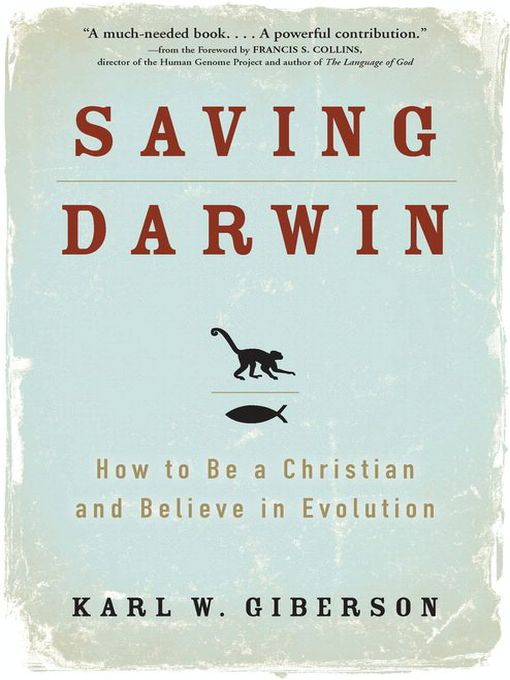
BOOK RECOMMENDATION: Saving Darwin

As part of my ongoing interest in the cultural conflict between science and religion, particularly evangelicalism, I have been reading Karl Giberson's book, Saving Darwin: How to Be a Christian and Believe in Evolution.

Giberson is professor of physics at Eastern Nazarene College, director of the Forum on Faith and Science at Gordon College, and Co-Director of the Venice Summer School on Science and Religion. His unique contribution to the literature is to provide an enlightening historical overview of the cultural conflict in the U.S., while at the same time presenting scientific evidence for evolution in a clear manner from a Christian perspective.

The burden of his book is captured in this quote, with which I wholeheartedly agree...
Places exist on which believers can stand, however, in the midst of the controversy. We don't know near enough about evolution to infer from it that God is not the creator. And we don't know anywhere near enough about God to dismiss the idea that evolution might be a part of God's creative processes. If we can embrace a bit of humility and avoid the temptation to enlarge either evolution or biblical literalism into an entire worldview, we can dismiss this controversy as the irrelevant shouting match that it is. (p. 18)
Giberson's book by itself does not offer a complete case that will satisfy most evangelicals, for it is not his task to examine the Biblical creation texts themselves and deal with the interpretive issues they raise. However, as an evangelical Christian, he does offer this sage advice with regard to our approach to the Bible:
Ambiguities about evolution coexisted with ambiguities about biblical interpretation. For evolution to conflict with the Bible, these ambiguities would have to resolve in a specific way that was genuinely incompatible. We can certainly select a biblical interpretation that will conflict with a particular explanation for evolution. But why would we want to do that? Absent a revelation from God commanding such a cantankerous move, there is simply no reason to do this. Blessed are the peacemakers, said Jesus, not those who go around manufacturing controversy. (p. 58, emphasis mine).
Most helpful to me was the historical overview Giberson gives, with surprising insights about some of the sources of creationist teachings and perspectives. I read The Genesis Flood in Bible College in the 70's when its concepts of flood geology and creationist logic were basic fundamentalist doctrine. However, I was never taught that these teachings originated from the dreams and visions of Ellen G. White, the founder of Adventism, who those same folks considered to be a false prophet.

Giberson also makes the obvious but overlooked point that, in America, this conflict is not really a fight between science and religion, even though the evangelists on each extreme would have us view it that way. To his credit, Giberson attacks the immoderate "religious" agenda of those who are using evolution as a way of promoting materialism with as much vigor as he critiques the persistent creationists.
The creation-evolution controversy is only, in the most trivial sense, a scientific dispute. It is, instead, a culture war, fought with culture-war weapons by culture warriors. Facts are almost irrelevant. Truth is valued when it serves a purpose and not for its own sake. Name-calling, caricature, cover-up, and hyperbole dominate. Compromise is out of the question.... (p. 166)
Thanks to Karl Giberson for providing at least a partial antidote to the unhealthy atmosphere created by this conflict.

Wednesday, February 11, 2009

An Unnecessary Divide

The 200th anniversary of Darwin's birthday has raised the usual dust storms of controversy between creationists and those who are convinced that the theory of evolution best accounts for the scientific evidence about the origins and development of life.

I have no interest in entering this debate. I am a Bible-believing Christian who happens to think that most of the evangelical response to this issue has unnecessarily inflamed the culture wars and exacerbated a needless and harmful divide between the church and science.

My interest as a pastor and teacher has always been in understanding the Bible as a follower of Jesus and as one called to provide spiritual nourishment for others. To read Genesis, the relevant text in the creation debate, for ammunition in that battle, is way down my list of priorities. Furthermore, I think it is an illegitimate use of the text when we force it to speak to issues it was never meant to address.

The early chapters of Genesis should first of all be read in the context of the Torah, the five-fold book that begins the Bible.
  • The Torah's main themes are the Promised Land, God's blessing, and the seed (the chosen people of promise). These are set forth in the topic sentence of the Torah, Genesis 12.1-3.
  • Genesis 1 introduces these themes by telling how the God who made everything (Gen 1.1) prepared a good land and put his people in it to live within his blessing (Gen 1.2-2.3).
  • The larger section of which Gen 1 is a part, Genesis 1-11, is the early history of the land of promise. It shows, over and over again, how people failed to live in God's good blessings and were exiled from the land, yet always with the provision of God's salvation as well. This section ends with people moving eastward from the land and being scattered over the face of the whole earth.
  • Genesis 12-50 is the early history of the people of promise. It shows how God chose Abraham and his descendants, promised them the land and the restoration of his blessing to all nations through his seed.
The rest of the Torah, of course, continues these themes and concludes its story with the people on the verge of entering the Promised Land.

My point is that the early chapters of Genesis are about this story—about the land of promise and God's plan that people live in his blessing and experience his rest. These are the very themes that fill the rest of the Torah, the themes that Moses' audience, the first recipients of this book, needed to hear as they prepared to enter the land. That is why Moses, under the Spirit's inspiration, wrote Genesis 1 as he did.

Creationism vs. evolution? Not anywhere in sight.

Thursday, July 31, 2008

People of Faith Studying Science

Last weekend, we took our youngest son to Chicago to visit campuses to help him prepare to make a decision about college during his upcoming senior year. One issue with which Christian-based liberal arts colleges and universities must deal is how devout people approach the study of the natural sciences. Friends of ours, who are practicing scientists and people of faith, are in the college-search process too and in a recent email they lamented the poor quality and lack of emphasis on science in the Christian schools they have inquired about. This may be because Christ-followers are confused and conflicted about how to think about this subject.

While at Wheaton College in Wheaton, IL, I picked up a booklet that contains a thoughtful and well-stated summary of the foundations of their approach. You can find it online on the Wheaton College website here: Perspective on Natural Sciences.

Here are some excerpts from the statement:
In the contemporary academy, science represents a theoretical discipline that addresses natural phenomena; by its accepted standards and procedures, it does not go beyond the natural realm for explanations. The hypotheses and theories generated in scientific study are based upon empirically measured phenomena. Like all endeavors of disclosing truth, including theology, the practice of science is dynamic and the theories it generates are always in a state of self-correction as new data are evaluated. Although science uses a naturalistic methodology, the use of that methodology does not necessarily imply a metaphysical naturalism (a philosophical commitment to the idea that the material world is all there is), nor does it imply that the scientist who is a Christian believes that naturalistic factors can fully explain all phenomena.

...
At Wheaton, special emphasis is given to integration of the Christian faith with all areas of learning and applied practice. This emphasis is, in turn, rooted in our deep commitment to the complete truthfulness and authority of the Scriptures. Nevertheless, we encourage the careful examination of all worthwhile ideas in our curriculum, including those that may seem to contradict our own institutional commitments. When we confront seeming contradictions between the "findings of science" and our understanding of the teaching of Scripture, for instance, we reaffirm our belief in an inerrant Bible. However, we also humbly realize that neither our interpretations of Scripture nor the "findings of science" are without error. Hence, we carefully examine all relevant evidence to seek resolution of the seeming contradiction, but we also are willing to accept uncertainty in matters where we have insufficient certainty, either regarding the teaching of Scripture, the findings of science, or both. We approach such matters in the confidence that our God will lead us into a deeper understanding of His Truth, and that the practice of critical inquiry - grounded in trust in the truthfulness of Scripture - will prepare our students to respond wisely to the challenges they will face. In all endeavors, Wheaton College remains firmly committed to structuring its programs in service "For Christ and His Kingdom."

Aspects of our institution's confessional stance are disconcerting to many nonreligious scientists, including our confidence that Christ designed and created the physical world, that this world bears the imprint of its rational Creator, that He is the author of all life, and, especially, that He directly created the first human pair. Yet our institution's confessional stance leaves certain issues open, issues which some in the Christian community regard as properly closed. The most notable of these issues are the age of the Earth, the age of the cosmos, and the methods by which God did His work of creation. Indeed, among our faculty there are a variety of interpretations of the age of the Earth and the age of the cosmos, as well as the means used by God to create the variegated array of life on our planet. The faculty are firm in their conviction that Christ created all of humankind through the direct creation of an historical Adam and Eve. As stated earlier in this document, and of such great significance that it bears repeating here, is that we hold fast to the truth that through one man (Adam) humankind fell, and through one man (Christ) humankind is saved. While all faculty believe in the complete truthfulness and authority of Scripture, some embrace or lean toward a creationism, of the Young Earth variety, others a punctuated or progressive creationism. Nonetheless, our faculty embrace Christ's creative design and action in the created order. They strive to treat all views charitably, respectfully, and intelligently as they lead campus discussion regarding these controversial matters. We believe that we honor Christ by taking precisely this approach, and we think that this is an academically honest way to impart knowledge to our students.

Charitable. Respectful. Intelligent. Deep commitment to the truthfulness and authority of the Scriptures.

Well said.

Thursday, March 13, 2008

Augustine's Advice to Christians Who Talk about Science

St. Augustine made the following remarks in his book The Literal Meaning of Genesis. This is excellent counsel for believers in our day who try to speak about scientific issues without adequate understanding.

Usually, even a non-Christian knows something about the earth, the heavens, and the other elements of this world, about the motion and orbit of the stars and even their size and relative positions, about the predictable eclipses of the sun and moon, the cycles of the years and the seasons, about the kinds of animals, shrubs, stones, and so forth, and this knowledge he holds to as being certain from reason and experience. Now, it is a disgraceful and dangerous thing for an infidel to hear a Christian, presumably giving the meaning of Holy Scripture, talking nonsense on these topics; and we should take all means to prevent such an embarrassing situation, in which people show up vast ignorance in a Christian and laugh it to scorn. The shame is not so much that an ignorant individual is derided, but that people outside the household of faith think our sacred writers held such opinions, and, to the great loss of those for whose salvation we toil, the writers of our Scripture are criticized and rejected as unlearned men. If they find a Christian mistaken in a field which they themselves know well and hear him maintaining his foolish opinions about our books, how are they going to believe those books in matters concerning the resurrection of the dead, the hope of eternal life, and the kingdom of heaven, when they think their pages are full of falsehoods and on facts which they themselves have learnt from experience and the light of reason? Reckless and incompetent expounders of Holy Scripture bring untold trouble and sorrow on their wiser brethren when they are caught in one of their mischievous false opinions and are taken to task by those who are not bound by the authority of our sacred books. For then, to defend their utterly foolish and obviously untrue statements, they will try to call upon Holy Scripture for proof and even recite from memory many passages which they think support their position, although they understand neither what they say nor the things about which they make assertion. [1 Timothy 1.7]

Let him who has ears to hear, take heed to this wise counsel.