Saturday, December 6, 2008

The First Week of Advent: Saturday

We conclude this first week of Advent by looking at a portion of Psalm 9, which is the Vespers reading for this evening in The Divine Hours.
I will give thanks to the Lord with my whole heart;
I will tell of all your wonderful deeds.
I will be glad and exult in you;
I will sing praise to your name, O Most High.
When my enemies turned back,
they stumbled and perished before you.
For you have maintained my just cause;
you have sat on the throne giving righteous judgement.
You have rebuked the nations, you have destroyed the wicked;
you have blotted out their name for ever and ever.
The enemies have vanished in everlasting ruins;
their cities you have rooted out;
the very memory of them has perished.
But the Lord sits enthroned for ever,
he has established his throne for judgement.
He judges the world with righteousness;
he judges the peoples with equity.
The Lord is a stronghold for the oppressed,
a stronghold in times of trouble.
And those who know your name put their trust in you,
for you, O Lord, have not forsaken those who seek you.
Sing praises to the Lord, who dwells in Zion.
Declare his deeds among the peoples.
It is only fitting that this portion repeats many of the emphases we have looked at this week from the Book of Psalms.
  • God is at work, putting the world to rights.
  • God has vindicated his King, and saved him from his enemies.
  • The Lord reigns over all the earth and will one day consummate his works of salvation and judgment.
  • Those who take refuge in him will find safety and security, now and forever.
One of my favorite passages from Psalm 9 is verse 10: "And those who know your name put their trust in you, for you, O Lord, have not forsaken those who seek you."
  • The name Jesus reminds us he is Savior.
  • The name Emmanuel assures us that "God is with us."
  • The name Son of David announces that he is the Messianic King promised by God to gather his people and restore God's blessing to the whole world.
  • The name Son of God proclaims that he is one with the Ancient of Days, the Creator and Lord, the great "I AM"—very God of God as well as very Man of man.

The First Week of Advent: Friday

Psalm 2, today's reading, is one of two psalms that introduce the Book of Psalms.
  • Psalm 1 tells us that this collection of worship poems, first used by individuals and worship leaders in the service of God in Israel, have now been put together to be read as "Torah"—God's instruction to his people.
  • Psalm 2 gives us the content of this divine instruction. Though the world rages against God and his ways, the Lord reigns, and will install his Messiah on the throne. This Anointed King, the "Son of God," will receive the whole world and all its nations as his inheritance, and he will put the world to rights. The psalm concludes by calling everyone to bow down before this King and take refuge in him.
The entire Book of Psalms is The Book of the King and should be read in this light.
Why do the nations conspire,
and the peoples plot in vain?
The kings of the earth set themselves,
and the rulers take counsel together,
against the Lord and his anointed, saying,
‘Let us burst their bonds asunder,
and cast their cords from us.’
He who sits in the heavens laughs;
the Lord has them in derision.
Then he will speak to them in his wrath,
and terrify them in his fury, saying,
‘I have set my king on Zion, my holy hill.’
I will tell of the decree of the Lord:
He said to me, ‘You are my son;
today I have begotten you.
Ask of me, and I will make the nations your heritage,
and the ends of the earth your possession.
You shall break them with a rod of iron,
and dash them in pieces like a potter’s vessel.’
Now therefore, O kings, be wise;
be warned, O rulers of the earth.
Serve the Lord with fear,
with trembling kiss his feet,

or he will be angry, and you will perish in the way;
for his wrath is quickly kindled.
Happy are all who take refuge in him.

Joy to the world!

The Lord is come!
Let earth receive her King!
Let ev'ry heart prepare Him room,
And heav'n and nature sing!


Thursday, December 4, 2008

The First Week of Advent: Thursday

Psalm 7 is today's passage from The Divine Hours for Vespers. The majority of psalms in Books I-II of the Book of Psalms (Psalms 1-41/42-72) have David's name attached to them. Since Psalm 2 identifies the main message of the Book of Psalms as God reigning through his chosen King (Messiah), we discover in reading the first two books that David is set forth as the ideal king, the model for the final King to come.

In Psalm 7, as in many other psalms, we learn some interesting characteristics of this king, the circumstances of his life, his trust in God, and his ultimate vindication by God's righteous judgment.
O Lord my God, in you I take refuge;
save me from all my pursuers, and deliver me,
or like a lion they will tear me apart;
they will drag me away, with no one to rescue.
O Lord my God, if I have done this,
if there is wrong in my hands,
if I have repaid my ally with harm
or plundered my foe without cause,
then let the enemy pursue and overtake me,
trample my life to the ground,
and lay my soul in the dust.
Selah
Rise up, O Lord, in your anger;
lift yourself up against the fury of my enemies;
awake, O my God; you have appointed a judgement.
Let the assembly of the peoples be gathered around you,
and over it take your seat on high.
The
Lord judges the peoples;
judge me, O
Lord, according to my righteousness
and according to the integrity that is in me.
O let the evil of the wicked come to an end,
but establish the righteous,
you who test the minds and hearts,
O righteous God.
God is my shield,
who saves the upright in heart.
God is a righteous judge,
and a God who has indignation every day.
If one does not repent, God will whet his sword;
he has bent and strung his bow;
he has prepared his deadly weapons,
making his arrows fiery shafts.
See how they conceive evil,
and are pregnant with mischief,
and bring forth lies.
They make a pit, digging it out,
and fall into the hole that they have made.
Their mischief returns upon their own heads,
and on their own heads their violence descends.
I will give to the
Lord the thanks due to his righteousness,
and sing praise to the name of the
Lord, the Most High.
At his first Advent, the King came into a world which opposed and pursued him. Though innocent, they surrounded him like lions and dragged him away to the cross. In the end, however, God proved to be his shield; he saved the upright in heart and raised him up to reign. He brought the evil of the wicked to an end and established the Righteous One.

Still, we pray with him for the consummation of his righteous reign. Still, we await the day when the peoples will be gathered before him for a final accounting and the full establishment of justice and peace. And as we wait, we live under his reign and promote his purposes.

This is Advent.

Wednesday, December 3, 2008

The First Week of Advent: Wednesday

The images of "darkness" and "light" are integral to Advent. In our hemisphere, the days are growing darker as we move into winter. The Advent Wreath gets brighter each Sunday as we mark the time until Christmas. But darkness and light, of course, are also potent spiritual symbols. In Scripture, darkness represents ignorance, evil, and separation from God. Light, on the other hand, speaks of God's revelation, the purity of virtue and the glorious presence of the Holy One.

Today's Vesper's Psalm, Psalm 12, describes the spiritual darkness in which we find ourselves.
Help, O Lord, for there is no longer anyone who is godly;
the faithful have disappeared from humankind.
They utter lies to each other;
with flattering lips and a double heart they speak.
May the Lord cut off all flattering lips,
the tongue that makes great boasts,
those who say, ‘With our tongues we will prevail;
our lips are our own—who is our master?’
‘Because the poor are despoiled, because the needy groan,
I will now rise up,’ says the Lord;
‘I will place them in the safety for which they long.’
The promises of the Lord are promises that are pure,
silver refined in a furnace on the ground,
purified seven times.
You, O Lord, will protect us;
you will guard us from this generation for ever.
On every side the wicked prowl,
as vileness is exalted among humankind.
In the midst of the darkness of ungodliness, unfaithfulness, lies, deception, flattering and the proud boasting of those who claim they are in charge of their own lives and destinies, the God of Light rises up and speaks pure words of salvation to those whose hearts shiver in the night.
O come, Thou Dayspring, come and cheer
Our spirits by Thine advent here;
Disperse the gloomy clouds of night,
And death's dark shadows put to flight.
Rejoice! Rejoice!
Emmanuel shall come to thee, O Israel.

Tuesday, December 2, 2008

The First Week of Advent: Tuesday

Each day in Advent, we are preparing our hearts to celebrate Christ's coming at Christmas. We are also anticipating his parousia, his personal return. This is the heart of the season--anticipation, expectation, preparation. Today's psalm reading, from Psalm 16, whets our appetite for his glorious presence.
The Lord is my chosen portion and my cup;
you hold my lot.
The boundary lines have fallen for me in pleasant places;
I have a goodly heritage.
I bless the Lord who gives me counsel;
in the night also my heart instructs me.
I keep the Lord always before me;
because he is at my right hand, I shall not be moved.
Therefore my heart is glad, and my soul rejoices;
my body also rests secure.
For you do not give me up to Sheol,
or let your faithful one see the Pit.
You show me the path of life.
In your presence there is fullness of joy;
in your right hand are pleasures for evermore. (verses 5-11)
God's presence is what makes the difference in the world and in our lives. Like the Levites of old, God's people are not those who possess lands or riches, but God himself, as their inheritance. In the darkness, we embrace the light of his counsel. Along the paths of daily life, he keeps our feet steady and our gait strong. When we pass through the door of death, we fear no evil, for instead of darkness and isolation, we find that we are "with Christ, which is far better" (Phil 1.23).

Psalm 16 is yet another testament to the God who made what some scholars call the Tripartite Promise (of which there are over 50 references in the Bible): "I will be their God, and they will be my people, and I will dwell in their midst."
  • When Jesus came into the world, the angel told his parents he would be called, "Emmanuel," which means "God with us" (Matt 1.23).
  • Before the risen Christ ascended to heaven, he told his followers, "I am with you always, even to the end of the age" (Matt 28.20).
  • Looking forward to his return, he promised, "And if I go and prepare a place for you, I will come again and will take you to myself, so that where I am, there you may be also" (John 14.3).
We long for Jesus to come to us in specific ways during Advent. But we must never forget that he is really and truly present already: in the Word, in Spirit, in the worship and sacraments shared by his people, in the works of mercy and love that disciples do in his name. All these provide tastes of the "fullness of joy" and "pleasures forevermore" that await us when he comes again.

Monday, December 1, 2008

The First Week of Advent: Monday

Today's psalm reading is from Psalm 112.

Whereas yesterday's words focused our attention wholly on God as the One who shines his face on us in salvation, bringing light to our darkness, today's Scripture emphasizes that those who receive his glorious grace reflect that light to those around them through acts of love and mercy.
Praise the Lord!
Happy are those who fear the Lord,
who greatly delight in his commandments.
Their descendants will be mighty in the land;
the generation of the upright will be blessed.
Wealth and riches are in their houses,
and their righteousness endures for ever.
They rise in the darkness as a light for the upright;
they are gracious, merciful, and righteous.
It is well with those who deal generously and lend,
who conduct their affairs with justice.
For the righteous will never be moved;
they will be remembered for ever.
They are not afraid of evil tidings;
their hearts are firm, secure in the Lord.
Their hearts are steady, they will not be afraid;
in the end they will look in triumph on their foes.
They have distributed freely, they have given to the poor;
their righteousness endures for ever;
their horn is exalted in honour.
The wicked see it and are angry;
they gnash their teeth and melt away;
the desire of the wicked comes to nothing.
This psalm of wisdom, of course, does not tell the whole story of life. Certainly the righteous suffer and their case is not always heard in this fallen world. And we know that the wicked prosper, often frustratingly so to those who long for justice. Nevertheless, Christian believers hold to a longer view, an ultimate sense of the right, the rewards of virtue, and the just punishment of evil. We look to a God who will one day put the world to rights, who has indeed taken the major step toward doing so in the first Advent of his Son, the Lord Jesus Christ.

To follow him in Advent means to be partners with him in this work. Today. Each day. Until he comes again.

Sunday, November 30, 2008

The First Week of Advent: Sunday

Psalm 80 is the Vespers Psalm for Advent Sunday I. Verses 1-7 form the reading in The Divine Hours for this day.
Give ear, O Shepherd of Israel,
you who lead Joseph like a flock!
You who are enthroned upon the cherubim, shine forth
before Ephraim and Benjamin and Manasseh.
Stir up your might,
and come to save us!
Restore us, O God;
let your face shine, that we may be saved.
O Lord God of hosts,
how long will you be angry with your people’s prayers?
You have fed them with the bread of tears,
and given them tears to drink in full measure.
You make us the scorn of our neighbours;
our enemies laugh among themselves.
Restore us, O God of hosts;
let your face shine, that we may be saved.
Even in the excerpt you can see that this community lament is marked by a refrain: "Restore us, O God; let your face shine, that we may be saved" (see verses 3, 7, 19). Note that this refrain is not only repeated, but also developed throughout the psalm.
  • In the first instance, Asaph appeals to "God"
  • In the second, he cries out, "O God of hosts"
  • In the final refrain God is designated, "Lord God of hosts"
These poetic variations suggest a growing apprehension of the greatness and power of God to intervene and save his people. In the darkness and distress of their exile and devastation, they pray that his face will shine forth upon them; that the light of his grace and mercy will break through the darkness and set them free.

As the days grow darker during Advent, gradually swallowing our days, we pray that the light of God's presence and power will grow among us, delivering us from the forces of darkness and death.
Restore us, O Lord God of hosts;
let your face shine, that we may be saved.

The Season of Advent

DUCCIO di Buoninsegna
The Nativity between Prophets Isaiah and Ezekiel
1308-11


Today is the commencement of Advent, the beginning of the church year, and the season of Christian expectation and preparation. During Advent, God's people express their longing for the coming of Messiah, the King promised by God, who will bring righteousness and peace to all the earth.
  • Advent prepares us to celebrate the first coming of Jesus at Christmas, the Word made flesh, born of the Virgin Mary in Bethlehem.
  • Advent also prepares us to welcome Jesus at his second coming, known as the parousia (or appearing) of the King, when the dead will be raised and all creation made new forever (1Thessalonians 4.13-17).
During this Advent season, I will be meditating on various psalms. Each day's psalm is taken from the evening vespers of Phyllis Tickle's The Divine Hours prayer guide.

Saturday, November 29, 2008

SATURDAY SPORTS WRAP: The Amazing Grizzlies!

This week, I've been preoccupied with an ear infection, work responsibilities, and being with family and friends over Thanksgiving, so blogging has taken a back seat. Back to regular daily posts tomorrow, when I'll start sharing daily Advent thoughts...

The most exciting news to report over the past week has been the great success of the Franklin College Grizzlies in the NCAA Division III playoffs. FC is now one of only eight teams left in the tournament, after two impressive victories on each of the past two Saturdays. You can see the entire bracket at d3Football.com.


FIRST ROUND: Franklin Outlasts Otterbein
First, FC traveled to Otterbein College in Westerville, Ohio on Nov. 22 to face the Cardinals. It wasn't exactly the "frozen tundra," but a wintry day nonetheless in central Ohio. Would the weather turn this into a defensive battle? The first quarter suggested it might, with both teams failing to score. Then, each team scored a couple of opportunistic TD's in the second quarter to make the tally 14-14 at the half. We headed to our cars to warm up during half time.

When the two squads took the field for the second half, this suddenly turned into an entirely different game. The QB's took over, and soon the Grizzlies and Cardinals were marching up and down the field in a third quarter that saw FC put up 27 points and OC 17, with five lead changes. In the final period Franklin pulled ahead for good, and when the dust settled, the Grizzlies had prevailed, 62-45. Chad Rupp, the leading passer in FC history and HCAC offensive player of the year, completed a remarkable 41 for 62 passes with 527 yards and 7 touchdowns, including an NCAA record five TD's caught by wide receiver Logan Deffner.


SECOND ROUND: FC Defeats North Central
Sr. QB and Gagliardi Trophy nominee Chad Rupp completed 31 of 52 passes for 411 yards, and was also Franklin's top rusher with 83 yards on 15 carries, as he led the Grizzlies to a 38-28 victory over North Central College on Saturday, Nov. 29. On the defensive side, senior linemen Levi Smythe and Dan McManus led the way in pressuring and stopping NC, combining for 15 tackles and 4 1/2 sacks. The Cardinals came out of the gate fast, sprinting out to a 14-3 lead on their home field before the Grizzlies fought back into the game, the lead, and eventually the win.

Thursday, November 20, 2008

THURSDAY THINGAMAJIG: Christmas Book List II

Here is a list of various non-fiction books, any of which I would love to find under the tree on Christmas morning.

WEDNESDAY QWOTE: On Contemplation and Prayer

Today's quotes are from Diana Butler Bass's book, Christianity for the Rest of Us: How the Neighborhood Church is Transforming the Faith.

In her chapter on "Contemplation," Ms. Bass writes an extended meditation on the need for holy silence and making listening to God in prayer a priority in our noisy world. She quotes Richard Rohr, who wrote, "When the church is no longer teaching the people how to pray, we could almost say it will have lost its reason for existence." She records the words of a church member, who reported that she had come to recognize the importance of silence. "Not many churches give you real silence, if you think about it. I've come to value it..."

Then she records this indictment of contemporary churches:
Some church growth specialists think that successful churches entertain people during worship--the more activity, the more noise, the more loud music, the better. From that perspective, silence is boring and an evangelism turnoff. Quiet churches cannot be fun churches. Contemplation is not a gift for the whole church but something practiced only by supersaints. ...Following this logic, it is best, I suppose, to keep everyday Christians distracted with overhead projectors, rock bands, and podcast sermons.
Thankfully, there are churches and pastors who understand the foolishness of this approach. A priest named Gary has come to realize that
"intentional reflection, attention to God, and restraint" are necessary practices of the devout life. He claims that "We need it now greater than ever. Our haste leads us to forget the needs of the soul. We will latch onto anything to feed us. We hope that something--our clergy, a new love relationship--will satisfy our restlessness."
Diana Butler Bass concludes:
Human desire for fulfillment cannot be satisfied by the world. True knowledge of the self, of love and meaning, comes only in silence.

Monday, November 17, 2008

MONDAY MUSINGS: Who Sets the Agenda for the Church?

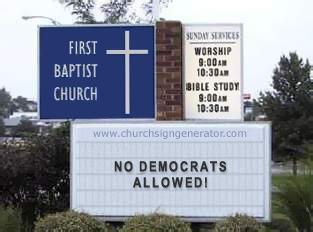
The sign in the picture is not real, just someone's impression of what the real message is in many churches today.

Somehow in the last twenty years, the evangelical church has often allowed those who advocate culture war politics to set the agenda for the church and Christian people. We have become known more for the political positions we take and the particular sinful practices we oppose than for the Good News we promote!
  • In many cases we have bought the questionable argument that there is only one correct "Christian" position, not only on a moral or ethical question under discussion, but also on the one right way to go about changing things. Anyone who disagrees with that position or method, or who even wants to consider other options, is automatically considered suspect.
  • Furthermore, and even more dangerous, is the fact that we have been drawn into the political arena and have accepted the premise that this is the arena in which we fight our most important battles.
  • Finally, we have accepted the "culture warrior" definition of ourselves, which makes it impossible to treat those with other political views as anything other than "enemies" in the struggle.
In short, we have allowed the world system, the media, and those who have anointed themselves war strategists and generals in the culture war to set our agenda for us. Why don't we believe the Bible? Why do we get sucked in like this? Why don't we allow words like these, from Paul, to protect us from being drawn into the world's agenda?

Indeed, we live as human beings, but we do not wage
war according to human standards... (2Cor 10.3)

In this light, Scot McKnight has posted a remarkable letter on the Jesus Creed blog today. It is from a conservative pastor who struggled with the issues during this past election and ultimately voted for Barack Obama. In the process he shared his struggles and decision with a few close friends. It became known, as things tend to get known within church families, and now he is facing severe criticism, people leaving the church, folks saying he is not qualified to be a pastor, etc. I encourage everyone who reads this to go to Scot's blog, meditate on this letter, and give a comment.

Sunday, November 16, 2008

pSunday Psalms: Sermon on Psalm 146

Today, I had a special opportunity to preach in the Community Church where I served four years ago. The pastor, a dear friend, invited me to come and give a Thanksgiving message from a psalm of my choice. I chose Psalm 146, and gave my message the title, "What Does It Mean to 'Praise the Lord'?"


Here is the text of Psalm 146, from the NRSV.
Praise the Lord!
Praise the Lord, O my soul!
I will praise the Lord as long as I live;
I will sing praises to my God all my life long.
Do not put your trust in princes,
in mortals, in whom there is no help.
When their breath departs, they return to the earth;
on that very day their plans perish.
Happy are those whose help is the God of Jacob,
whose hope is in the Lord their God,
who made heaven and earth,
the sea, and all that is in them;
who keeps faith for ever;
who executes justice for the oppressed;
who gives food to the hungry.
The Lord sets the prisoners free;
the Lord opens the eyes of the blind.
The Lord lifts up those who are bowed down;
the Lord loves the righteous.
The Lord watches over the strangers;
he upholds the orphan and the widow,
but the way of the wicked he brings to ruin.
The Lord will reign for ever,
your God, O Zion, for all generations.
Praise the Lord!
You can read the manuscript of this sermon in PDF format HERE.

SATURDAY SPORTS WRAP: FC Keeps Victory Bell

UPDATE: Franklin received a #5 seed and will travel to Otterbein College (9-1) in Westerville, Ohio on Saturday, Nov. 22 to play the #4 seeded Cardinals, whose only loss this season was to the #1 team in the nation, Mt. Union. Kickoff time is at noon.

Another cold, wet, windy day greeted football fans at Franklin College Saturday for the annual Victory Bell rivalry game against Hanover College. This is a special game for those of us who live in Franklin, because many of the young men who played for Franklin High School now play for Hanover as well as FC, and it is great to see everyone again.

In today's mud bowl, the outcome was never in doubt, with the Grizzlies prevailing 34-0.

I'll be updating this post on Sunday afternoon, Nov. 16, to announce Franklin's seeding and opponent in the NCAA Division III tournament next Saturday. You can watch the selection on ESPN News at 3pm, and follow all the analysis at D3Football.com

FRIDAY FOTO: Farewell to Colors

Photo by Michael Mercer, 2008

A last glimpse of autumn's beauty...
November has come.
The world is now awash in browns and grays.
We crawl under our blankets.
We dream of spring and the return of colors.

Saturday, November 15, 2008

THURSDAY THINGAMAJIG: Christmas Book List I

Here's part one of my annual Christmas wish list for books. We'll start today with the realm of Biblical studies.

Here are ten books about the Bible and biblical theology, any of which I would love to find under the tree on Christmas morning...
  • Psalms, 3 vols. (Baker Commentary on the Old Testament Wisdom and Psalms), by John Goldingay
  • Psalms 1-59 (Continental Commentaries), by Hans-Joachim Kraus
That's a good start!

Friday, November 14, 2008

WEDNESDAY QWOTE: Of Money and Neighbors

Economics has been leading the news and preoccupying our minds in recent days. This is one of those subjects that, especially on the broad scale, goes far beyond my comprehension and expertise. Others will have to speak to that. As an individual Christian, chaplain and Bible teacher, I have always been more interested in money matters at the level of the "widow's mite."

I like the following quote from Walter Brueggemann, because it looks at society and economics from this grassroots level. He reminds us that good stewardship of our resources is a matter of sustaining community and treating our neighbors with respect and dignity.

The Deuteronomic tradition presents society as a neighborhood and enjoins attitudes and policies that enhance neighborliness. Deuteronomy insists that economic life must be organized to ensure the well-being of widows, orphans and immigrants. This response to dislocation insists that maintaining a public economy of compassion and justice is a way to move beyond despair. "You shall not deprive a resident alien or an orphan of justice. You shall not take a widow’s garment in pledge. Remember you were a slave in Egypt ...," Deuteronomy commands. A society that cannot be generous to those in need will not be blessed. The book instructs, "Every seventh year you shall grant a remission of debts.... Do not be hard-hearted or tight-fisted toward your needy neighbor. You shall rather open your hand, willingly lending enough to meet the need, whatever it may be."

This is perhaps the most astonishing command in the Bible. It was the practice in that ancient world, as it is now, that anyone who owed money to another had to work it off. The more owed, the more work required. And if one owed enough, one might eventually belong to the "company store." But ancient Israel set a limit to such debt-related work, in order to prevent the formation of a permanent underclass. No matter how great the debt, it was to be worked off for six years and no longer. Then whatever debt remained was canceled. Deuteronomy makes clear that economic practice is a form of neighborliness and that economic provision must be adjusted to sustain community.

Tuesday, November 11, 2008

TUESDAY TRAVELS: The tragedy of "Veteran's Day"

(from the BBC)

Here in the U.S., we just marked Veteran’s Day. Many in our time forget, however, that this was not the commemoration’s original name. Veteran’s Day was first Armistice Day, marking the Armistice at the end of World War I, which was signed on the 11th hour of the 11th day of the 11th month in 1918. Today is the 90th anniversary of that signing.

In northern France leaders from 21 EU countries gathered at Verdun, the first great battle of the war, which lasted for an appalling ten months, and where an estimated 600,000 casualties (dead, wounded, missing) were taken. In London, three of the last surviving British veterans of the Great War were honored. Henry Allingham (112), Harry Patch (110), and Bill Stone (108) watched as current servicemen laid wreaths on their behalf. Mr. Patch said, “It is important to remember the dead from both sides of the conflict. Irrespective of the uniforms we wore, we were all victims.” Across the continent, dozens of remembrance ceremonies were held to honor all of them.

The statistics of WWI are staggering. It lasted five years, and involved 35 countries. Over 65 million soldiers fought; 10 million died and 20 million were wounded. For the first time in history, the full power of modern technology was brought to bear in making war, such as airplanes, tanks and submarines. However, the most horrible aspect of WWI, for which it is remembered, was its brutal trench warfare. As defenses dug in, attacking forces were slaughtered in record numbers—on the first day of the Battle of Somme, for example, 80,000 British soldiers were killed or wounded. Also, for the first time in history, the war was fought by civilian armies, not professional soldiers, making the massive loss of life even harder to bear.

In countless ways, World War I created the fundamental elements of 20th century history. Genocide and the use of poison gas emerged as acts of war. The international system was totally transformed. On the political right fascism came out of the war; on the left the communist revolution in Russia leading to the USSR. America became a world power. Britain never recovered from the shock of WWI, and started her decline to the ranks of the second-class powers. At the peace conference of 1919, the German, Turkish, and Austro-Hungarian empires were broken up. New boundaries were drawn in Europe and the Middle East, boundaries -- as in Iraq and Kuwait -- which were still intact at the end of the century. And, just as the war was ending, German Nationalists like Hitler gathered millions who rejected the peace and blamed Jews and Communists for their defeat. The road to the Second World War started there.

One of the most tragic things we can say is that “Armistice Day” eventually became known as “Veteran’s Day.” WWI was supposed to be “the war to end all wars.” If it had been, we would still be remembering Armistice Day today. Instead, however, on Veteran’s Day we sadly note that “wars and rumors of war” continue to characterize this fallen world in which we live.

Let us mark this day with a fresh commitment. In our work and in our lives, let us promote peace. Let us be people of kindness, compassion, forgiveness and reconciliation. In all the battles of life, may we be peacemakers. And, as we remember veterans this week, let us also lift our hearts in prayer for the day to come when:

“They shall beat their swords into ploughshares,
and their spears into pruning-hooks;
nation shall not lift up sword against nation,
neither shall they learn war any more.”
(Isaiah 2.5)


Monday, November 10, 2008

MONDAY MUSINGS: Making Giving Easier

As a pastor, I always found it difficult to communicate about money matters with my congregations. For one thing, I am not gifted with any degree of financial acumen, nor am I particularly interested in the business aspects of the church. Of course, I recognized and taught stewardship principles from the Bible, but my teaching, I'm sure, communicated much more theory than practical counsel.

That is why I was so impressed with the insert in our church bulletin yesterday and the brief presentation made during announcements after the service. Our congregation celebrates the final Sunday of the church year, Christ the King Sunday, with an emphasis on consecration and stewardship. By way of practical application, on this day we designate our financial pledges for the next year.

We are preparing for that day now, and therefore the insert and presentation on Sunday.
  • On one side of the insert was, "A revealing breakdown of our congregation's giving patterns." A set of ten steps was pictured, signifying levels of weekly pledged amounts from $0.00 per week to $100.01 plus per week. As the leader instructed us, we wrote down how many member families were giving at each level. This gave us a clear picture in one snapshot of where the whole church is with regard to stewardship.
  • On the other side was a table. The far left column listed weekly income amounts from $200 to $3,000. The rest of the columns showed how much it would be to give 15%, 12%, 10%, and so on down to 1% of one's weekly income. Find your income, go across to the percentage you would like to give, and you get the amount. So, for example, if your weekly income was $1,000 and you wanted to give 12%, you go to that box and see that your weekly giving would be $120.
The challenge was for each of us to grow in our giving 1% for the year to come.

Simple. Practical. Understandable. Effective.

pSunday Psalms: The King's Prayers

In his work, An Old Testament Theology, Bruce Waltke gives an overview of the Book of Psalms:
The book of Psalms consists of five books of psalms (1-41, 42-72, 73-89, 90-106, 107-150). Psalms 1-2 are its introduction, and 146-50 its climactic finale of praise. Psalm 1 introduces the individual who submits to God's rule a blessed person, and Psalm 2 introduces the principal subject of the Psalter, the king in prayer. (p. 159)
The king in prayer—this is the main perspective of the Book of Psalms. David and his heirs are the main pray-ers of these worship and wisdom songs. Especially in Books I, II, and V, we see King David himself in continual conversation with God.

Now, remember that this book was written long after the days of David, and after the kingdom had failed and fallen and been taken captive into exile. Those who returned from the Babylonian Exile were without a king to lead and guide them as they struggled to rebuild their lives and nation. Yet the Book of Psalms was given to assure them that, though the nations may rage against them, the Lord himself was reigning in their midst and would one day rule the world through his Anointed (Messiah). Psalm 2 called them to place their hope in the One to whom God would say, "You are my Son; today I have begotten you. Ask of me, and I will make the nations your heritage, and the ends of the earth your possession" (2.7-8).

In order to flesh out the character of this coming Messiah, the Book of Psalms sets forth David as his prototype. As David trusted God, so would his greater Son. As David suffered the opposition of the wicked, so the Messiah. As David persevered and triumphed by God's grace, giving praise to his Lord, so the ultimate King would be vindicated and raised to the throne.

Therefore, when we read the psalms, we are not to simply understand them in the light of David's experiences, rather, these are the prayers of the Messiah himself!

Dietrich Bonhoeffer saw this clearly:
According to the witness of the Bible, David is, as the anointed king of the chosen people of God, a prototype of Jesus Christ. What happens to him happens for the sake of the one who is in him and who is said to proceed from him, namely Jesus Christ. (p. 18)
According to an intriguing passage in 2Samuel 23, David himself may have intended this. The NRSV translates it like this:
Now these are the last words of David:
The oracle of David, son of Jesse,
the oracle of the man whom God exalted,
the anointed of the God of Jacob,
the favourite of the Strong One of Israel:
The spirit of the Lord speaks through me,
his word is upon my tongue.
The God of Israel has spoken,
the Rock of Israel has said to me:
One who rules over people justly,
ruling in the fear of God, is like the light of morning,
like the sun rising on a cloudless morning,
gleaming from the rain on the grassy land.
Is not my house like this with God?
For he has made with me an everlasting covenant,
ordered in all things and secure.
Will he not cause to prosper
all my help and my desire?
But the godless are all like thorns that are thrown away;
for they cannot be picked up with the hand;
to touch them one uses an iron bar
or the shaft of a spear.
And they are entirely consumed in fire on the spot.
Verse one may be understood in the sense that David is writing "about the Man whom God raised up, the Messiah of the God of Jacob, the One about whom sweet songs of Israel are sung." The rest of the passage speaks of God's covenant with David concerning an everlasting kingdom in his household.

The Book of Psalms is about the Lord Jesus Christ. It records his prayers, his sufferings and his triumphs. He is the King for whom the returned exiles were to wait with expectation. He is the Savior and Lord to whom the apostolic Gospels and Epistles testify. The Son of David. The Son of God. The King through whom God's blessing will be restored to all the earth.

Saturday, November 8, 2008

SATURDAY SPORTS WRAP: HCAC Champions!

The Franklin Grizzlies claimed the Heartland Collegiate Athletic Conference championship and gained an automatic berth to the NCAA Division III tournament with a 31-20 victory at Manchester College Saturday.

It didn't come easily. The day was all November—chill and gray with a blustery wind—and Franklin seemed ready neither for the weather nor the energy with which Manchester took the field on their Senior Day. The Spartans quickly put ten points on the board in the first quarter, while the Grizzlies' normally potent offense was stymied. Franklin finally roused and scored fourteen in the second period to take the lead into halftime, a lead they would never relinquish. The weather conditions worsened as the second half wore on, and the teams battled back and forth, with the Grizzlies outlasting the home team in the end.

Congratulations to Coach Mike Leonard and his team for their second straight conference championship! Next Saturday, Franklin hosts Hanover for the annual Victory Bell game. Then comes selection Sunday, when the Grizzlies will learn their seeding and opponent in the tournament, which begins November 22.

Go Grizzlies!

Friday, November 7, 2008

FRIDAY FOTO: Autumns Past

I have enjoyed taking autumn pictures for as long as I've had access to a camera. Here are some old fall pictures I found while digging through our photo boxes.

They were taken in October of 1984 in Vermont.

Click on each picture for a larger view.


Thursday, November 6, 2008

THURSDAY THINGAMAJIG: Recommended Podcast

Here's a podcast that I have been enjoying lately. It's the voice of the Evangelical Lutheran Church in America, and it's called, "Grace Matters." The host is the Rev. Peter W. Marty, who is hospitable and insightful as he interviews guests on a wide variety of subjects and then gives a message based on the topic of the day.

I have heard interviews from the field of religion, business, medicine, science, government, and from the lives of everyday people living out their faith in both ordinary and extraordinary circumstances. The show is well-paced and the spirit gracious and irenic.

Highly recommended!

Wednesday, November 5, 2008

WEDNESDAY QWOTE: A Day of Pride in America

Today, I am proud to be an American. Yesterday's election confirmed the special nature of this great country in which we live. I don't believe in "manifest destiny" or "American exceptionalism" in a theological sense. God has only chosen one nation in world history, and it's not us. Nevertheless, the fact that we could elect an African-American President one generation after the assassination of Martin Luther King is an amazing accomplishment that says a lot about the goodness and opportunity that thrive in our land.

I am also proud because last night two of the most gracious, hopeful and civil speeches I've ever heard were given by the two candidates, one conceding and the other celebrating victory. If only the entire campaign could have been conducted with the respect and civility of these speeches! Nevertheless, these men should be commended for their inspiring words, and it is to be hoped that the goodwill expressed in words last night will continue in days to come.

McCain's Concession Speech
"...A century ago, President Theodore Roosevelt's invitation of Booker T. Washington to visit — to dine at the White House — was taken as an outrage in many quarters. America today is a world away from the cruel and prideful bigotry of that time. There is no better evidence of this than the election of an African-American to the presidency of the United States. Let there be no reason now for any American to fail to cherish their citizenship in this, the greatest nation on Earth.

"...I urge all Americans who supported me to join me in not just congratulating him, but offering our next president our goodwill and earnest effort to find ways to come together, to find the necessary compromises, to bridge our differences and help restore our prosperity, defend our security in a dangerous world, and leave our children and grandchildren a stronger, better country than we inherited. Whatever our differences, we are fellow Americans..."
Obama's Victory Speech
"...The road ahead will be long. Our climb will be steep. We may not get there in one year or even one term, but America - I have never been more hopeful than I am tonight that we will get there. I promise you - we as a people will get there.

"There will be setbacks and false starts. There are many who wont agree with every decision or policy I make as President, and we know that government cant solve every problem. But I will always be honest with you about the challenges we face. I will listen to you, especially when we disagree. And above all, I will ask you join in the work of remaking this nation the only way its been done in America for two-hundred and twenty-one years - block by block, brick by brick, calloused hand by calloused hand...

"Let us resist the temptation to fall back on the same partisanship and pettiness and immaturity that has poisoned our politics for so long. Let us remember that it was a man from this state who first carried the banner of the Republican Party to the White House - a party founded on the values of self-reliance, individual liberty, and national unity. Those are values we all share, and while the Democratic Party has won a great victory tonight, we do so with a measure of humility and determination to heal the divides that have held back our progress. As Lincoln said to a nation far more divided than ours, We are not enemies, but friends; though passion may have strained it must not break our bonds of affection. And to those Americans whose support I have yet to earn - I may not have won your vote, but I hear your voices, I need your help, and I will be your President too."

Tuesday, November 4, 2008

TUESDAY TRAVELS: First in the Nation

Since 1948, people in the tiny towns of Dixville Notch and Hart's Location, NH have been the first to cast their votes in national elections each four years. Folks gather before midnight to get first position in the election, and the towns take pride in having a 100% turnout. Each voter gets an individual booth, so there is no waiting at the midnight hour.

Earlier today, the good folks in these New England burgs continued the tradition, and here are the results:
  • In Dixville Notch: Obama—15 votes, McCain—6 votes.
  • In Hart's Location: Obama—17 votes, McCain—10 votes, Ron Paul—2 votes (write-in)
Ralph Nader was on the ballot in both towns, and received no votes.

With this wonderful tradition intact, an historic day in the United States commenced.

Monday, November 3, 2008

MONDAY MUSINGS: The Church and Politics

On election eve, some wise thoughts from Greg Boyd.

No matter what happens in tomorrow's election, God will remain in control and the church will still be called to be Body of Christ in this world. Some may lure us into thinking that the political process is the only effective way to get things done, and those in positions of power may get the most press for their decisions, but the world will only truly be changed when ordinary people of faith begin getting involved in the world as Jesus did, laying down their lives day after day to benefit others.

By the way, if someone thinks I am picking on the "Christian Right" here, the article from which these thoughts are taken is an extended criticism of the "Christian Left." Both are misguided when they buy into the notion that exercising power over others and passing laws to enforce desirable behavior is what God's people are to be pursuing as their primary agenda. Jesus' words could not be plainer:

"You know that those who are recognized as rulers of the Gentiles lord it over them; and their great men exercise authority over them. But it is not this way among you, but whoever wishes to become great among you shall be your servant; and whoever wishes to be first among you shall be slave of all. For even the Son of Man did not come to be served, but to serve, and to give His life a ransom for many."
(Mark 10.42-45)

It is in the context of this radical approach to changing the world that Pastor Boyd writes:

The church should provide leadership to the world by our spiritual and moral example of how we live together and serve the world, not by our self-designated superior wisdom on how to fix society by political means. Swearing allegiance to Christ doesn’t mean we know more than others. It just means we are willing to sacrifice more than others. Swearing allegiance to Christ thus doesn’t mean one has more wisdom on domestic or international social issues. It just means one is willing to bleed more to bring God’s love to domestic and international social issues.

This willingness to suffer gives the Church a unique and powerful authority to address issues and transform the world. But it does so only if the Church in fact is willing to sacrifice more than others. If the Church would model the beautiful life as a community and in our Christ-like service to the world, we would win authority to speak into domestic and international issues. But when we focus on how we should speak into domestic and international issues before we ourselves model the beautiful life, we have no more authority than anyone else. Like everyone else, we have only our opinion to offer.

Trying to get the Church to participate in the political process the “right” way is like trying to motivate a secular person to pray the “right” way. So it is, for example, that we have the “Christian Right” trying to get Christians to vote to “save the family” by outlawing gay marriage while Christians happen to have a higher divorce rate than the national average. And the “Christian Left” is trying to get Christians to vote to end poverty while the vast majority of churches in America don’t have any of their day-to-day budget or activity allocated to helping alleviate poverty. What Jesus said of individuals applies to the Church as a whole: first take the plank out of your own eye before you look for a dust particle in your neighbor’s eye (Mt. 7.1-3).

Our singular focus ought to be on the church simply being the church, manifesting the beautiful life of the Kingdom. And we ought to do this not as a practical step toward gaining some of Caesar’s power – as though this was our ultimate goal — but because this is simply what it means to faithfully follow Jesus.

Saturday, November 1, 2008

pSunday Psalms: Bird's Eye View

"As Moses gave five books of laws to Israel, so David gave five books of psalms to Israel." (Midrash on the Psalms)
The Book of Psalms went through several stages of development.
  • First, psalms, songs and wisdom poems were composed by individuals and liturgical leaders for use in the worship of Israel.
  • Second, many of these were put together and preserved in collections, such as the Psalms of Asaph (73-83) and the Songs of Ascent (120-134).
  • Third, after the Exile the individual psalms and collections were gathered and shaped into five books that became The Book of Psalms.
This five-fold Book forms a poetic "cantata" about God's covenant with David. Psalms is about God's Kingdom. Here is a simple overview of the contents of the five books and the way they have been put together to tell this story.
  • INTRODUCTION (Pss 1-2). Psalm 1 tells us that this book is torah from God, designed to help his people live in the covenant blessings. Psalm 2 tells us more specifically what this torah teaches—that God rules and will rule the world, despite opposition, through his Messiah; therefore, the blessed are those who take refuge in him.
  • BOOKS ONE & TWO (Pss 3-41/42-72). These are the books of the king. Dominated by prayers of David, these books present him as God's ideal king, who suffers yet trusts in God and triumphs. By the end of Book II (Ps 72), prayers are raised on behalf of David's son and heir, Solomon. Thus these books focus, not just on David himself, but on the house of David, to which God made eternal promises.
  • BOOK THREE (Pss 72-89). This is the book of the failed kingdom. It begins with psalms that question God's ways and the triumph of his enemies (Pss 73-74), and ends with the bleakest psalm in the book (Ps 88) and a composite psalm that reviews the covenant with David (Ps 89.1-37) and then laments his kingdom's destruction (Ps 89.38-52). What has become of God's covenant with David? What will become of his people?
  • BOOK FOUR (Pss 90-106). Book IV is the book of hope. Opening with a psalm of Moses (Ps 90), the exiles who now have no king are encouraged to review the foundations of their faith and remember that the Lord himself is their true Ruler (Pss 93-99). This book provides the main theological answer to the exiles' laments. It assures them that God remains King and Judge of the world, their Rock and Refuge, and a loving Father who remembers their frailties. The book ends with a series of historical psalms, recalling God's mercies to their ancestors and appealing for an end to their exile.
  • BOOK FIVE (Pss 107-150). The final book is the book of instruction. Ps 107, which opens this section, shows the exiles at home again. But how will they proceed? How shall they live so that they will not repeat the sins of the past? This book is made up of three parallel panels that each include the following elements: (1) Each panel begins with psalms that call God's people to give thanks, (2) Each panel ends with psalms that call God's people to praise the Lord, (3) Each contains a collection of David psalms, reintroducing him as the model of faith, (4) Each contains a prominent torah psalm, (5) Each contains prominent royal psalms that point to the coming King.
As Moses gave the Torah to Israel, to instruct them about living in God's blessing under the Sinai Covenant, so David gave a Torah to Israel, instructing the returned exiles to hope in the Davidic Covenant and live as kingdom people under the reign of their true King.

SATURDAY SPORTS WRAP: Back on Top

The Franklin College Grizzlies ran over HCAC rival Rose Hulman in a virtual battle for the conference championship Saturday, 42-7. FC's defense played an outstanding game, not allowing an offensive touchdown, and the offense was its usual productive self, scoring three TDs in each half. With two more games left in the regular season, the Grizzlies are in the driver's seat to win the conference and return to the NCAA Division III playoffs.

Next week, Franklin travels to Manchester, 2-3 in HCAC play and 4-4 overall.